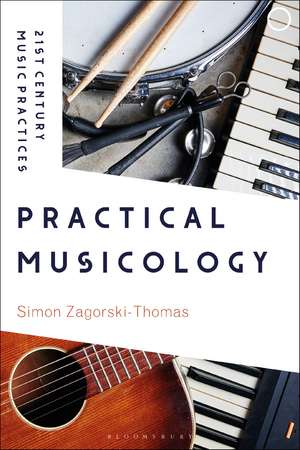
Practical Musicology: 21st Century Music Practices
Autor Professor Simon Zagorski-Thomasen Limba Engleză Hardback – 11 aug 2022
Preț: 614.39 lei
Preț vechi: 958.41 lei
-36%
Puncte Express: 922
Carte disponibilă
Livrare economică 26 octombrie-09 noiembrie
Livrare prin curier în România Termenul estimat este afișat lângă disponibilitate.
Transport gratuit pentru acest produs Plată online sau ramburs, în funcție de opțiunile comenzii.
Retur gratuit în 14 zile Comandă securizată și suport în română.
Specificații
ISBN-13: 9781501357794
ISBN-10: 1501357794
Pagini: 256
Dimensiuni: 160 x 232 x 20 mm
Greutate: 0.5 kg
Editura: Bloomsbury Publishing
Colecția Bloomsbury Academic
Seria 21st Century Music Practices
Locul publicării:New York, United States
ISBN-10: 1501357794
Pagini: 256
Dimensiuni: 160 x 232 x 20 mm
Greutate: 0.5 kg
Editura: Bloomsbury Publishing
Colecția Bloomsbury Academic
Seria 21st Century Music Practices
Locul publicării:New York, United States
V-ar putea interesa
-
 Can't Slow Down: How 1984 Became Pop's Blockbuster YearMichaelangelo Matos-29%Preț: 135.16 lei191.26 lei
 -
 -18%Preț: 1248.98 lei1523.15 lei
 -
 Anthology to accompany GATEWAYS TO UNDERSTANDING MUSICSamuel N. Dorf-15%Preț: 576.05 lei677.70 lei
 -
 AwangardaLisa Cooper VestPreț: 510.76 lei
 -
 The Politics of OperaMitchell CohenPreț: 204.32 lei
 -
 The Musicology of Record ProductionSimon Zagorski-ThomasPreț: 297.48 lei
 -
 New York and the International Sound of Latin Music, 1940-1990Benjamin LapidusPreț: 253.62 lei
 -
 Preț: 151.54 lei
 -
 Harflerin IlmiMuhyiddin Ibn `arabiPreț: 106.23 lei
Cuprins
1 Introduction
2 Context
3 Musicking
4 Learning and Knowing
5 Communication and Influence
6 Interaction and Influence
7 Systems and Networks
Afterword
Bibliography
Index
2 Context
3 Musicking
4 Learning and Knowing
5 Communication and Influence
6 Interaction and Influence
7 Systems and Networks
Afterword
Bibliography
Index
Recenzii
What could musicology be in the 21st century? In his book, Simon Zagorski-Thomas outlines a practical musicology that wholeheartedly embraces all contemporary forms of sound and music production between streaming audio, game sounds, EDM and engineering a record production. The future of musicology, as Zagorski-Thomas envisions it, is a musicology that provides historical and technological knowledge and critique of how music and sound are actually produced, presented, experienced and consumed: a comprehensive musicology of aesthetic practices, which is indeed urgently needed.
Practical Musicology is a brave and brilliant exploration of ways to explore and research 21st-century music practices anew. Drawing on his own exemplary research practice, Simon Zagorski-Thomas critically and eloquently advances and applies new ideas to Practical Musicology, ones which lay out a new theoretical framework, harnessing models of knowledge, capacity, power, identity, and technology anew, to illustrate, not only how 'to do' music, but also how 'to do music better'. A new and provocative Practical Musicology is put to work to explain how aesthetics emerge, develop and become embodied in practice. This is a must-read for all of us whose wanting a new 'way in' for thinking critically and differently about 21st-century music practices.
Practical Musicologyis just that - a practical introduction to the study of music making as a thing we do, consciously or unconsciously, separately or together, according to deeply embedded conceptual schemata that can give rise to powerful aesthetic judgments embedded in diverse and non-linguistic forms of human communication. It also provides a very sophisticated theoretical introduction to an embodied and practice-based musical epistemology: how what we do with music influences what we can think, know and say about it.
Zagorski-Thomas brings his own aesthetic sensibility as a composer, engineer, and teacher to bear, persuasively making the case that a practical musicology will concern itself not just with what musicians have done, or why - but how they can do what they do, better. As a statement of musicological purpose, this volume is thus both practical and visionary in the same breath, much like that complex, ineffable group activity we have come to call "music," wherever, whenever, and however we engage in it.
Practical Musicology is a brave and brilliant exploration of ways to explore and research 21st-century music practices anew. Drawing on his own exemplary research practice, Simon Zagorski-Thomas critically and eloquently advances and applies new ideas to Practical Musicology, ones which lay out a new theoretical framework, harnessing models of knowledge, capacity, power, identity, and technology anew, to illustrate, not only how 'to do' music, but also how 'to do music better'. A new and provocative Practical Musicology is put to work to explain how aesthetics emerge, develop and become embodied in practice. This is a must-read for all of us whose wanting a new 'way in' for thinking critically and differently about 21st-century music practices.
Practical Musicologyis just that - a practical introduction to the study of music making as a thing we do, consciously or unconsciously, separately or together, according to deeply embedded conceptual schemata that can give rise to powerful aesthetic judgments embedded in diverse and non-linguistic forms of human communication. It also provides a very sophisticated theoretical introduction to an embodied and practice-based musical epistemology: how what we do with music influences what we can think, know and say about it.
Zagorski-Thomas brings his own aesthetic sensibility as a composer, engineer, and teacher to bear, persuasively making the case that a practical musicology will concern itself not just with what musicians have done, or why - but how they can do what they do, better. As a statement of musicological purpose, this volume is thus both practical and visionary in the same breath, much like that complex, ineffable group activity we have come to call "music," wherever, whenever, and however we engage in it.