Cantitate/Preț
Produs

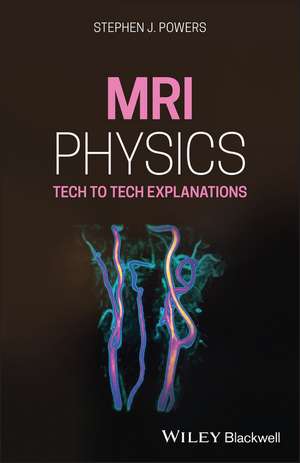
Powers, S: MRI Physics

Autor Stephen J. Powers
en Limba Engleză Paperback – apr 2021

Notăm cu interes publicarea volumului MRI Physics, o resursă care răspunde necesității de actualizare a protocoalelor de siguranță și a standardelor de examinare ARRT. Într-un domeniu în care recomandările privind expunerea la radiofrecvență (RF) și gestionarea mediului magnetic sunt într-o continuă rafinare, Stephen J. Powers propune o abordare pragmatică a fenomenelor cuantice. Remarcăm trecerea de la teoria pură la aplicabilitatea clinică, explicând mecanismele din spatele calității imaginii — de la hardware-ul scannerului până la tehnicile de supresie tisulară.

Structura cursului urmărește o progresie logică: debutează cu tipologia magneților și a bobinelor, plonjează în fizica vectorului de magnetizare netă și culminează cu analiza complexă a timpilor de relaxare (T1 și T2). Merită menționat că autorul demitizează „triunghiul calității imaginii” (contrast, SNR, rezoluție), oferind tehnologilor instrumentele necesare pentru a manipula parametrii geometrici în funcție de patologie. Acolo unde The MRI Study Guide for Technologists se concentrează pe un format de examinare prin întrebări și răspunsuri pentru verificarea cunoștințelor, MRI Physics aprofundează mecanismele fizice fundamentale, oferind explicațiile conceptuale necesare pentru a înțelege de ce apar anumite artefacte și cum pot fi ele corectate.

Experiența de lectură este fluidizată de stilul „Tech to Tech”, care elimină jargonul matematic excesiv în favoarea unor explicații directe. Vizualul joacă un rol esențial, diagramele secvențelor de impuls și fotografiile clinice servind drept punte între teorie și consola de operare a scannerului MRI. Este o resursă de referință care transformă fizica abstractă într-un set de competențe operaționale.

Citește tot Restrânge

Preț: 36853 lei

Preț vechi: 38792 lei
-5%

Puncte Express: 553

Carte disponibilă

Livrare economică 07-21 mai
Livrare express 22-28 aprilie pentru 3894 lei


Specificații

ISBN-13: 9781119615026
ISBN-10: 111961502X
Pagini: 416
Dimensiuni: 140 x 216 x 23 mm
Greutate: 0.52 kg
Ediția:1
Editura: Wiley
Locul publicării:Chichester, United Kingdom

De ce să citești această carte

Recomandăm această carte tehnologilor radiologi și rezidenților care doresc să stăpânească fizica RM fără a se pierde în formule matematice complexe. Este instrumentul ideal pentru pregătirea certificării ARRT, oferind claritate asupra subiectelor dificile precum gradienții și secvențele de impuls. Cititorul câștigă capacitatea de a optimiza contrastul și de a asigura siguranța pacientului, elemente critice în practica radiologică modernă.


Despre autor

Stephen J. Powers este un tehnolog MRI cu o vastă experiență clinică și educațională, recunoscut pentru capacitatea sa de a traduce conceptele complexe ale fizicii medicale într-un limbaj accesibil practicienilor. Expertiza sa este ancorată în realitățile sălii de examinare, fiind specializat în pregătirea personalului medical pentru examenele de certificare avansată. Prin publicațiile sale la editura Wiley, Powers a devenit o voce autorizată în instruirea tehnologilor, punând accent pe siguranța magnetică și pe optimizarea tehnică a imagisticii prin rezonanță magnetică.


Descriere scurtă

Das Werk MRI Physics: Tech to Tech Explanations soll angehenden MRT-Spezialisten und Strahlentherapeuten, die sich auf die Pr1/4fungen zur MRT-Zertifizierung vorbereiten, dabei helfen, schwierige Konzepte und Themen schnell und einfach zu verstehen. Der n1/4tzliche Leitfaden wurde von einem sehr erfahrenen Technologen verfasst und erklrt in einer klaren und leserfreundlichen Weise, was jeder MRT-Spezialist wissen muss. Zu den Themen des Buchs zhlen Sicherheitsaspekte im Zusammenhang mit Magnetfeld und Hochfrequenz, Pulssequenzen, Artefakte, MRT-Mathematik, die besonders schwierigen Gradienten und IV-Kontrastmittel.
* Grundlegende Hinweise zu Sicherheitsfragen, Protokolloptionen, kritischem Denken und Bildkontrastoptimierung
* Einfache Darstellung des anspruchsvollen Themas MRT-Physik durch klare Sprache und verstndliche Erklrungen
* Pr1/4fungsrelevante Inhalte f1/4r die Pr1/4fungen der American Registry of Radiologic Technologists (ARTT) und Continuing Qualifications Requirements (CQR)
* Mit zahlreichen Illustrationen und Fotos zu verschiedenen MRT-Konzepten, Pulssequenz-Design, Artefakten und der Anwendung der Konzepte im klinischen Umfeld

Cuprins

About the Author xv Preface xvii Acknowledgements xix Introduction 1 1 Hardware: Magnet Types and Coils 15 Magnets 15 Coils 17 2 The Basics 23 Why the Hydrogen Molecule? 24 The Net Magnetization Vector 26 MRI is a Sequence of Events 27 Free Induction Decay (FID) 32 Relaxation 33 Proton Density 38 Image Contrast 38 The IQ Triangle: Contrast, SNR, Resolution 39 B0 and B1 43 Free and Bound Protons 44 3 Image Weighting 47 Where Does Image Weighting Come From? 48 Time of Repetition (TR) 50 Time of Echo (TE) 52 TE and TR 54 Why Different TR Ranges for Different Field Strengths? 54 How Does TR Control T1? 55 What Does TR Affect? 56 Interpreting the T1 Relaxation Curve 57 Time of Repetition: Effects of the TR 57 TE: The T1 and T2 of it 58 Interpreting the T2 Relaxation Curve 60 Effects of TE on Image Contrast 62 What Do the Lines on the Curves Really Mean Anyway? 62 One Last Weighting Triangle 65 T1 and T2 Contrast Review 66 4 Introduction to the Basic Pulse Sequences 69 What is a Pulse Sequence? 69 Spin Echo (SE) 70 Gradient Echo/Gradient Recalled Echo (GRE) 73 Line Diagram Anatomy 74 The Ernst Angle 77 5 Multi Echo Spin Echo Sequence 81 Introduction to k-Space 82 k-Space: Phase Encoding 85 With FSE, Watch the Speed Limit! 86 k-Space, ETL, and Image Contrast 87 Filling k-Space 89 Pros and Cons of FSE 89 Another Way to View T2* and 180°s 91 Where Do Relaxation and Decay Curves Come From? 92 A T2* Curve Compared to the T2 Curve 93 Metal Artifact Reduction (MARS) 94 Driven Equilibrium: A "Forced T1" 95 3D FSE: CUBE/SPACE/VISTA 97 Single Shot FSE/HASTE 98 6 Tissue Suppression 105 Tissue Saturation versus Suppression 107 Inversion Recovery - Part One: STIR 108 Inversion Recovery: STIR with Vectors 109 Inversion Recovery Part Two: T2 FLAIR 113 IR Sequences: T1 and T2 FLAIR 116 IR Weightings: STIR, T1 and T2 FLAIR 117 Inversion Recovery - Part Two 119 The Rupture View 120 Tissue Saturation: Chemical Shift 121 Chemical Saturation at Low Fields 123 Tissue Saturation: SPAIR and SPIR 124 The Dixon Technique 126 Water Excitation 126 Saturation Pulses or Bands 129 Subtractions 131 Magnetization Transfer 135 IR Prepped Sequences 137 How is an RF Pulse Selective or Non-Selective? 140 Water Excitation Sequences 142 7 The Gradient Echo Sequence 145 GRE Sequence Structure 147 Phase Dispersion and Gradient Reversal 148 Analog to Digital Converter (ADC) 149 GRE Sequence Image Weighting 149 Two Different Kinds of T2 Relaxation 152 The GRE Weighting Triangle 153 GRE and SE Differences 156 Different Gradient Echo Types 157 In and Out of Phase TEs 161 In Phase/Out of Phase at 1.5 T 163 8 Gradient Echo Magnetic Resonance Angiography 167 Time of Flight MRA 168 TOF Angiography: Two Golden Rules 171 Types of MRA Sequences 171 TOF Concept in MRA versus MRV 172 2D versus 3D 172 2D TOF MRAs 175 3D TOF MRAs 176 In-Plane Saturation 178 In-Plane Saturation Avoidance 179 Magnetization Transfer (MT) 181 Options for Better MRAs 183 Phase Contrast MRA 185 9 k-Space 191 What Is Fourier Transform? 192 k-Space Filling 192 10 Echo Planar Sequences 203 Diffusion Weighted Imaging 205 Diffusion Tensor Imaging or White Matter Tractography 215 Susceptibility Weighted Imaging 216 Brain Perfusion 218 Arterial Spin Labeling 222 Spectroscopy 225 11 Geometric Parameters: Trade-offs and Effects on Image Quality 231 Field of View (FOV) Is Your Film Size 232 Nex, ACQ, NSA, and SNR 235 Scan Matrix 237 Frequency Matrix 237 Echo Train Length 238 Echo Spacing 239 Echo Train Balancing 240 Slice Thickness and Slice Gap 242 Fractional Echo 243 Bandwidth 244 Rectangular (Rec.) FOV 249 No Phase Wrap/Phase Oversampling/Fold-Over Suppression 251 Concatenations or Acquisitions 254 Sequential Order Acquisition 255 12 Image Artifacts 257 Motion 258 Flow Artifact/Phase Mis-registration 262 RF Artifacts 265 Wrap/Aliasing/Fold-over Artifact 265 Gibbs Artifact (Ringing/Truncation) 268 Chemical Shift Artifact 271 Cross-talk 276 Cross-excitation 278 Gradient Warp or Distortion 281 Metal Artifacts 281 Corduroy Artifact 283 Annifact 284 Moiré Fringe Artifact or Zebra Artifact 285 Magnetic Susceptibility Artifact 286 Dielectric Effect or Standing Wave 288 Magic Angle Artifact 290 13 Gradients 295 Physical Gradients 296 Logical Gradients 302 14 MRI Math 313 The Larmor Equation: W0 = gammaB0 314 Acquisitions or Nex or NSA 314 Scan Time Equations 315 Pixel Size and Voxel Volume 317 How to Convert Hz per Pixel to MHz 318 In and Out of Phase TEs 319 Dixon Method or Technique 320 SNR and the 3D Sequence 321 15 Parallel Imaging 325 Parallel Imaging: What Is It? 325 When and Where to Use the Speed 326 Parallel Imaging: How Does It Work? 327 Parallel Imaging: Pros and Cons 330 16 IV Gadolinium 335 Why We Use Gad 336 How Does Gad Shorten the T1 of Tissues? 337 The Blood-Brain Barrier 341 Post Contrast T2 FLAIR Imaging 342 Imaging Gadolinium 345 Eovist(r) 347 Glossary 351 Suggested Reading 388 Index 389

Notă biografică

Stephen J. Powers, BSRT (R), (CT), (MR) is currently an MR Technologist for South Coast Hospital Systems in the USA, and former MRI Clinical Applications Specialist for General Electric Health Care. Stephen has over twenty years of classroom, lecture and clinical instructor experience.

Descriere

MRI PHYSICS MRI PHYSICSTECH TO TECH EXPLANATIONSTechnologists must have a solid understanding of the physics behind Magnetic Resonance Imaging (MRI), including safety, the hows and whys of the quantum physics of the MR phenomenon, and how to competently operate MRI scanners. Generating the highest quality images of the human body involves thorough knowledge of scanner hardware, pulse sequences, image contrast, geometric parameters, and tissue suppression techniques.MRI Physics: Tech to Tech Explanations is designed to help student MRI technologists and radiotherapists preparing for Advanced MRI certification examinations to better understand difficult concepts and topics in a quick and easy manner.Written by a highly experienced technologist, this useful guide provides clear and reader-friendly coverage of what every MR Technologist needs to know. Topics include safety considerations associated with the magnetic field and RF, pulse sequences, artifacts, MRI math, the much-feared gradients, and I.V. contrast.Provides basic guidance on safety considerations, protocols options, critical thinking, and image contrast optimizationSimplifies the challenging topic of MRI physics using straightforward language and clear explanationsCovers content for American Registry of Radiologic Technologists (ARRT) and Continuing Qualifications Requirements (CQR) examsFeatures numerous illustrations and photographs of various MRI concepts, pulse sequence design, artifacts, and the application of concepts in clinical settingsMRI Physics: Tech to Tech Explanations is a must-have resource for the experienced and training MRI technologist, medical students, and radiology residency rotations.