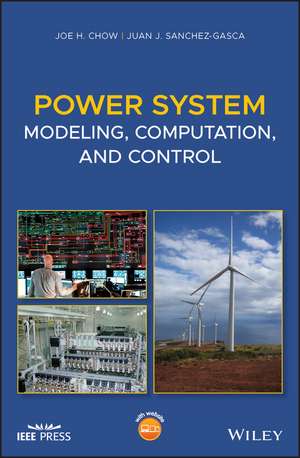
Power System Modeling, Computation, and Control
Autor Joe H Chow, Juan J Sanchez-Gascaen Limba Engleză Hardback – 28 ian 2020
Preț: 831.65 lei
Preț vechi: 913.90 lei
-9%
Puncte Express: 1247
Carte tipărită la comandă
Livrare economică 05-19 decembrie
Livrare prin curier în România Termenul estimat este afișat lângă disponibilitate.
Transport gratuit pentru acest produs Plată online sau ramburs, în funcție de opțiunile comenzii.
Retur gratuit în 14 zile Comandă securizată și suport în română.
Specificații
ISBN-13: 9781119546870
ISBN-10: 1119546877
Pagini: 664
Dimensiuni: 175 x 250 x 40 mm
Greutate: 1.31 kg
Editura: Wiley
Locul publicării:Chichester, United Kingdom
ISBN-10: 1119546877
Pagini: 664
Dimensiuni: 175 x 250 x 40 mm
Greutate: 1.31 kg
Editura: Wiley
Locul publicării:Chichester, United Kingdom
V-ar putea interesa
-
 Auto AudioAndrew YoderPreț: 267.24 lei
-
 Logic and Computer Design Fundamentals, Global EditionM. Morris Mano-11%Preț: 679.86 lei763.89 lei
-
 Satellite and Terrestrial Hybrid NetworksPascal Berthou-9%Preț: 985.86 lei1083.36 lei
-
 Digital Signal and Image Processing Using Matlab, Volume 3Gérard Blanchet-9%Preț: 1024.95 lei1126.32 lei
-
 Advanced Control of AC / DC Power NetworksAbdelkrim Benchaib-9%Preț: 1013.41 lei1113.64 lei
-
 Digital Communications 1Didier Le Ruyet-9%Preț: 1026.58 lei1128.12 lei
-
 Digital Communications 2Mylène Pischella-9%Preț: 1023.05 lei1124.23 lei
-
 Innovation Capabilities and Economic Development in Open EconomiesVanessa Casadella-9%Preț: 1005.76 lei1105.23 lei
-
 Taschenbuch der MesstechnikJörg HoffmannPreț: 273.22 lei
-
 Beschleunigtes Magnetic Particle ImagingNadine TraulsenPreț: 440.25 lei
-
 Preț: 399.05 lei
-
 Preț: 288.41 lei
-
 Preț: 299.63 lei
-
 El muntatge cinematogràfic : del guió a la pantallaJoan Marimón i PadrosaPreț: 381.25 lei
-
 Power Quality Issues in Distributed GenerationJaroslaw Luszcz-23%Preț: 806.20 lei1047.02 lei
Cuprins
Preface xvii
About the Companion Website xxi
1 Introduction 1
1.1 Electrification 1
1.2 Generation, Transmission, and Distribution Systems 2
1.3 Time Scales 5
1.4 Organization of the Book 7
Part I System Concepts 9
2 Steady-State Power Flow 11
2.1 Introduction 11
2.2 Power Network Elements and Admittance Matrix 12
2.3 Active and Reactive Power Flow Calculations 16
2.4 Power Flow Formulation 19
2.5 Newton-Raphson Method 21
2.6 Advanced Power Flow Features 27
2.7 Summary and Notes 31
Appendix 2.A Two-winding Transformer Model 32
Appendix 2.B LU Decomposition and Sparsity Methods 36
Appendix 2.C Power Flow and Dynamic Data for the 2-area, 4-machine System 39
Problems 42
3 Steady-State Voltage Stability Analysis 47
3.1 Introduction 47
3.2 Voltage Collapse Incidents 48
3.3 Reactive Power Consumption on Transmission Lines 49
3.4 Voltage Stability Analysis of a Radial Load System 55
3.5 Voltage Stability Analysis of Large Power Systems 61
3.6 Continuation Power Flow Method 64
3.6.1 Continuation Power Flow Algorithm 66
3.7 An AQ-Bus Method for Solving Power Flow 67
3.8 Power System Components Affecting Voltage Stability 73
3.9 Hierarchical Voltage Control 79
3.10 Voltage Stability Margins and Indices 80
3.11 Summary and Notes 82
Problems 83
4 Power System Dynamics and Simulation 87
4.1 Introduction 87
4.2 Electromechanical Model of Synchronous Machines 88
4.3 Single-Machine Infinite-Bus System 90
4.4 Power System Disturbances 94
4.5 Simulation Methods 98
4.6 Dynamic Models of Multi-Machine Power Systems 106
4.7 Multi-Machine Power System Stability 114
4.7.1 Reference Frames for Machine Angles 115
4.8 Power System Toolbox 117
4.9 Summary and Notes 119
Problems 119
5 Direct Transient Stability Analysis 123
5.1 Introduction 123
5.2 Equal-Area Analysis of a Single-Machine Infinite-Bus System 124
5.3 Transient Energy Functions 127
5.4 Energy Function Analysis of a Disturbance Event 131
5.5 Single-Machine Infinite-Bus Model Phase Portrait and Region of Stability 135
5.6 Direct Stability Analysis using Energy Functions 138
5.7 Energy Functions for Multi-Machine Power Systems 139
5.8 Dynamic Security Assessment 146
5.9 Summary and Notes 146
Problems 147
6 Linear Analysis and Small-Signal Stability 149
6.1 Introduction 149
6.2 Electromechanical Modes 150
6.3 Linearization 151
6.4 Linearized Models of Single-Machine Infinite-Bus Systems 157
6.5 Linearized Models of Multi-Machine Systems 160
6.6 Developing Linearized Models of Large Power Systems 164
6.7 Summary and Notes 171
Problems 171
Part II Synchronous Machine Models and their Control Systems 175
7 Steady-State Models and Operation of Synchronous Machines 177
7.1 Introduction 177
7.2 Physical Description 177
7.3 Synchronous Machine Model 179
7.4 Park Transformation 185
7.5 Reciprocal, Equal Lad Per-Unit System 189
7.6 Equivalent Circuits 196
7.7 Steady-State Analysis 199
7.8 Saturation Effects 204
7.9 Generator Capability Curves 207
7.10 Summary and Notes 209
Problems 209
8 Dynamic Models of Synchronous Machines 213
8.1 Introduction 213
8.2 Machine Dynamic Response During Fault 213
8.3 Transient and Subtransient Reactances and Time Constants 216
8.4 Subtransient Synchronous Machine Model 221
8.5 Other Synchronous Machine Models 227
8.6 dq-axes Rotation Between a Generator and the System 229
8.7 Power System Simulation using Detailed Machine Models 230
8.8 Linearized Models 232
8.9 Summary and Notes 234
Problems 235
9 Excitation Systems 237
9.1 Introduction 237
9.2 Excitation System Models 238
9.3 Type DC Exciters 239
9.4 Type AC Exciters 252
9.5 Type ST Excitation Systems 254
9.6 Load Compensation Control 257
9.7 Protective Functions 259
9.8 Summary and Notes 259
Appendix 9.A Anti-Windup Limits 260
Problems 261
10 Power System Stabilizers 265
10.1 Introduction 265
10.2 Single-Machine Infinite-Bus System Model 266
10.3 Synchronizing and Damping Torques 271
10.4 Power System Stabilizer Design using Rotor Speed Signal 275
10.5 Other PSS Input Signals 288
10.6 Integral-of-Accelerating-Power or Dual-Input PSS 289
10.7 Summary and Notes 293
Problems 293
11 Load and Induction Motor Models 295
11.1 Introduction 295
11.2 Static Load Models 296
11.3 Incorporating ZIP Load Models in Dynamic Simulation and Linear Analysis 298
11.4 Induction Motors: Steady-State Models 303
11.5 Induction Motors: Dynamic Models 315
11.6 Summary and Notes 323
Problems 324
12 Turbine-Governor Models and Frequency Control 327
12.1 Introduction 327
12.2 Steam Turbines 328
12.3 Hydraulic Turbines 333
12.4 Gas Turbines and Co-Generation Plants 339
12.5 Primary Frequency Control 342
12.6 Automatic Generation Control 351
12.7 Turbine-Generator Torsional Oscillations and Subsynchronous Resonance 356
12.8 Summary and Notes 366
Problems 367
Part III Advanced Power System Topics 371
13 High-Voltage Direct Current Transmission Systems 373
13.1 Introduction 373
13.2 AC/DC and DC/AC Conversion 377
13.3 Line-Commutation Operation in HVDC Systems 383
13.4 Control Modes 391
13.5 Multi-terminal HVDC Systems 397
13.6 Harmonics and Reactive Power Requirement 398
13.7 AC-DC Power Flow Computation 401
13.8 Dynamic Models 406
13.9 Damping Control Design 411
13.10 Summary and Notes 416
Problems 416
14 Flexible AC Transmission Systems 421
14.1 Introduction 421
14.2 Static Var Compensator 422
14.3 Thyristor-Controlled Series Compensator 441
14.4 Shunt VSC Controllers 451
14.5 Series and Coupled VSC Controllers 469
14.6 Summary and Notes 480
Problems 481
15 Wind Power Generation and Modeling 487
15.1 Background 487
15.2 Wind Turbine Components 489
15.3 Wind Power 491
15.4 Wind Turbine Types 496
15.5 Steady-State Characteristics 499
15.6 Wind Power Plant Representation 505
15.7 Overall Control Criteria for Variable-Speed Wind Turbines 510
15.8 Wind Turbine Model for Transient Stability Planning Studies 513
15.9 Plant-Level Control Model 526
15.10 Summary and Notes 527
Problems 528
16 Power System Coherency and Model Reduction 531
16.1 Introduction 531
16.2 Interarea Oscillations and Slow Coherency 532
16.3 Generator Aggregation and Network Reduction 544
16.4 Simulation Studies 555
16.5 Linear Reduced Model Methods 557
16.6 Dynamic Model Reduction Software 559
16.7 Summary and Notes 560
Problems 560
References 563
Index 577