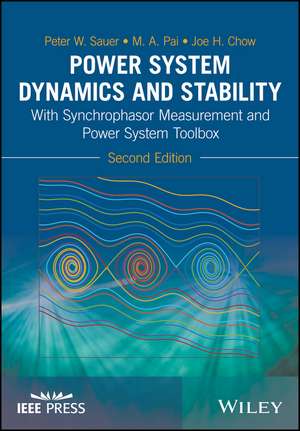
Power System Dynamics and Stability
Autor Peter W Saueren Limba Engleză Hardback – 22 sep 2017
Prin parcurgerea lucrării Power System Dynamics and Stability, cititorul va implementa modele de simulare numerică pentru rețele multi-mașină și va proiecta stabilizatori de sistem utilizați în controlul rețelelor electrice moderne. Această a doua ediție, publicată de Wiley, reprezintă o evoluție tehnică necesară, integrând tehnologia unităților de măsură fazorială (PMU) ca instrument central în monitorizarea în timp real a perturbărilor din sistemele energetice. Recomandăm acest volum pentru rigoarea cu care tratează derivarea sistematică a modelelor de mașini sincrone, oferind o bază teoretică solidă prin utilizarea varietăților integrale pentru simplificarea ordinului modelelor fără a sacrifica precizia fizică. Credem că structura tehnică a cărții facilitează o trecere coerentă de la modelarea analitică la aplicația practică. Autorii, Peter W Sauer, M a Pai și Joe H Chow, pun accent pe metodele funcției de energie, analizând suprafețele limită de energie potențială și punctele de echilibru instabile. Cititorul care a aplicat ideile din Power System Stability and Control de Leonard L. Grigsby va găsi aici elementul care completează viziunea de ansamblu: o metodologie de simulare integrată cu Power System Toolbox, care permite testarea scenariilor de stabilitate pe modele complexe de rețea. Spre deosebire de alte manuale teoretice, volumul de față include resurse practice sub formă de fișiere MATLAB, transformând conceptele de analiză a semnalelor mici și modurile electromecanice în instrumente de lucru verificabile. Putem afirma că este o resursă esențială pentru înțelegerea limitărilor modelelor dinamice de ordin redus în contextul operării rețelelor actuale, puternic instrumentate digital.
Preț: 862.57 lei
Preț vechi: 947.87 lei
-9%
Carte tipărită la comandă
Livrare economică 01-15 decembrie
Specificații
ISBN-10: 111935577X
Pagini: 374
Dimensiuni: 175 x 250 x 25 mm
Greutate: 0.77 kg
Ediția:2nd edition
Editura: Wiley
Locul publicării:Chichester, United Kingdom
V-ar putea interesa
-
 Powers and Compensation in Circuits with Nonsinusoidal CurrentLeszek S. Czarnecki-9%Preț: 364.71 lei399.34 lei
 -
 Power Electronics HandbookMuhammad H. Rashid-29%Preț: 1305.58 lei1839.96 lei
 -
 Power System Analysis and Design, SI EditionAdam Birchfield-21%Preț: 583.43 lei739.88 lei
 -
 -19%Preț: 501.18 lei618.74 lei
 -
 -23%Preț: 1129.04 lei1466.28 lei
 -
 -19%Preț: 462.24 lei570.66 lei
 -
 Power System Stability and Control, Second EditionPrabha S. Kundur-32%Preț: 793.27 lei1167.52 lei
 -
 Electrical Power System EssentialsPieter Schavemaker-19%Preț: 601.23 lei742.26 lei
 -
 -19%Preț: 514.71 lei635.44 lei
 -
 Analysis of Electric Machinery and Drive SystemsPaul C Krause-23%Preț: 769.47 lei999.32 lei
 -
 -23%Preț: 1294.93 lei1681.72 lei
 -
 The Electric Power Engineering Handbook - Five Volume SetLeonard L. Grigsby-9%Preț: 6897.54 lei7579.71 lei
 -
 Inter-area Oscillations in Power Systems: A Nonlinear and Nonstationary PerspectiveArturo Roman Messina-18%Preț: 907.54 lei1106.75 lei
 -
 -26%Preț: 2304.02 lei3134.06 lei
 -
 Power System Dynamic Modelling and Analysis in Evolving NetworksBabak Badrzadeh-18%Preț: 2209.98 lei2695.09 lei
 -
 -18%Preț: 1152.40 lei1405.37 lei
 -
 -11%Preț: 413.53 lei464.65 lei
 -
 The Essentials of Power System Dynamics and ControlHemanshu Roy Pota-15%Preț: 609.38 lei716.92 lei
 -
 Application of Advance Techniques in Power and Energy SystemsPartha Sarathee Bhowmik-18%Preț: 1189.33 lei1450.40 lei
Public țintă
Primary: Postgraduate students in power systems and stability. Secondary: Researchers in power system dynamics and stability.De ce să citești această carte
Această resursă este esențială pentru inginerii de sistem și studenții la masterat care doresc să stăpânească simularea dinamică a rețelelor electrice. Cititorul câștigă competențe practice în utilizarea datelor de la PMU-uri și în modelarea în MATLAB. Este un ghid tehnic care face puntea între ecuațiile diferențiale complexe ale mașinilor electrice și operarea sigură a infrastructurii energetice naționale.
Despre autor
Peter W. Sauer, M.A. Pai și Joe H. Chow sunt figuri proeminente în mediul academic și de cercetare din domeniul ingineriei electrice, fiind recunoscuți pentru contribuțiile lor la teoria stabilității sistemelor de putere. Peter W. Sauer a activat ca profesor la University of Illinois, având o expertiză vastă în modelarea mașinilor electrice. M.A. Pai este cunoscut pentru cercetările sale asupra metodelor funcției de energie aplicate în stabilitatea tranzitorie, în timp ce Joe H. Chow, profesor la Rensselaer Polytechnic Institute, este un expert în controlul sistemelor și tehnologia sincrofazorială. Împreună, autorii oferă o perspectivă interdisciplinară ce îmbină controlul automat cu ingineria sistemelor energetice.