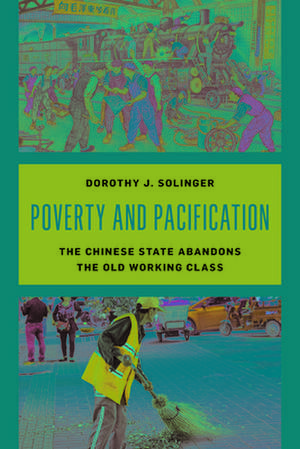
Poverty and Pacification: The Chinese State Abandons the Old Working Class
Autor Dorothy J. Solingeren Limba Engleză Hardback – 16 feb 2022
Prin volumul Poverty and Pacification, Dorothy J. Solinger aduce o perspectivă critică și profund umanizată asupra „muncitorilor uitați” ai Chinei urbane, oferind o analiză care depășește cifrele macroeconomice ale modernizării. Notăm cu interes modul în care autoarea documentează tranziția brutală a zeci de milioane de angajați de la securitatea locului de muncă pe viață, specifică erei socialiste, la statutul de persoane marginalizate, forțate să supraviețuiască prin programul de asistență socială dibao. Spre deosebire de literatura care se concentrează strict pe succesul economic chinez, această lucrare investighează prețul social al reformelor de piață și modul în care statul a utilizat pârghii de asistență minimă pentru a pacifica o clasă socială aflată în derivă.
Suntem de părere că structura cărții, împărțită în patru secțiuni tematice, facilitează înțelegerea procesului de „obsolescență” a forței de muncă. De la contextul istoric al schimbărilor de misiune ale statului chinez, până la experiențele subiective ale muncitorilor disponibilizați (xiagang), textul este susținut de 25 de tabele statistice și zeci de interviuri care dau voce celor invizibili. Cititorii familiarizați cu Welfare, Work, and Poverty de Qin Gao vor aprecia aici accentul pus pe dimensiunea politică a controlului social, Dorothy J. Solinger demonstrând cum asistența socială a fost mai degrabă un instrument de gestionare a riscului de revoltă decât un program veritabil de reducere a sărăciei. Această abordare continuă temele explorate de autoare în Polarized Cities, unde analiza clivajelor economice din mediul urban chinez este centrală. Ne-a atras atenția în mod deosebit secțiunea finală a cărții, care discută reducerile drastice ale listelor de beneficiari dibao sub pretextul integrării în sistemele de pensii, o manevră politică ce subliniază vulnerabilitatea constantă a vechii clase muncitoare.
Preț: 600.42 lei
Preț vechi: 930.72 lei
-35%
Carte tipărită la comandă
Livrare economică 04-18 decembrie
Specificații
ISBN-10: 1538154951
Pagini: 360
Ilustrații: 1 b/w illustrations; 25 tables;
Dimensiuni: 161 x 238 x 30 mm
Greutate: 0.66 kg
Editura: Bloomsbury Publishing
Colecția Rowman & Littlefield
Locul publicării:New York, United States
De ce să citești această carte
Recomandăm această carte cercetătorilor și studenților interesați de sociologie politică și istoria Chinei contemporane. Este o lectură esențială pentru a înțelege mecanismele de control social din spatele miracolului economic chinez. Cititorul câștigă o perspectivă documentată asupra modului în care sistemul de asistență socială dibao funcționează nu doar ca plasă de siguranță, ci ca instrument de neutralizare a tensiunilor politice într-un stat aflat în plină transformare capitalistă.
Despre autor
Dorothy J. Solinger este profesor emerit de științe politice la University of California, Irvine, fiind considerată una dintre cele mai autoritare voci în studiul politicilor sociale și al muncii din China. Cariera sa s-a concentrat pe intersecția dintre stat, piață și cetățenie, publicând lucrări de referință precum States` Gains, Labor`s Losses și Chinese Business under Socialism. Expertiza sa este fundamentată pe cercetări extinse de teren, fiind recunoscută pentru capacitatea de a corela politicile guvernamentale de nivel înalt cu realitățile cotidiene ale populațiilor marginalizate din marile metropole chineze.
Descriere
Cuprins
Preface
SECTION I: BACKGROUND
1 Three Shifts in State Mission
2 Urban Poverty and Its Paltry Palliatives
3 The Dibao and the Dibaohu
SECTION II: EXPERIENCES OF LAYOFF AND DIBAO
4 Xiagang: From Master to Mendicant
5 Dibao: Management and Missteps
6 Dibao: Survival and Perspectives
SECTION III: COMPARISONS AND VARIATIONS
7 "Social Assistance?": A Comparative Perspective
8 Dibao: Differential Disbursement
SECTION IV: HARSH CHANGES
9 Policy Manipulations
10 Denouement: Drastic Cut in the Dibao Rolls-
Did Pensions Replace the Dibao?
Conclusion
Glossary
Works Cited
Index
Recenzii
Poverty and Pacification is a modern classic of welfare studies in post-socialist China and a devastating portrait of this aspect of state-society relations. The book should stimulate interdisciplinary research on poverty in wealthy and poor cities, as well as on policy formulations to reduce urban-rural and regional inequalities. The rhetoric of growth and prosperity aside, it is urgent to reorganize work, health care, housing, and education to improve the Chinese working people's livelihoods and the lives of their children.
Following her widely acclaimed studies on the citizenship of peasant migrants and industrial workers, Dorothy Solinger-a world authority on China's politics and social policies-provides another incredibly detailed and forceful account of the plight of the working class and welfare retrenchment. This extraordinary book is a testimony to China's painful social engineering to modernity.
In this interesting book, Dorothy Solinger crystallizes her long-standing research on China's urban poor, exposing the government's miserable treatment of a huge number of former workers who had once been loyal stalwarts of Maoist socialism. Drawing from a vast amount of field notes and documentation, she analyzes the manipulative mechanisms by which different levels of the government have been able to relegate this sector of the populace to marginal oblivion.
Dorothy Solinger is one of the most eminent social scientists who specializes in modern China. This admirable study of China's inadequate welfare system for the urban poor, based on in-depth documentary research and insightful interviews, reveals the callous underside of the Chinese leadership's social policies. It is one of Solinger's best books.
Solinger's study of China's forgotten and invisible urban residents-often living in desperate conditions at odds with the dominant narrative of China's miracle of economic growth and development-is the culmination of two decades of research. It is a work of meticulous detail, drawing on multiple methods and sources of information presented alongside a commanding knowledge of the literature that explains the emergence of China's social assistance in the economic and political context of the last thirty years. What marks this as a standout study of China's management of the urban poor and the development of the social assistance system is Solinger's empathy for those in poverty, who receive only what help the state deems adequate. They are not forgotten or ignored; rather, they are central to the analysis, and it is all the stronger for it.
Based on her decades of pathbreaking and passionate research, Solinger offers a masterful analysis of the urban indigents in China. Their stories are told with gravity and insights into the evolving policy regimes and political economy.
Poverty and Pacification: The Chinese State Abandons the Old Working Class provides an incredibly thorough treatment of China's Minimum Livelihood Guarantee scheme, from the program's origins, to its administration, to its evolution. Most importantly, however, this book humanizes the experience of Dibao recipients by providing a space where the voices of China's urban poor are heard. Poverty and Pacification is essential reading not only for those who want to understand urban poverty in China but also for anyone interested in Chinese politics and society.
Dorothy Solinger has produced a remarkable sequel to her classic account of China's rural migrant workers (Contesting Citizenship in Urban China, 1999). In Poverty and Pacification, Solinger shifts her attention to the tens of millions of veteran urban workers who have lost their jobs as China's factories have been privatized, restructured, and closed. Based on more than two decades of research in nine Chinese cities, she provides a disturbing portrayal of how industrial restructuring has dismantled the lives of men and women who had once been promised lifetime employment. While her earlier book documented the severe difficulties encountered by rural migrants, it also reflected their hopes of upward mobility; her new book, in contrast, treats the downward trajectory of once proud workers who have been cast aside.
This excellent book is necessary reading for scholars of urban inequality, social mobility and stratification, and public policy - not only those working onChina but anyone concerned with rising urban inequality across transitional contexts.
During the latter part of the 1990s, workers in urban areas of China were significantly affected by the restructuring of the economy. In contrast to previous conditions, state-owned enterprises (SOEs) and collective firms faced stringent budget restrictions. As a result, many workers were laid off... I recommend this book to anyone interested in China's Dibao system, particularly to those interested in the problems faced by urban Dibao recipients.