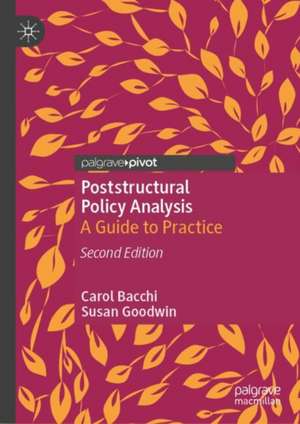
Poststructural Policy Analysis
Autor Carol Bacchi, Susan Goodwinen Limba Engleză Hardback – 13 aug 2025
This book offers a distinctive approach to policy analysis and a refreshing and politically engaged way of thinking about policy. It clearly articulates a Foucault-influenced poststructural perspective on policy and policy analysis for researchers, students and policy makers. As a "guide to practice", the book introduces a critical analytical approach to policy analysis called ‘What’s the Problem Represented to be?’ (WPR). Instead of treating policy as simply the government’s best efforts to problems, this analytic strategy highlights how policies produce ‘problems’ as particular sorts of problem and how governing takes place through these problematisations. First published in 2016, the book describes the conceptual and theoretical underpinnings of the WPR approach to policy analysis in a detailed and accessible manner. It features examples of application of the approach with topics as diverse as obesity, economic policy, migration, drug and alcohol policy, and gender equality.
In this second edition, the authors centralise a complementary analytic strategy for poststructural policy analysis—poststructural interview analysis (PIA). This edition integrates this material as a new chapter which sets out PIA as a novel approach to poststructural interview analysis and includes examples of PIA applications. The new chapter provides excellent guidance to undertake interview analysis in a manner congruent with the poststructural precepts set out in the book.
In this second edition, the authors centralise a complementary analytic strategy for poststructural policy analysis—poststructural interview analysis (PIA). This edition integrates this material as a new chapter which sets out PIA as a novel approach to poststructural interview analysis and includes examples of PIA applications. The new chapter provides excellent guidance to undertake interview analysis in a manner congruent with the poststructural precepts set out in the book.
Preț: 299.09 lei
Puncte Express: 449
Carte tipărită la comandă
Livrare economică 30 noiembrie-05 decembrie
Livrare prin curier în România Termenul estimat este afișat lângă disponibilitate.
Transport gratuit de la 400.00 lei Plată online sau ramburs, în funcție de opțiunile comenzii.
Retur gratuit în 14 zile Comandă securizată și suport în română.
Specificații
ISBN-13: 9781349961337
ISBN-10: 1349961337
Pagini: 188
Ilustrații: IX, 178 p. 1 illus.
Dimensiuni: 153 x 216 x 15 mm
Greutate: 0.32 kg
Ediția:Second Edition 2025
Editura: Palgrave MacMillan
ISBN-10: 1349961337
Pagini: 188
Ilustrații: IX, 178 p. 1 illus.
Dimensiuni: 153 x 216 x 15 mm
Greutate: 0.32 kg
Ediția:Second Edition 2025
Editura: Palgrave MacMillan
Notă biografică
Carol Bacchi is Professor Emerita of Politics at the University of Adelaide, Australia. Her work over the past forty years has encouraged rethinking of taken-for-granted truths about women’s history, equality policy and public policy generally. Major publications include Same Difference: Feminism and Sexual Difference (1990/2024), Women, Policy and Politics: The Construction of Policy Problems (1999), The Politics of Affirmative Action: 'Women', Equality & Category Politics (1996) and Analysing Policy: What’s the Problem Represented to Be? (2009).
Susan Goodwin is Professor of Policy Studies at the University of Sydney, Australia. Her research
Susan Goodwin is Professor of Policy Studies at the University of Sydney, Australia. Her research
Cuprins
Part
I
Asking
new
policy
questions
1Introduction2
2Making
politics
visible:
The
WPR
approach15
3Key
themes
and
concepts33
Power,
knowledge
and
resistance34
Practices,
events
and
relations
39
Discourses
and
discursive
practices43
Problematizing,
problematizations,
self-problematization47
Governmentality:
rationalities
and
technologies52
Genealogy
and
subjugated
knowledges58
Subjectification,
subject
positions
and
dividing
practices63
Part
IIInterrogating
policies
as
constitutive:
WPR
applications
4Making
and
unmaking
“problems”71
Understandings
of
“problems”
in
policy
analysis72
Alcohol
and
other
drug
“problems”77
“Gender
equality”80
5Making
and
unmaking
“subjects”87
Education
policy90
Health
policy92
Immigration
policy94
Economic
policy96
Transport/environment
policy98
Disability/equality
policy99
Family
policy<101
6Making
and
unmaking
“objects”104
“traffic”/“cycling”107
“poverty”/“social
inclusion”109
“addiction”111
“literacy”114
States
of
being:
“wellbeing”,
“disability”,
“developing/developed”116
7Making
and
unmaking
“places”120
Making
(up)
“the
state”
123
Making
(up)
“Europe”124
Making
(up)
“urban”/“rural”
“places”127
Making
(up)
“developed”
and
“developing”
“places”130
Making
(up)
“public
places”132
8Conclusion135
Appendix:
Poststructural
Interview
Analysis:
Politicizing
“personhood”
by
Carol
Bacchi
and
Jennifer
Bonham143
Bibliography155
Index
Textul de pe ultima copertă
This
book
offers
a
novel,
refreshing
and
politically
engaged
way
to
think
about
public
policy.
Instead
of
treating
policy
as
simply
the
government’s
best
efforts
to
address
problems,
it
offers
a
way
to
question
critically
how
policies
produce
“problems”
as
particular
sorts
of
problems,
with
important
political
implications.
Governing,
it
is
argued,
takes
place
through
these
problematizations.
According
to
the
authors,
interrogating
policies
and
policy
proposals
as
problematizations
involves
asking
questions
about
the
assumptions
they
rely
upon,
how
they
have
been
made,
what
their
effects
are,
as
well
as
how
they
could
be
unmade.
To
enable
this
form
of
critical
analysis,
this
book
introduces
an
analytic
strategy,
the
“What’s
the
Problem
Represented
to
be?”
(WPR)
approach.
It
features
examples
of
applications
of
the
approach
with
topics
as
diverse
as
obesity,
economic
policy,
migration,
drug
and
alcohol
policy,
and
gender
equality
to
illustrate
the
growing
popularity
of
this
way
of
thinking
and
to
provide
clear
and
useful
examples
of
poststructural
policy
analysis
in
practice.
Susan
Goodwin
is
Associate
Professor
of
Policy
Studies
at
the
University
of
Sydney,
Australia.
Her
research
focuses
on
social
policy
and
gender,
and
she
contributes
to
policy
processes
at
local,
national
and
international
levels.
Recent
publications
include Markets,
Rights
and
Power
in
Australian
Social
Policy (2015), Schools,
Communities
and
Social
Inclusion (2011)
and Social
Policy
for
Social
Change (2010).
Carol
Bacchi
is
Professor
Emerita
of
Politics
at
the
University
of
Adelaide,
Australia.
Her
work
over
the
past
forty
years
has
encouraged
rethinking
of
taken-for-granted
truths
about
women’s
history,
equality
policy
and
public
policy
generally.
Major
publications
include: Same
Difference:
Feminism
and
Sexual
Difference (1990), Women,
Policy
and
Politics:
The
Construction
of
Policy
Problems (1999)
and Analysing
Policy:
What’s
the
Problem
Represented
to
Be? (2009).
Caracteristici
Offers
a
novel,
refreshing,
and
politically
engaged
way
to
think
about
public
policy
Introduces
and
develops
an
innovative,
critical
framework
in
policy
analysis
Rethinks
policy
development
through
a
poststructural
lens