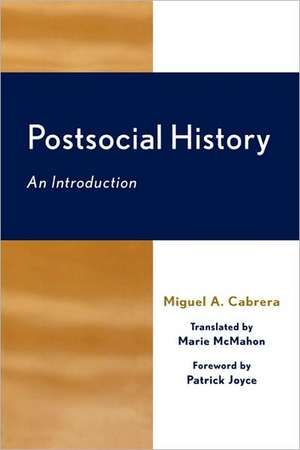
Postsocial History: An Introduction
Autor Miguel A. Cabrera Cuvânt înainte de Patrick Joyce Traducere de Marie McMahonen Limba Engleză Paperback – 7 feb 2005
Postsocial History is a lucid and unprecedented account of the need for a new, modern theoretical model. By arguing convincingly for the inclusion of language in that model, Cabrera awakens a revolutionary new approach to historiography. This book will prove indispensable to historians, and to social scientists in general, who are dissatisfied with the old paradigms and seek new ways of addressing the challenges of social research.
Preț: 305.48 lei
Preț vechi: 403.33 lei
-24%
Puncte Express: 458
Carte tipărită la comandă
Livrare economică 05-19 decembrie
Livrare prin curier în România Termenul estimat este afișat lângă disponibilitate.
Transport gratuit de la 400.00 lei Plată online sau ramburs, în funcție de opțiunile comenzii.
Retur gratuit în 14 zile Comandă securizată și suport în română.
Specificații
ISBN-13: 9780739107720
ISBN-10: 0739107720
Pagini: 192
Dimensiuni: 154 x 228 x 15 mm
Greutate: 0.29 kg
Editura: Bloomsbury Publishing
Colecția Lexington Books
Locul publicării:New York, United States
ISBN-10: 0739107720
Pagini: 192
Dimensiuni: 154 x 228 x 15 mm
Greutate: 0.29 kg
Editura: Bloomsbury Publishing
Colecția Lexington Books
Locul publicării:New York, United States
V-ar putea interesa
-
 A Short History of SlaveryJames Walvin-36%Preț: 59.55 lei93.37 lei
 -
 -21%Preț: 421.96 lei533.98 lei
 -
 Life On Air: A History of Radio FourDavid Hendy-15%Preț: 112.74 lei133.13 lei
 -
 Alcohol in World HistoryGina Hames-18%Preț: 1112.72 lei1356.98 lei
 -
 Twenty Chickens for a SaddleRobyn Scott-25%Preț: 70.16 lei94.17 lei
 -
 Farewell To The East EndJennifer Worth-25%Preț: 59.55 lei79.46 lei
 -
 -25%Preț: 219.85 lei292.52 lei
 -
 The Birth of BiopoliticsArnold I. DavidsonPreț: 250.63 lei
 -
 Daily Life in the United States, 1920-1940David E. Kyvig-15%Preț: 127.36 lei149.87 lei
 -
 The Real Gorbals StoryColin MacFarlane-20%Preț: 74.63 lei92.85 lei
Cuprins
Part 1 Foreword
Chapter 2 Introduction
Chapter 3 The Background: From Social History to the New Cultural History
Chapter 4 Beyond the Cultural Turn: Discourse and Postsocial History
Chapter 5 The Discursive Construction of Social Reality
Chapter 6 The Making of Interests and Identities
Chapter 7 A New Concept of Social Action
Chapter 8 A New Agenda for Historical Studies
Chapter 2 Introduction
Chapter 3 The Background: From Social History to the New Cultural History
Chapter 4 Beyond the Cultural Turn: Discourse and Postsocial History
Chapter 5 The Discursive Construction of Social Reality
Chapter 6 The Making of Interests and Identities
Chapter 7 A New Concept of Social Action
Chapter 8 A New Agenda for Historical Studies
Recenzii
Few works as carefully review, with the same degree of nuance and understanding, the postulates, implications, and historiographical entailments of the linguistic turn for historical writing.
Postsocial History provides a valuable overview of cultural history's broad challenge to traditional conceptions of agency and social action, and it lays out in unusually explicit terms the theoretical grounds-the "theory of society"-on which that challenge rests. Cabrera captures and crystallizes a profound transformation in historical practice and also adds new impetus to the movement he describes.
Postsocial Historyis a brilliant and penetrating critical examination of the current state of historical thought. Cabrera diagnoses recent changes in historians' practices and argues forcefully for what he sees as a newly crystallizing form of historical explanation. No one who cares about the future of historical thinking can afford to miss this book....
Cabrera has provided a timely meditation on the discursive turn in historical scholarship. Pulling together debates across the histories of gender and colonialism, as well as social and cultural histories, he meticulously outlines the new 'post-social' questions and agendas for historical research after the discursive turn. It is a fine piece of historiographical writing that should be read by all those interested in understanding the myriad linguistic, cultural and discursive turns over recent decades and the competing histories of the social they have produced.
Writing history takes place in the shadows of the present. Yet the present has changed so much in the recent past that we have not yet absorbed the implications of our new situation for reading and writing history. Miguel Cabrera offers an energetic and fresh account of how diverse new scholarship has inaugurated 'postsocial' ways of historicizing-discursive ones that have the potential to resonate in a relation between writing history and living historically in the present.
Postsocial History provides a valuable overview of cultural history's broad challenge to traditional conceptions of agency and social action, and it lays out in unusually explicit terms the theoretical grounds-the "theory of society"-on which that challenge rests. Cabrera captures and crystallizes a profound transformation in historical practice and also adds new impetus to the movement he describes.
Postsocial Historyis a brilliant and penetrating critical examination of the current state of historical thought. Cabrera diagnoses recent changes in historians' practices and argues forcefully for what he sees as a newly crystallizing form of historical explanation. No one who cares about the future of historical thinking can afford to miss this book....
Cabrera has provided a timely meditation on the discursive turn in historical scholarship. Pulling together debates across the histories of gender and colonialism, as well as social and cultural histories, he meticulously outlines the new 'post-social' questions and agendas for historical research after the discursive turn. It is a fine piece of historiographical writing that should be read by all those interested in understanding the myriad linguistic, cultural and discursive turns over recent decades and the competing histories of the social they have produced.
Writing history takes place in the shadows of the present. Yet the present has changed so much in the recent past that we have not yet absorbed the implications of our new situation for reading and writing history. Miguel Cabrera offers an energetic and fresh account of how diverse new scholarship has inaugurated 'postsocial' ways of historicizing-discursive ones that have the potential to resonate in a relation between writing history and living historically in the present.