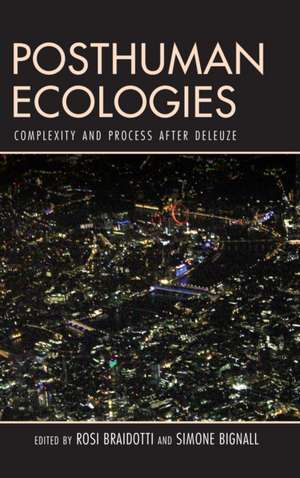
Posthuman Ecologies: Complexity and Process after Deleuze
Editat de Rosi Braidotti, Simone Bignallen Limba Engleză Paperback – 12 dec 2018
Preț: 257.70 lei
Puncte Express: 387
Carte tipărită la comandă
Livrare economică 27 noiembrie-11 decembrie
Livrare prin curier în România Termenul estimat este afișat lângă disponibilitate.
Transport gratuit de la 400.00 lei Plată online sau ramburs, în funcție de opțiunile comenzii.
Retur gratuit în 14 zile Comandă securizată și suport în română.
Specificații
ISBN-13: 9781786608239
ISBN-10: 1786608235
Pagini: 288
Dimensiuni: 146 x 226 x 20 mm
Greutate: 0.4 kg
Editura: Bloomsbury Publishing
Colecția Rowman & Littlefield
Locul publicării:New York, United States
ISBN-10: 1786608235
Pagini: 288
Dimensiuni: 146 x 226 x 20 mm
Greutate: 0.4 kg
Editura: Bloomsbury Publishing
Colecția Rowman & Littlefield
Locul publicării:New York, United States
Descriere
The devolved and dispersed character of human agency and moral responsibility in the contemporary condition appears linked with the deepening global trauma of 'inhumanism' as a paradox of the Anthropocene. Reclaiming human agency and accountability appears crucial for collective resistance to the unprecedented state of environmental and social collapse resulting from the inhumanity of contemporary capitalist geopolitics and biotechnologies of control. Understanding the potential for such resistance in the posthuman condition requires urgent new thinking about the nature of human influence in complex interactional systems, and about the nature of such systems when conceived in non-anthropocentric way. Through specific readings and uses of Deleuze's conceptual apparatus, this volume examines the operation of human-actioned systems as complex and heterogeneous arenas of affection and accountability. This exciting collection extends non-humanist concepts for understanding reality, agency and interaction in dynamic ecologies of reciprocal determination and influence. The outcome is a vital new theorisation of human scope, responsibility and potential in the posthuman condition.
Cuprins
1. Rosi Braidotti and Simone Bignall - Introduction: posthuman systems / 2. Iris Van der Tuin - Deleuze and diffraction / 3. Jussi Parikka - Cartographies of environmental arts / 4. Andrej Radman - Involutionary architecture: unyoking coherence from congruence / 5. Elizabeth de Freitas - Love of learning: amorous and fatal / 6. James Williams - Time and the posthuman / 7. Sean Bowden - 'Becoming-equal to the act': the temporal structure of action and agential responsibility / 8. Suzanne McCullagh - Heterogeneous collectivities and the capacity to act: conceptualising nonhumans in the political sphere / 9. Simone Bignall and Daryle Rigney - Indigeneity, posthumanism and nomad thought: transforming colonial ecologies / 10. Thomas Nail - Kinopolitics: borders in motion / 11. Gregory Flaxman - Out of control: from political economy to political ecology / 12. Jon Roffe - Economic systems and the problematic character of price / 13. Edward Mussawir - A modification in the subject of right: Deleuze, jurisprudence a
Recenzii
This volume offers an alternative take on critiques of both humanism as inhuman and the posthuman. It presents a differential, diffractive selection of calls to creating new territories and networks at local, global and transversal levels, always attentive to the extensive and increasingly ambiguous emergences of what we currently consider 'life'.
This is an astoundingly rich collection of essays, edited and collected by one of the major forces in posthumanist thought, and one of postcolonial theory's rising stars. Braidotti and Bignall have collected major figures in philosophy, geography, feminist theory and critical theory, and focused on the twenty-first century's major challenges. How do we think about the future, given the present's range of potentials for systemic collapse? These essays embrace complexity with a stunning level of lucidity and originality.
Simone Bignall and Rosi Braidotti's Posthuman Ecologies stages a cutting-edge deployment of Deleuze's work in relation to complex and heterogenous systems. Politically astute in its commitment to material differences, this innovative collection foregrounds the counter-knowledges, interdisciplinarity and affirmative ethics that we so desperately need as we grapple with the posthuman condition.
This is a rich and provocative compendium of difficult questions, valuable speculations and thoughtful, pointed answers. The contributors cut through the entanglements in this vital discussion and seek to re-establish the conversation around post-/in-/transhumanism(s) on a more fruitful ground.
In this volume, concepts in need of revision - action, environment, change, response - are elegantly placed in conversation with one another. A timely contribution to the effort of becoming-human.
This is an astoundingly rich collection of essays, edited and collected by one of the major forces in posthumanist thought, and one of postcolonial theory's rising stars. Braidotti and Bignall have collected major figures in philosophy, geography, feminist theory and critical theory, and focused on the twenty-first century's major challenges. How do we think about the future, given the present's range of potentials for systemic collapse? These essays embrace complexity with a stunning level of lucidity and originality.
Simone Bignall and Rosi Braidotti's Posthuman Ecologies stages a cutting-edge deployment of Deleuze's work in relation to complex and heterogenous systems. Politically astute in its commitment to material differences, this innovative collection foregrounds the counter-knowledges, interdisciplinarity and affirmative ethics that we so desperately need as we grapple with the posthuman condition.
This is a rich and provocative compendium of difficult questions, valuable speculations and thoughtful, pointed answers. The contributors cut through the entanglements in this vital discussion and seek to re-establish the conversation around post-/in-/transhumanism(s) on a more fruitful ground.
In this volume, concepts in need of revision - action, environment, change, response - are elegantly placed in conversation with one another. A timely contribution to the effort of becoming-human.