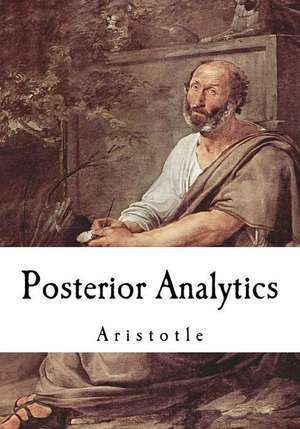
Posterior Analytics
Autor Aristotle Traducere de G. R. G. Mureen Limba Engleză Paperback
Preț: 57.71 lei
Puncte Express: 87
Carte disponibilă
Livrare economică 09-23 noiembrie
Livrare prin curier în România Termenul estimat este afișat lângă disponibilitate.
Transport gratuit de la 400.00 lei Plată online sau ramburs, în funcție de opțiunile comenzii.
Retur gratuit în 14 zile Comandă securizată și suport în română.
Specificații
ISBN-13: 9781537382791
ISBN-10: 1537382799
Pagini: 80
Dimensiuni: 178 x 254 x 4 mm
Greutate: 0.15 kg
ISBN-10: 1537382799
Pagini: 80
Dimensiuni: 178 x 254 x 4 mm
Greutate: 0.15 kg
V-ar putea interesa
-
 Aristotle: A Very Short IntroductionJonathan Barnes-19%Preț: 57.55 lei71.35 lei
 -
 Philosophia Togata I: Essays on Philosophy and Roman SocietyMiriam Griffin-33%Preț: 660.35 lei981.34 lei
 -
 Collected PapersGareth Evans-28%Preț: 349.25 lei484.26 lei
 -
 -29%Preț: 364.04 lei509.76 lei
 -
 The Law of Non-Contradiction: New Philosophical EssaysGraham Priest-28%Preț: 470.20 lei652.88 lei
 -
 A Philosophical Guide to ConditionalsJonathan Bennett-28%Preț: 356.64 lei494.02 lei
 -
 The Philosophy of Mathematics TodayMatthias Schirn-27%Preț: 416.82 lei572.70 lei
 -
 -28%Preț: 443.25 lei615.36 lei
 -
 Vagueness and ContradictionRoy Sorensen-29%Preț: 356.71 lei499.48 lei
 -
 Absolute GeneralityAgustín Rayo-28%Preț: 415.85 lei579.71 lei
 -
 Preț: 207.45 lei
 -
 The Presocratic PhilosophersJonathan BarnesPreț: 391.79 lei
 -
 ParadoxesR. M. SainsburyPreț: 234.64 lei
Notă biografică
Aristotle (384-322 BC) was an ancient Greek philosopher, scientist, and teacher whose writings became foundational works in Western philosophy and scholarship. A student of Plato and tutor to Alexander the Great, Aristotle founded the Lyceum in Athens and produced influential works on ethics, politics, logic, science, literature, and rhetoric.His systematic approach to knowledge shaped centuries of intellectual development. Aristotle's writings remain among the most studied works in history and continue to influence philosophy, education, science, political theory, and the study of human communication.
Descriere
Descriere de la o altă ediție sau format:
The Posterior Analytics contains some of Aristotle's most influential thoughts in logic, epistemology, metaphysics, and the philosophy of science. The first book expounds and develops the notions of a demonstrative argument and of a formal, axiomatized science; the second discusses a cluster of problems raised by the axioms or principles of such a science, and investigates in particular the theory of definition. For the second edition of this volume, the translation has been completely rewritten; and the commentary, which is done with the needs of philosophical readers in mind, has been thoroughly revised in the light of the scholarship of the last twenty years. There is an additional glossary and the bibliography has been extended.
The Posterior Analytics contains some of Aristotle's most influential thoughts in logic, epistemology, metaphysics, and the philosophy of science. The first book expounds and develops the notions of a demonstrative argument and of a formal, axiomatized science; the second discusses a cluster of problems raised by the axioms or principles of such a science, and investigates in particular the theory of definition. For the second edition of this volume, the translation has been completely rewritten; and the commentary, which is done with the needs of philosophical readers in mind, has been thoroughly revised in the light of the scholarship of the last twenty years. There is an additional glossary and the bibliography has been extended.
Recenzii
The notes in CIAP-B are crisp and incisive, and offer a dazzling array of opinions that are original with Barnes or are argued for in original ways. The commentary is immensely learned and abounds with references to ancient texts and to secondary literature.