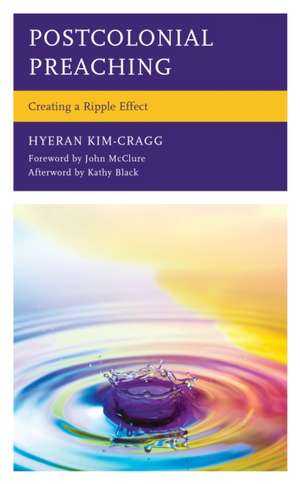
Postcolonial Preaching: Creating a Ripple Effect: Postcolonial and Decolonial Studies in Religion and Theology
Autor Rev. HyeRan Kim-Cragg Cuvânt înainte de John McClure Cuvânt după de Kathy Blacken Limba Engleză Paperback – 22 aug 2022
Din seria Postcolonial and Decolonial Studies in Religion and Theology
- nou
 Preț: 566.93 lei
 - 24%
 Preț: 312.60 lei
 - 35%
 Preț: 681.75 lei
 - 33%
 Preț: 591.62 lei
 - 26%
 Preț: 262.57 lei
 - 33%
 Preț: 517.17 lei
 - 28%
 Preț: 221.43 lei
 - 32%
 Preț: 563.96 lei
 - 25%
 Preț: 268.40 lei
 - 33%
 Preț: 518.25 lei
 - 33%
 Preț: 516.98 lei
 - 34%
 Preț: 551.23 lei
 - 28%
 Preț: 218.85 lei
 - 26%
 Preț: 259.10 lei
 - 32%
 Preț: 569.05 lei
 - nou
 Preț: 563.78 lei
 - nou
 Preț: 213.03 lei
 - nou
 Preț: 564.98 lei
Preț: 260.58 lei
Preț vechi: 355.40 lei
-27%
Puncte Express: 391
Carte tipărită la comandă
Livrare economică 05-19 decembrie
Livrare prin curier în România Termenul estimat este afișat lângă disponibilitate.
Transport gratuit de la 400.00 lei Plată online sau ramburs, în funcție de opțiunile comenzii.
Retur gratuit în 14 zile Comandă securizată și suport în română.
Specificații
ISBN-13: 9781793617118
ISBN-10: 1793617112
Pagini: 160
Dimensiuni: 148 x 228 x 10 mm
Greutate: 0.25 kg
Editura: Bloomsbury Publishing
Colecția Lexington Books
Seria Postcolonial and Decolonial Studies in Religion and Theology
Locul publicării:New York, United States
ISBN-10: 1793617112
Pagini: 160
Dimensiuni: 148 x 228 x 10 mm
Greutate: 0.25 kg
Editura: Bloomsbury Publishing
Colecția Lexington Books
Seria Postcolonial and Decolonial Studies in Religion and Theology
Locul publicării:New York, United States
Cuprins
Table of Contents
Introduction: Why Postcolonial Preaching?
Chapter 1: Rehearsal: Practicing the Realm of God Here And Now But Not Quite Yet
Chapter 2: Imagination: Proclaiming a New World Beyond Our Immediate Grasp
Chapter 3: Place: Grappling with Colonial Realities and Locating One's Own Social Location
Chapter 4: Pattern: Vessels to Carry the Living Water
Chapter 5: Language: Becoming a Postcolonial Polyglot with Cultural Linguistic Competency
Chapter 6: Exegesis: Exploring a Postcolonial Contrapuntal Reading for Interpreting Scripture
Conclusion: What Next
Afterword
Introduction: Why Postcolonial Preaching?
Chapter 1: Rehearsal: Practicing the Realm of God Here And Now But Not Quite Yet
Chapter 2: Imagination: Proclaiming a New World Beyond Our Immediate Grasp
Chapter 3: Place: Grappling with Colonial Realities and Locating One's Own Social Location
Chapter 4: Pattern: Vessels to Carry the Living Water
Chapter 5: Language: Becoming a Postcolonial Polyglot with Cultural Linguistic Competency
Chapter 6: Exegesis: Exploring a Postcolonial Contrapuntal Reading for Interpreting Scripture
Conclusion: What Next
Afterword
Recenzii
The refugee camp on the island Moria in Greece was burning while I was reading the manuscript. Thousands of people were misplaced. The shameful failure of the European border regime was exposed anew. I take Kim-Cragg's thoughtful and provocative proposal for a postcolonial perspective on preaching as a much needed contribution that takes these realities seriously.
How can we confront the winds of chauvinism in a meaningful way? How can our proclamation shape our imagination in radically eschatological ways? How do we deal constructively with (post)colonial realities that are surrounding us? How do we approach biblical texts by engaging in postcolonial contrapuntal reading? Deep homiletical reflections and inspiring sermons address these questions.
This pandemic has literally displaced preaching. Sermons are delivered via fiber optics on laptop screens instead of pulpits back lit by stained glass. Pews have been emptied, yet the hunger for hearing a living word deepens. Postcolonial Preaching frames the trauma of the loss of life, job, home, even memory, in the traveling mercies of the gospel. Backpack her insights as you travel with your community; learn how to make the journey home.
A post-colonial world is coming to life even as tendrils of colonialism still have a grip on the present world. HyeRan Kim-Cragg offers important perspectives to help preachers empower coming of the new world while reducing the grip of the old. The author advocates a Ripple approach: rehearsing the new world, imagining a world beyond our immediate grasp, paying attention to colonial realities, patterning homiletical vessels for living water, learning language that is culturally respectful and diverse, and exegesis of the Bible in postcolonial perspective. Such preaching will, indeed, expand the postcolonial ripple in the church and beyond.
Indeed, this book creates "a ripple effect" in the field of homiletics. The author invites readers to postcolonial struggles and critical reflection on the proclamation of the good news of God's grace to our postcolonial world. The six homiletical principles-rehearsal, imagination, place, pattern, language, and exegesis-proposed from the multiple angles of the postcolonial perspective retool homiletical theories to be more effective for the practice of preaching in the postcolonial context.
I was delighted to read in Postcolonial Preaching: Creating a Ripple Effect how HyeRan Kim-Cragg offers six essential elements for postcolonial preaching organized as widening circles instead of following the western logic of linear and hierarchical arrangement. As a professor of preaching, I am looking forward to explore with my students how this book may widen their imaginations, use postcolonial contrapuntal reading for exegesis, and use the multilayered complexity of language in relation to body, inclusivity, culture, and colonialism. May all postcolonial preachers drop a Gospel truth to cause gentle and consistent small waves that change the world.
HyeRan Kim-Cragg's Postcolonial Preaching is likely to appear on the required reading list for seminary preaching courses within months of its publication. I have adopted it as a primary resource for the courses I facilitate because of its honesty about the homiletical status quo, where we are, and its invitation to embrace postcolonial preaching as "a rehearsal of the realm of God," that is, where we might be. "Places, everyone. Let's begin."
Kim-Cragg's book is an essential preaching resource for any teacher of preaching, student of preaching, or practical theologian with an interest in postcolonial or decolonial studies.
How can we confront the winds of chauvinism in a meaningful way? How can our proclamation shape our imagination in radically eschatological ways? How do we deal constructively with (post)colonial realities that are surrounding us? How do we approach biblical texts by engaging in postcolonial contrapuntal reading? Deep homiletical reflections and inspiring sermons address these questions.
This pandemic has literally displaced preaching. Sermons are delivered via fiber optics on laptop screens instead of pulpits back lit by stained glass. Pews have been emptied, yet the hunger for hearing a living word deepens. Postcolonial Preaching frames the trauma of the loss of life, job, home, even memory, in the traveling mercies of the gospel. Backpack her insights as you travel with your community; learn how to make the journey home.
A post-colonial world is coming to life even as tendrils of colonialism still have a grip on the present world. HyeRan Kim-Cragg offers important perspectives to help preachers empower coming of the new world while reducing the grip of the old. The author advocates a Ripple approach: rehearsing the new world, imagining a world beyond our immediate grasp, paying attention to colonial realities, patterning homiletical vessels for living water, learning language that is culturally respectful and diverse, and exegesis of the Bible in postcolonial perspective. Such preaching will, indeed, expand the postcolonial ripple in the church and beyond.
Indeed, this book creates "a ripple effect" in the field of homiletics. The author invites readers to postcolonial struggles and critical reflection on the proclamation of the good news of God's grace to our postcolonial world. The six homiletical principles-rehearsal, imagination, place, pattern, language, and exegesis-proposed from the multiple angles of the postcolonial perspective retool homiletical theories to be more effective for the practice of preaching in the postcolonial context.
I was delighted to read in Postcolonial Preaching: Creating a Ripple Effect how HyeRan Kim-Cragg offers six essential elements for postcolonial preaching organized as widening circles instead of following the western logic of linear and hierarchical arrangement. As a professor of preaching, I am looking forward to explore with my students how this book may widen their imaginations, use postcolonial contrapuntal reading for exegesis, and use the multilayered complexity of language in relation to body, inclusivity, culture, and colonialism. May all postcolonial preachers drop a Gospel truth to cause gentle and consistent small waves that change the world.
HyeRan Kim-Cragg's Postcolonial Preaching is likely to appear on the required reading list for seminary preaching courses within months of its publication. I have adopted it as a primary resource for the courses I facilitate because of its honesty about the homiletical status quo, where we are, and its invitation to embrace postcolonial preaching as "a rehearsal of the realm of God," that is, where we might be. "Places, everyone. Let's begin."
Kim-Cragg's book is an essential preaching resource for any teacher of preaching, student of preaching, or practical theologian with an interest in postcolonial or decolonial studies.