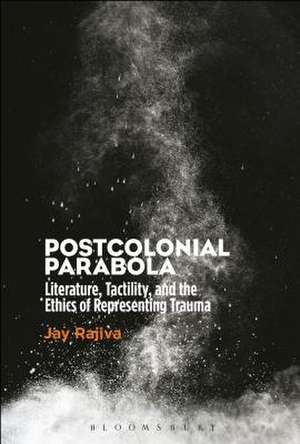
Postcolonial Parabola: Literature, Tactility, and the Ethics of Representing Trauma
Autor Dr. Jay Rajivaen Limba Engleză Paperback – 21 mar 2019
Though postcolonial literature's capacity to represent trauma has received considerable scrutiny in recent years, Postcolonial Parabola is innovative in its consideration of the postcolonial text as a literary object. Working within a phenomenological framework that ties together disparate postcolonial periods, Jay Rajiva explores how narrative structure shapes the experience of reading the postcolonial literatures of South Africa, India, and Sri Lanka. He argues that these texts enmesh the reader in an asymptotic tactility: though readers might approach the disclosure of trauma, they cannot arrive at it. Awareness of the asymptotic nature of reading such works is crucial to a meaningful, ethical engagement with literary representations of postcolonial trauma.
Preț: 248.23 lei
Preț vechi: 330.95 lei
-25%
Puncte Express: 372
Carte tipărită la comandă
Livrare economică 08-22 decembrie
Livrare prin curier în România Termenul estimat este afișat lângă disponibilitate.
Transport gratuit de la 400.00 lei Plată online sau ramburs, în funcție de opțiunile comenzii.
Retur gratuit în 14 zile Comandă securizată și suport în română.
Specificații
ISBN-13: 9781501351501
ISBN-10: 1501351508
Pagini: 224
Dimensiuni: 152 x 229 x 13 mm
Greutate: 0.3 kg
Editura: Bloomsbury Publishing
Colecția Bloomsbury Academic
Locul publicării:New York, United States
ISBN-10: 1501351508
Pagini: 224
Dimensiuni: 152 x 229 x 13 mm
Greutate: 0.3 kg
Editura: Bloomsbury Publishing
Colecția Bloomsbury Academic
Locul publicării:New York, United States
V-ar putea interesa
-
 The Dictionary of Imaginary PlacesGianni GuadalupiPreț: 198.90 lei
 -
 -27%Preț: 366.38 lei501.43 lei
 -
 -27%Preț: 367.11 lei501.84 lei
 -
 The Things We MeanStephen Schiffer-28%Preț: 369.05 lei510.41 lei
 -
 Against Interpretation: And Other EssaysSusan SontagPreț: 104.42 lei
 -
 -15%Preț: 485.98 lei571.74 lei
 -
 Learning to Curse: Essays in Early Modern CultureStephen GreenblattPreț: 181.26 lei
 -
 The Material Image: Art and the Real in FilmBrigitte PeuckerPreț: 202.59 lei
 -
 BookshelfLydia Pyne-31%Preț: 52.37 lei76.33 lei
 -
 Cigarette LighterJack Pendarvis-33%Preț: 50.64 lei75.31 lei
 -
 HoodAlison Kinney-32%Preț: 51.00 lei75.39 lei
 -
 Horror Plum'dMichael R CollingsPreț: 267.87 lei
Cuprins
Acknowledgments
Introduction: Postcolonial Comparison
1. Excess and Tactility: Toward Interpretation as Vexed Contact
2. Transfixion and Subversion: The Unexpected Endings of J. Devi and Coetzee
3. Seduction and Substitution: Behr, Sidhwa, and the Child Narrator
4. Motion and Stillness: Surface as Depth in Dangor and Ondaatje
Conclusion: Postcolonial Relation
References
Notes
Index
Introduction: Postcolonial Comparison
1. Excess and Tactility: Toward Interpretation as Vexed Contact
2. Transfixion and Subversion: The Unexpected Endings of J. Devi and Coetzee
3. Seduction and Substitution: Behr, Sidhwa, and the Child Narrator
4. Motion and Stillness: Surface as Depth in Dangor and Ondaatje
Conclusion: Postcolonial Relation
References
Notes
Index
Recenzii
This is an intriguing and conceptually ambitious work.
An ample, philosophy-laced, and at the same time original analysis of postcolonial trauma literature, based on the juxtaposition of two distinct postcolonial histories: Indian Partition and South African apartheid ... Postcolonial Parabola is built on solid theoretical grounds leading to a complex and intriguing argument.
Jay Rajiva's illuminating and engaging book makes a valuable contribution to postcolonial trauma studies. It manages to stand out in this increasingly crowded field thanks to its novel methodology and fresh comparative approach, productively connecting narratives bearing witness to South Asian and South African historical tragedies through a sustained focus on the tactility of the encounter between reader and trauma text.
Postcolonial Parabola is a brave and important milestone in the ongoing attempt to read trauma beyond the Euro-American context of trauma studies. Its subtle, compelling and highly original readings show how, like the arc of a parabola, literary narratives from South Africa and the Indian subcontinent approach but never quite 'touch' traumatic experience. Drawing on the work of Derrida and Nancy, Rajiva takes the phenomenological account of embodiment to its own limit: the reader's experience of postcolonial trauma is necessarily prosthetic, haunted by a distance that it can never quite traverse. In showing how this distance is differently calibrated by the form that each narrative takes, Postcolonial Parabola is a masterfully measured exposition of precisely what it is that postcolonial literature can-and cannot-offer its readers.
An ample, philosophy-laced, and at the same time original analysis of postcolonial trauma literature, based on the juxtaposition of two distinct postcolonial histories: Indian Partition and South African apartheid ... Postcolonial Parabola is built on solid theoretical grounds leading to a complex and intriguing argument.
Jay Rajiva's illuminating and engaging book makes a valuable contribution to postcolonial trauma studies. It manages to stand out in this increasingly crowded field thanks to its novel methodology and fresh comparative approach, productively connecting narratives bearing witness to South Asian and South African historical tragedies through a sustained focus on the tactility of the encounter between reader and trauma text.
Postcolonial Parabola is a brave and important milestone in the ongoing attempt to read trauma beyond the Euro-American context of trauma studies. Its subtle, compelling and highly original readings show how, like the arc of a parabola, literary narratives from South Africa and the Indian subcontinent approach but never quite 'touch' traumatic experience. Drawing on the work of Derrida and Nancy, Rajiva takes the phenomenological account of embodiment to its own limit: the reader's experience of postcolonial trauma is necessarily prosthetic, haunted by a distance that it can never quite traverse. In showing how this distance is differently calibrated by the form that each narrative takes, Postcolonial Parabola is a masterfully measured exposition of precisely what it is that postcolonial literature can-and cannot-offer its readers.