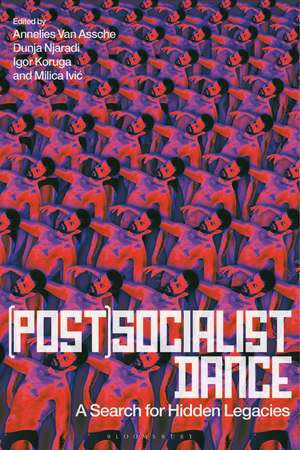
(Post)Socialist Dance: A Search for Hidden Legacies
Annelies Van Assche, Dunja Njaradi, Igor Koruga, Milica Ivicen Limba Engleză Hardback – 31 oct 2024
It traces hidden and invisibilized legacies over the span of one century, probing questions that can make viewers, artists, and scholars uncomfortable regarding dance histories, memories, circulations and production modes in and around the (post)socialist world. The contributions delve into a variety of dance practices (folk, traditional, ballet, modern, contemporary), modes of dance production (institutionalization processes, festival-making and market logics), and dance circulations (between centres and peripheries, between different genres and styles). The main focus is Eastern Europe (including Russia) but the book also addresses Cuba and China. The book's historical examples make the reader aware, too, of the (post)socialist bodies' influence in today's dance, including in contemporary dance scenes.
The (post)socialist context promises to be a prosperous laboratory to explore uncomfortable questions of legitimacy. Whose choreographic work is staged as a 'quality' dance production? Which dance practices are worthy of scholarly study? What are the limits of dance studies' understanding of what dance is or should be? In view of reclaiming the Second World through dance, this book thus probes questions that should be asked today but are not easy to answer; questions that dance practitioners, facilitators, critics, and researchers, including ourselves, are often not at ease with either. In doing so, the cracks of dance history begin to be sealed, and neglected dance practices are written back into history, provided with the academic recognition that they deserve.
Preț: 551.25 lei
Preț vechi: 863.76 lei
-36%
Puncte Express: 827
Carte disponibilă
Livrare economică 16-30 noiembrie
Livrare prin curier în România Termenul estimat este afișat lângă disponibilitate.
Transport gratuit pentru acest produs Plată online sau ramburs, în funcție de opțiunile comenzii.
Retur gratuit în 14 zile Comandă securizată și suport în română.
Specificații
ISBN-13: 9781350408159
ISBN-10: 1350408158
Pagini: 240
Ilustrații: 22 bw illus
Dimensiuni: 155 x 234 x 20 mm
Greutate: 0.5 kg
Editura: Bloomsbury Publishing
Colecția Bloomsbury Academic
Locul publicării:London, United Kingdom
ISBN-10: 1350408158
Pagini: 240
Ilustrații: 22 bw illus
Dimensiuni: 155 x 234 x 20 mm
Greutate: 0.5 kg
Editura: Bloomsbury Publishing
Colecția Bloomsbury Academic
Locul publicării:London, United Kingdom
V-ar putea interesa
-
 The Meaning Of TangoChristine DennistonPreț: 71.42 lei
 -
 The Oxford Handbook of Indian DanceAnurima Banerji-31%Preț: 999.82 lei1445.84 lei
 -
 The Oxford Handbook of Black Dance StudiesThomas F. DeFrantz-31%Preț: 868.00 lei1252.41 lei
 -
 DISCO!: Music, Image, DanceMimi Haddon-23%Preț: 199.47 lei259.34 lei
 -
 Funny Moves: Dance Humor PoliticsMarta E. Savigliano-21%Preț: 219.25 lei277.60 lei
 -
 Power MovesSeika BoyePreț: 236.32 lei
 -
 Terpsichore in SneakersSally BanesPreț: 204.71 lei
 -
 Moving History/Dancing CulturesAnn DilsPreț: 290.44 lei
 -
 Of the Presence of the BodyAndré LepeckiPreț: 191.50 lei
 -
 -18%Preț: 1062.29 lei1295.48 lei
 -
 Women’s Dance Traditions of Uzbekistan: Legacy of the Silk RoadLaurel Victoria Gray-20%Preț: 139.62 lei174.35 lei
 -
 -32%Preț: 551.86 lei816.77 lei
 -
 The Intellect Handbook of Dance Education ResearchLynnette Young Overby-23%Preț: 1058.45 lei1374.61 lei
 -
 Preț: 215.88 lei
 -
 Dance, Performance and Visual ArtLinda E. Dankworth-18%Preț: 807.99 lei985.36 lei
 -
 Global Groove: Art, Dance, Performance & ProtestMuseum Folkwang-14%Preț: 315.26 lei366.13 lei
 -
 -18%Preț: 309.95 lei380.00 lei
 -
 -18%Preț: 1483.14 lei1808.70 lei
Cuprins
List of Illustrations
List of Contributors
Preface
Acknowledgements
INTRODUCTORY ESSAYS
(Post)Socialism? Postsocialist Studies and the Three-Worlds Theory
Dunja Njaradi, Igor Koruga
Dance? Dance Studies and (Post)Socialist Dance
Annelies Van Assche, Milica Ivic
PART 1 - DANCE HISTORY AND MEMORY
ONE, TWO, THREE.COMRADE, COME, DANCE WITH ME
Igor Koruga
Choreography, Revolution, War: Kozaracko kolo between Anthropology and Dance Studies
Dunja Njaradi
The Complex Reputation of a Yugoslav Folklore Ballet: A Consideration of The Legend of Ohrid's National Character
Stefanie Van de Vyvere
The World of Art in the Russian World: Post-Soviet Rewritings of the Russian Ballet
Hanna Järvinen
Dancing in Life: Inner Mongolia's Ulan Muchir Grassland Art Troupes as Socialist Performance Practice
Emily Wilcox
PART 2 - DANCE PRODUCTION AND CIRCULATION
Conversations with Kinga: A Tribute to the Body and Craftsmanship
Annelies Van Assche
From Revolutionary to Reactionary: Contemporary Dance in Serbia Between Institutionalization and Anti-Institutionalization.
Milica Ivic
Dancing in Ruins: Lorna and Gabriela Burdsall in Cuba and the Diaspora
Elizabeth B Schwall
Festival-making and choreography: tales of affordance and crises in the work of Dusan Muric
Alexandra Baybutt
Index
List of Contributors
Preface
Acknowledgements
INTRODUCTORY ESSAYS
(Post)Socialism? Postsocialist Studies and the Three-Worlds Theory
Dunja Njaradi, Igor Koruga
Dance? Dance Studies and (Post)Socialist Dance
Annelies Van Assche, Milica Ivic
PART 1 - DANCE HISTORY AND MEMORY
ONE, TWO, THREE.COMRADE, COME, DANCE WITH ME
Igor Koruga
Choreography, Revolution, War: Kozaracko kolo between Anthropology and Dance Studies
Dunja Njaradi
The Complex Reputation of a Yugoslav Folklore Ballet: A Consideration of The Legend of Ohrid's National Character
Stefanie Van de Vyvere
The World of Art in the Russian World: Post-Soviet Rewritings of the Russian Ballet
Hanna Järvinen
Dancing in Life: Inner Mongolia's Ulan Muchir Grassland Art Troupes as Socialist Performance Practice
Emily Wilcox
PART 2 - DANCE PRODUCTION AND CIRCULATION
Conversations with Kinga: A Tribute to the Body and Craftsmanship
Annelies Van Assche
From Revolutionary to Reactionary: Contemporary Dance in Serbia Between Institutionalization and Anti-Institutionalization.
Milica Ivic
Dancing in Ruins: Lorna and Gabriela Burdsall in Cuba and the Diaspora
Elizabeth B Schwall
Festival-making and choreography: tales of affordance and crises in the work of Dusan Muric
Alexandra Baybutt
Index
Recenzii
A critical and timely intervention into the politics of dance historiography . Its case studies bring to light neglected archives, forgotten figures, and complex political legacies, offering compelling narratives that situate dance within broader debates about memory, nationalism, and ideology . For critical dance scholars and historians, the volume presents a rich and multilayered set of theoretical provocations.
(Post)Socialist Dance reveals a set of broad socio-cultural and political landscapes that constitute a self-standing field of embodied knowledges, insufficiently recognised in the Western canon thus far. Several local yet related case studies by the local artists and researchers, presented in convergence with Western scholars, illuminate a parallel epistemology of Dance that may be read alongside histories from marginalised cultures of the Global South. There is a range of insightful examples from different, more and less recent, histories of dances in socialist societies across 20th and 21st centuries. As a collection, the book reveals new modes of seeing Dance as a social entity that shifts in different moments of crises , including various wars, the breakdown of European socialisms, and grappling with the swarm of neoliberal structures. The book is inspiring in its revelations about the resilience of dance makers who adapt to the advantages and disadvantages of art production in the shifting political and economic contexts.
(Post)Socialist Dance reveals a set of broad socio-cultural and political landscapes that constitute a self-standing field of embodied knowledges, insufficiently recognised in the Western canon thus far. Several local yet related case studies by the local artists and researchers, presented in convergence with Western scholars, illuminate a parallel epistemology of Dance that may be read alongside histories from marginalised cultures of the Global South. There is a range of insightful examples from different, more and less recent, histories of dances in socialist societies across 20th and 21st centuries. As a collection, the book reveals new modes of seeing Dance as a social entity that shifts in different moments of crises , including various wars, the breakdown of European socialisms, and grappling with the swarm of neoliberal structures. The book is inspiring in its revelations about the resilience of dance makers who adapt to the advantages and disadvantages of art production in the shifting political and economic contexts.