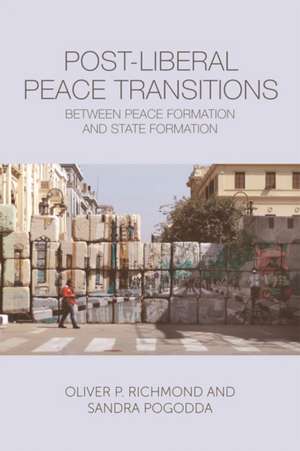
Post-Liberal Peace Transitions
Autor Oliver P Richmond, Sandra Pogoddaen Limba Engleză Paperback – aug 2017
Explores the interplay of forces that shape 'peace formation' in modern conflict-affected states
Why is it that states emerging from intervention, peacebuilding and statebuilding over the last 25 years appear to be 'failed by design'? This study explores the interplay of local peace agency with the (neo)liberal peacebuilding project. And it looks at how far can local 'peace formation' dynamics can go to counteract the forces of violence and play a role in rebuilding the state, consolidate peace processes and induce a more progressive form of politics.By looking at local agency related to peace formation, Oliver Richmond and Sandra Pogodda find answers to the pressing question of how large-scale peacebuilding or statebuilding may be significantly improved and made more representative of the lives, needs, rights, and ambitions of its subjects.
Key Features
- Comparative case studies, based on wide-ranging fieldwork, look at Afghanistan, Bosnia and Herzegovina, Cambodia, Cyprus, East Timor (Timor-Leste), Israel-Palestine, Kosovo, Northern Ireland, Sierra Leone and the Solomon Islands
- Takes an innovative theoretical approach, engaging with local and contextual forms of peacebuilding agency and including local authors
- Continues the project begun in Oliver Richmond's 2009 book Liberal Peace Transitions
Preț: 174.27 lei
Preț vechi: 208.97 lei
-17%
Puncte Express: 261
Carte disponibilă
Livrare economică 17 noiembrie-01 decembrie
Livrare prin curier în România Termenul estimat este afișat lângă disponibilitate.
Transport gratuit de la 400.00 lei Plată online sau ramburs, în funcție de opțiunile comenzii.
Retur gratuit în 14 zile Comandă securizată și suport în română.
Specificații
ISBN-13: 9781474428408
ISBN-10: 1474428401
Pagini: 256
Dimensiuni: 155 x 234 x 18 mm
Greutate: 0.43 kg
Editura: EDINBURGH UNIVERSITY PRESS
ISBN-10: 1474428401
Pagini: 256
Dimensiuni: 155 x 234 x 18 mm
Greutate: 0.43 kg
Editura: EDINBURGH UNIVERSITY PRESS
V-ar putea interesa
-
 Stones into SchoolsGreg MortensonPreț: 144.52 lei
 -
 The International Law of OccupationEyal Benvenisti-22%Preț: 404.18 lei518.79 lei
 -
 Fighting to the End: The Pakistan Army's Way of WarC. Christine Fair-31%Preț: 360.86 lei521.00 lei
 -
 -10%Preț: 365.82 lei405.29 lei
 -
 A Post-Liberal PeaceOliver RichmondPreț: 467.54 lei
 -
 More Bad News From IsraelGreg PhiloPreț: 252.67 lei
 -
 Preț: 169.06 lei
 -
 Contemporary Conflict Resolution, 4eO Ramsbotham-15%Preț: 610.37 lei718.08 lei
 -
 Preț: 176.50 lei
 -
 Beyond the Front LinesP. SeibPreț: 161.02 lei
 -
 Preț: 471.04 lei
 -
 Future WarChristopher CokerPreț: 167.77 lei
 -
 -18%Preț: 1401.39 lei1709.01 lei
 -
 Conflict and DevelopmentEleanor O' Gorman-17%Preț: 128.50 lei154.32 lei
Descriere
This book looks at the local agency related to peace formation in order to find answers to the pressing question of how large-scale peacebuilding or statebuilding may be significantly improved and made more representative of the lives, needs, rights, and ambitions of its subjects.
Notă biografică
Oliver P. Richmond is Research Professor of IR, Peace and Conflict Studies at the Humanitarian and Conflict Response Institute & Department of Politics, University of Manchester. His recent publications include Peace in IR (Routledge, 2008), Challenges to Peacebuilding: Managing Spoilers During Conflict Resolution (co-edited with Edward Newman) (UNU Press, 2006), and The Transformation of Peace (Palgrave, 2005).
Sandra Pogodda is Lecturer in Peace and Conflict Studies at the University of Manchester.
Sandra Pogodda is Lecturer in Peace and Conflict Studies at the University of Manchester.
Cuprins
Introduction: The contradictions of peace, international architecture, the state, and local agency, Oliver P. Richmond & Sandra Pogodda; Chapter 1 Lock out: Peace formation in Northern Ireland, Roger Mac Ginty; Chapter 2 Bosnia-Herzegovina: Domestic Agency and the Inadequacy of the Liberal Peace, Jasmin Ramovic, Stefanie Kappler & Roberto Belloni; Chapter 3, Peace Multitudes: Liberal Peace, Local Agency, and Peace Formation in Kosovo, Gezim Visoka; Chapter 4 Engendering the Post-liberal Peace in Cyprus: UNSC Resolution 1325 as a Tool, Olga Demetriou & Maria Hadjipavlou; Chapter 5 Peace formation versus everyday state formation in Palestine, Sandra Pogodda & Oliver P Richmond; Chapter 6 Afghanistan's Post-Liberal Peace: between external intervention and local efforts, Martine van Bijlert;Chapter 7 International interventions and local agency in peacebuilding in Sierra Leone, Morten Bøås & Patrick Tom; Chapter 8 Local Spaces for Peace in Cambodia?, Eng Netra and Caroline Hughes; Chapter 9 Timor-Leste: Building on local governance structures: embedding UN peace efforts from within, Paula Duarte Lopes; Chapter 10 Incompatibility, substitution or complementarity? Interrogating relationships between international, state and non-state peace agents in post-conflict Solomon Islands, Volker Boege