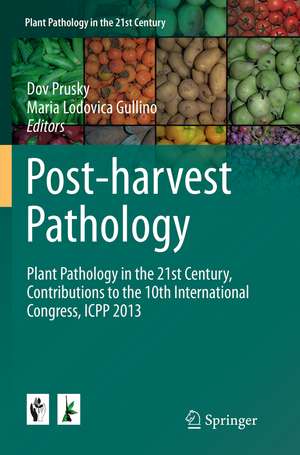
Post-harvest Pathology: Plant Pathology in the 21st Century, Contributions to the 10th International Congress, ICPP 2013: Plant Pathology in the 21st Century, cartea 7
Editat de Dov Prusky, Maria Lodovica Gullinoen Limba Engleză Paperback – 22 sep 2016
The present chapters deal with the newest report related to postharvest pathology in the world.


Preț: 901.19 lei
Preț vechi: 1099.01 lei
-18%
Puncte Express: 1352
Carte tipărită la comandă
Livrare economică 03-17 decembrie
Livrare prin curier în România Termenul estimat este afișat lângă disponibilitate.
Transport gratuit pentru acest produs Plată online sau ramburs, în funcție de opțiunile comenzii.
Retur gratuit în 14 zile Comandă securizată și suport în română.
Specificații
ISBN-13: 9783319353531
ISBN-10: 3319353535
Pagini: 145
Ilustrații: VIII, 137 p. 34 illus., 9 illus. in color.
Dimensiuni: 155 x 235 x 8 mm
Greutate: 0.22 kg
Ediția:Softcover reprint of the original 1st ed. 2014
Editura: Springer International Publishing
Colecția Springer
Seria Plant Pathology in the 21st Century
Locul publicării:Cham, Switzerland
ISBN-10: 3319353535
Pagini: 145
Ilustrații: VIII, 137 p. 34 illus., 9 illus. in color.
Dimensiuni: 155 x 235 x 8 mm
Greutate: 0.22 kg
Ediția:Softcover reprint of the original 1st ed. 2014
Editura: Springer International Publishing
Colecția Springer
Seria Plant Pathology in the 21st Century
Locul publicării:Cham, Switzerland
V-ar putea interesa
-
 -9%Preț: 1308.73 lei1438.17 lei
 -
 Preț: 311.22 lei
 -
 Modulation de la résistance aux glycopeptides chez les entérocoquesFlorence Depardieu-19%Preț: 578.02 lei713.61 lei
Cuprins
1: Molecular mechanism of a Rab/GTPase family genes Bcsas1 in pathogenicity of Botrytis cinerea.- 2: pH modulation of host environment, a general mechanism modulating fugal attack in postharvest pathogen interactions.- 3: Exploring regulatory mechanisms of ambient pH on pathogenicity of postharvest pathogens using proteomics.- 4: The role of ROS ins ASM-induced disease resistance in Fuji Apples.- 5: Anthracnose and stem-end rots of tropical and subtropical fruit-new names for old foes.- 6: Preharvest management strategies for postharvest disease control in mango.- 7: Postharvest control of gray mold on blueberry based on critical growth stages and infections risk estimations.- 8: Improving radio frequency treatment for the control of stone fruit rots.- 9: Use of essential oil to control postharvest rots on apples and peaches.- 10: Pichia anomala and Candida oeophila in biocontrol of postharvest diseases of fruits:20 years of fundamental and practical research.- 11: Fungicide resistance in fruit of postharvest pathogens.
Textul de pe ultima copertă
As a collection of papers that includes material present at the 2013 International Congress for Plant Pathology, this text features research right at the leading edge of the field. The findings are crucial in their implications for fruit production; an important marker sector where in some areas up to 50 percent of the crop can be lost after harvest. While postharvest fruit treatments with fungicides are the most effective means to reduce decay, rising concerns about toxicity and resistance. This has led to the development of alternative approaches for disease control, including biological control methods, the subject of some of the chapters of this book. With several new techniques requiring modification of the current postharvest practices, it is more important than ever to test new approaches as radio frequency and essential oils.
Other chapters deal with the mechanism of host fruit and vegetable resistance and host response, fungal pathogenicity factors and their relationship with the host response. Special attention was given to the mechanism of pH regulation of pathogenicity by postharvest pathogens.
Other chapters deal with the mechanism of host fruit and vegetable resistance and host response, fungal pathogenicity factors and their relationship with the host response. Special attention was given to the mechanism of pH regulation of pathogenicity by postharvest pathogens.
Caracteristici
Worldwide interest in this up-to-date topic Link to an International Congress with 2,000 participants Very well known authors, coming from all over the world Includes supplementary material: sn.pub/extras
Recenzii
From the reviews:
“Volume 2 deals with Post-harvest Pathology. This is a slender volume, containing only 14 papers … . They bring together a summary of work across the whole field of plant pathology … . They thus enable specialists to see their specialism as part of an integrated whole, and for students and those at the start of their careers they provide an invaluable summary of what is going on, who the key players are and where the knowledge lacunae lie.” (David Ingram, Food Security, Vol. 3, 2011)
“Volume 2 deals with Post-harvest Pathology. This is a slender volume, containing only 14 papers … . They bring together a summary of work across the whole field of plant pathology … . They thus enable specialists to see their specialism as part of an integrated whole, and for students and those at the start of their careers they provide an invaluable summary of what is going on, who the key players are and where the knowledge lacunae lie.” (David Ingram, Food Security, Vol. 3, 2011)