
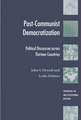
Post-Communist Democratization: Political Discourses across Thirteen Countries: Theories of Institutional Design
Autor John S. Dryzek, Leslie Templeman Holmesen Limba Engleză Hardback – 12 iun 2002
Din seria Theories of Institutional Design
-
 Preț: 293.16 lei
 -
 Preț: 332.35 lei
 -
 Preț: 153.77 lei
 -
 Preț: 297.25 lei
 -
 Preț: 292.05 lei
 -
 Preț: 293.36 lei
 - 14%
 Preț: 904.75 lei
 -
 Preț: 274.41 lei
 -
 Preț: 297.99 lei
 -
 Preț: 294.31 lei
 -
 Preț: 291.15 lei
 -
 Preț: 313.93 lei
 -
 Preț: 275.99 lei
 -
 Preț: 313.56 lei
 -
 Preț: 294.46 lei
 -
 Preț: 295.99 lei
 -
 Preț: 207.61 lei
 - 14%
 Preț: 684.30 lei
 - 14%
 Preț: 795.90 lei
 -
 Preț: 290.22 lei
Preț: 831.91 lei
Preț vechi: 967.34 lei
-14%
Puncte Express: 1248
Carte tipărită la comandă
Livrare economică 08-22 iulie
Livrare prin curier în România Termenul estimat este afișat lângă disponibilitate.
Transport gratuit pentru acest produs Plată online sau ramburs, în funcție de opțiunile comenzii.
Retur gratuit în 14 zile Comandă securizată și suport în română.
Specificații
ISBN-13: 9780521806640
ISBN-10: 052180664X
Pagini: 314
Ilustrații: 28 tables
Dimensiuni: 152 x 229 x 22 mm
Greutate: 0.59 kg
Ediția:New.
Editura: Cambridge University Press
Colecția Cambridge University Press
Seria Theories of Institutional Design
Locul publicării:Cambridge, United Kingdom
ISBN-10: 052180664X
Pagini: 314
Ilustrații: 28 tables
Dimensiuni: 152 x 229 x 22 mm
Greutate: 0.59 kg
Ediția:New.
Editura: Cambridge University Press
Colecția Cambridge University Press
Seria Theories of Institutional Design
Locul publicării:Cambridge, United Kingdom
V-ar putea interesa
-
 Democracy and the State in the New Southern EuropeRichard Gunther-13%Preț: 342.16 lei394.65 lei
 -
 -16%Preț: 333.23 lei395.17 lei
 -
 -34%Preț: 634.82 lei962.73 lei
 -
 The Politics of Memory: Transitional Justice in Democratizing SocietiesAlexandra Barahona De Brito-37%Preț: 685.55 lei1088.58 lei
 -
 -31%Preț: 380.12 lei550.78 lei
 -
 Democratization: Theory and ExperienceLaurence Whitehead-22%Preț: 338.64 lei433.00 lei
 -
 The Environmental Politics Reader: Debating the EarthJohn S. Dryzek-9%Preț: 443.21 lei484.46 lei
 -
 Climate-Challenged SocietyJohn S. Dryzek-15%Preț: 247.83 lei290.65 lei
 -
 The Oxford Handbook of Climate Change and SocietyJohn S. Dryzek-10%Preț: 285.87 lei317.97 lei
 -
 Preț: 286.56 lei
 -
 Preț: 286.56 lei
 -
 On the People's TermsPhilip PettitPreț: 183.12 lei
 -
 DemocracyCharles TillyPreț: 161.68 lei
 -
 Preț: 232.18 lei
 -
 Preț: 255.11 lei
 -
 Preț: 230.31 lei
 -
 Preț: 228.42 lei
 -
 The Uncivil WarDavid LebedoffPreț: 189.17 lei
Cuprins
Part I. Introductory: 1. The discourses of democratic transition; 2. Methodology; Part II. Pre-Transition Countries: 3. China; 4. Yugoslavia; Part III. Halting Transitions: 5. Belarus; 6. Russia; 7. Ukraine; Part IV. Transition Torn by War: 8. Armenia; 9. Georgia; 10. Moldova; Part V. Late Developers: 11. Slovakia; 12. Romania; 13. Bulgaria; Part VI. Trailblazers: 14. Poland; 15. Czechia; Part VII. Conclusions: 16. Differences that matter - and those that do not.
Recenzii
' … readers can learn a fair amount about conditions in the individual countries concerned.' Slavonica
' … this volume is nuanced, sympathetic to national differences and fully addresses some of the deterministic impulses of the standard democratization literature.' South East European Review
'Post-Communist Democratization is a valuable addition to the study of the democratization of the former communist countries … the book strongly opposes the hasty and sometimes politically motivated works based on cultural determination and is a welcome addition to the field of democratic theory. it is a highly recommended read for those democratization experts who believe that a more thorough study of the events of the last 10–15 years in the former communist block is yet to be done.' Acta Politica
'Post-Communist Democratization is an excellent piece of work. It was a well-conceived project, the findings of which have been equally well presented. It is a book that will be of interest to area specialists as well as those with a broader interest in theories of democracy. It is a pity that there are not more studies of this calibre available. Democratization
' … this volume is nuanced, sympathetic to national differences and fully addresses some of the deterministic impulses of the standard democratization literature.' South East European Review
'Post-Communist Democratization is a valuable addition to the study of the democratization of the former communist countries … the book strongly opposes the hasty and sometimes politically motivated works based on cultural determination and is a welcome addition to the field of democratic theory. it is a highly recommended read for those democratization experts who believe that a more thorough study of the events of the last 10–15 years in the former communist block is yet to be done.' Acta Politica
'Post-Communist Democratization is an excellent piece of work. It was a well-conceived project, the findings of which have been equally well presented. It is a book that will be of interest to area specialists as well as those with a broader interest in theories of democracy. It is a pity that there are not more studies of this calibre available. Democratization
Descriere
This book examines the way democracy is thought about and lived by people in the post-communist world.