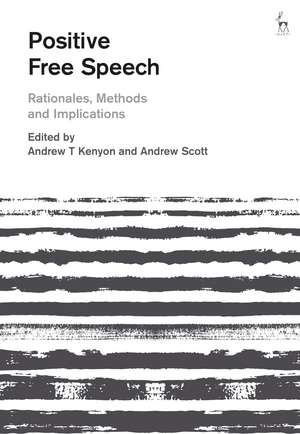
Positive Free Speech: Rationales, Methods and Implications
Editat de Professor Andrew T Kenyon, Dr Andrew Scotten Limba Engleză Hardback – 27 mai 2020
Preț: 380.05 lei
Preț vechi: 791.14 lei
-52% Precomandă
Carte nepublicată încă
Specificații
ISBN-10: 1509908293
Pagini: 216
Dimensiuni: 169 x 244 x 21 mm
Greutate: 0.54 kg
Editura: Bloomsbury Publishing
Colecția Hart Publishing
Locul publicării:London, United Kingdom
V-ar putea interesa
-
 Electronic Media Law and RegulationKenneth C. Creech-18%Preț: 729.90 lei890.13 lei
 -
 Drugs: America's Holy WarArthur Benavie-18%Preț: 1114.46 lei1359.11 lei
 -
 Media Diversity: Economics, Ownership, and the FccMara Einstein-18%Preț: 1119.00 lei1364.63 lei
 -
 Preț: 447.84 lei
 -
 Supplement Edition: Freedom of the PressJohn MiltonPreț: 120.19 lei
 -
 Lawfare: A First Amendment Guide for Reporting in an Age of Islamist LawfareBrooke M. GoldsteinPreț: 82.24 lei
 -
 Media Law and Policy in the Internet AgeDoreen Weisenhaus-25%Preț: 292.35 lei390.65 lei
 -
 Informed Publics, Media and International LawDaniel Joyce-30%Preț: 537.05 lei768.63 lei
 -
 The Illusion of the Free PressDr John Charney-26%Preț: 205.89 lei278.09 lei
 -
 The Media and Business Contracts HandbookAdrian C Laing-25%Preț: 1595.03 lei2127.03 lei
 -
 The Law and Business of the Entertainment IndustryDennis Greene-23%Preț: 1528.10 lei1984.55 lei
 -
 -32%Preț: 629.18 lei928.75 lei
 -
 -18%Preț: 1250.64 lei1525.16 lei
 -
 Code Du Théâtre: Lois, Règlements, Jurisprudence, Usages (Éd.1878)Charles Le SennePreț: 176.80 lei
 -
 -23%Preț: 417.46 lei542.16 lei
 -
 MedienrechtArtur-Axel Wandtke-20%Preț: 1215.62 lei1526.98 lei
 -
 -27%Preț: 753.23 lei1031.82 lei
 -
 Retransmission and U. S. Compliance with TRIPsDavid J. Brennan-27%Preț: 1152.87 lei1579.27 lei
 -
 International Intellectual Property Law and Human SecurityRobin Ramcharan-15%Preț: 672.24 lei790.86 lei
Caracteristici
Notă biografică
Andrew Kenyon is Professor of Law and a Director of the Centre for Media and Communications Law in the Melbourne Law School. Andrew Scott is an Associate Professor in the Department of Law at the London School of Economics and Political Science.
Cuprins
Descriere
Freedom of expression is generally analysed as a bare liberty that should not be constrained by state action. Underpinning rationales for freedom of speech very often imply, however, that the concept also has important positive aspects, and that to be truly 'democratic' the modern polity requires more than negative freedom. In contemporary conditions, this understanding of free speech raises matters such as media diversity or pluralism, the concept of voice and access to the public sphere, access to information, and the need to rethink the audience in relation to public speech. Whether securing positive free speech is a matter of politics or of law, a task for legislatures or for courts, is an open question. On one level, any programme of inculcating positive dimensions of free speech might be understood as inherently polycentric and hence political in character. Yet, a number of Northern European jurisdictions evince enhanced legal recognition for the principle.The aim of this collection of papers is to interrogate the rationales of positive free speech, to consider the political and juridical methods by which it has or may be more fully reflected in the modern state, and to consider the range of practical contexts in which its valorisation has or would have significant implications. The contributors are drawn from an array of European and international jurisdictions. They include academic lawyers, sociologists, and political scientists.