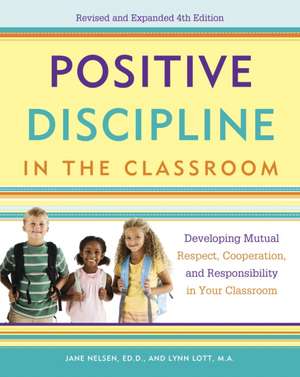
Positive Discipline in the Classroom
Autor Jane Nelsen, Lynn Lott, H Stephen Glennen Limba Engleză Paperback – 16 iul 2013
Găsim în această carte un manual de referință pentru managementul clasei, ajuns acum la a 4-a ediție, recalibrat special pentru a răspunde provocărilor mediului educațional contemporan. Într-o eră în care cadrele didactice trebuie să concureze cu distragerile digitale și să atingă standarde academice tot mai ridicate, autorii propun o trecere fundamentală de la controlul extern la auto-disciplină și cooperare. Structura textului facilitează înțelegerea mecanismelor psihologice din spatele comportamentului elevilor, oferind soluții practice pentru combaterea apatiei și dezvoltarea abilităților de rezolvare a problemelor. Descoperim aici tehnici concrete, precum organizarea reuniunilor de clasă, care transformă dinamica dintre profesor și elev dintr-una de confruntare într-una de parteneriat. Putem afirma că lucrarea extinde cadrul propus de Positive Discipline prin integrarea unor instrumente specifice contextului școlar actual, oferind o alternativă viabilă la sistemul clasic de pedepse și recompense. Această abordare se aliniază cu alte lucrări ale autoarei Jane Nelsen, precum Positive Time-Out, unde accentul cade pe transformarea momentelor de criză în oportunități de învățare emoțională, nu în măsuri punitive. Comparativ cu Discipline with Dignity, 4th Edition, care pune un accent major pe elevii disruptivi și pe impactul mediului social toxic, Positive Discipline in the Classroom se concentrează pe crearea unui climat general de respect reciproc care să prevină conflictele înainte ca acestea să apară. Stilul este direct, lipsit de jargon academic inutil, fiind presărat cu ilustrații și activități care ajută la internalizarea conceptelor. Este o resursă care redefinește rolul profesorului, permițându-i să petreacă mai mult timp predând și mai puțin timp gestionând crize de comportament.
Preț: 86.59 lei
Preț vechi: 106.95 lei
-19%
Carte disponibilă
Livrare economică 29 octombrie-05 noiembrie
Specificații
ISBN-10: 0770436579
Pagini: 272
Ilustrații: black & white illustrations
Dimensiuni: 187 x 236 x 20 mm
Greutate: 0.34 kg
Ediția:4th edition
Editura: Harmony/Rodale/Convergent
V-ar putea interesa
-
 Preț: 132.83 lei
 -
 Preț: 370.80 lei
 -
 -23%Preț: 1382.99 lei1796.10 lei
 -
 Preț: 331.38 lei
 -
 Preț: 262.65 lei
 -
 -29%Preț: 393.89 lei553.36 lei
 -
 Learning Grows: The Science of Motivation for the Classroom TeacherAndrew C. Watson-28%Preț: 431.85 lei597.61 lei
 -
 -29%Preț: 392.42 lei552.37 lei
 -
 -25%Preț: 219.35 lei292.20 lei
 -
 -17%Preț: 344.27 lei416.35 lei
 -
 -26%Preț: 176.55 lei237.25 lei
 -
 Preț: 245.42 lei
 -
 Chores Without WarsLynn LottPreț: 93.32 lei
 -
 PSAT Math Preparation Exercise BookReza NazariPreț: 131.16 lei
 -
 STAAR 8 Math Prep 2019 - 2020Reza NazariPreț: 121.28 lei
 -
 I NoticeClaire E. HallinanPreț: 59.72 lei
 -
 Ace the ACT Math in 30 DaysReza NazariPreț: 120.90 lei
 -
 Marble Notebook A4Young Dreamers PressPreț: 70.21 lei
 -
 Sustainable Enterprise Value CreationRichard SamansPreț: 218.86 lei
 -
 SongwritingJürgen TerhagPreț: 165.19 lei
 -
 Wirkt Lehrerbildung?Jürgen AbelPreț: 370.33 lei
 -
 Critiques for TransformationLorenzo DuBois BaberPreț: 392.27 lei
De ce să citești această carte
Această carte se adresează cadrelor didactice care doresc să elimine tensiunea din sala de clasă fără a apela la măsuri punitive. Cititorul câștigă o metodologie clară pentru a transforma clasa într-o comunitate bazată pe respect, unde elevii devin responsabili și motivați intrinsec. Este o recomandare esențială pentru oricine caută să înlocuiască metodele tradiționale de control cu strategii moderne de colaborare și încurajare.
Despre autor
Jane Nelsen este o psihologă americană de renume, educatoare și mamă a șapte copii, a cărei experiență vastă stă la baza conceptului de Disciplină Pozitivă. Lucrările sale, traduse la nivel global, explorează dezvoltarea psihologică a copilului în diverse etape, de la copilăria timpurie până la adolescență, așa cum vedem în Positive Discipline for Teenagers, Revised 3rd Edition. Împreună cu Lynn Lott și H Stephen Glenn, Nelsen a creat un sistem educațional bazat pe demnitate și respect, oferind soluții practice pentru provocările complexe ale parentingului și educației moderne.
Descriere scurtă
Over the years millions of parents and teachers have used the amazingly effective strategies of Positive Discipline to restore order and civility to their classrooms and homes. And in today's classroom, where teachers must compete with digital distractions for their students' attention while trying to satisfy increasingly demanding academic standards, it is more important than ever that educators be able to combat apathy, instill vital problem-solving skills, and create a climate that maximizes learning.
Now you too can use the time tested Positive Discipline strategies as a foundation for fostering cooperation, problem-solving skills, and mutual respect in children. This new edition of Positive Discipline in the Classroom is updated with essential tools for the modern teacher. Imagine, instead of controlling behavior, you can be teaching; instead of confronting apathy, you will enjoy motivated, eager students! Inside, you'll learn how to:
·Create a classroom climate that enhances academic learning
·Use encouragement rather than praise and rewards
·Instill valuable social skills and positive behavior through the use of class meetings
-Learn why involving students in solving problems is much more effective than punishment
·Understand the motivation behind students' behavior instead of looking for causes
·And much more!
“A must for every educator. The jargon-free concepts and strategies are easy to follow and have changed my life as a principal, as well as the lives of my teachers and students.” ߝ Bill Scott, Principal of Birney Elementary, Marietta, Georgia
“This book should be standard operating procedure. I highly recommend it to anyone who seeks to teach young people!” ߝ Robert W. Reasoner, president of the International Council for Self-Esteem
“Transforms the way teachers view themselves and their students. The activities in this book show how learning shifts from head to heart, where positive change can really take route.” ߝ Dina Emser, M.A., former elementary school principal and education consultant
Notă biografică
Extras
Positive Discipline: An Encouragement Model
A child needs encouragement like a plant needs water. It is essential to healthy growth and development.
rudolf dreikurs
Many people think of academic study as the purpose of school and that discipline programs should support academic excellence. Therefore, adults administer common disciplinary approaches based on rewards and punishment in an effort to control students. However, research demonstrates that unless children are taught social and emotional skills, they have a tough time learning, and discipline problems increase.
Positive Discipline is a different approach. Picture a train trying to reach its destination on one track. It can’t be done. The train needs two tracks, and so do our schools. The first track is academics, and the second track is social and emotional development. Positive Discipline consists of methods that involve students in focusing on solutions instead of being the recipients of punishments and rewards. Schools that have used this integrated system (both tracks side by side) report that behavior challenges decrease and academic excellence increases. The following photo, used with permission from the Visalia, California, School District, illustrates what they refer to as “A Climate for Learning.”
Years ago one of the authors was struggling to learn how to use a computer—she wondered if it was worth all the effort. Then she heard someone say, “It’s too late to decide whether there should be an electronic train. The choice now is when to jump on the train.” His words have echoed in her mind as one new electronic development has followed another. Her world is filled with electronics that make her life easier and more interesting. She’s glad she jumped on the train. Now that you’ve been introduced to the two tracks of Positive Discipline, we hope you’ll want to jump on that train.
Before you shake your head and say, “No way! I can’t handle one more thing in my already busy classroom,” we hope you’ll consider this: Positive Discipline will make your life easier. Really! If you’re a kind and firm teacher who focuses on academics along with teaching social and emotional skills, you’re already on board. If you’re wondering if a Positive Discipline classroom is the direction you’d like to go, here are some questions for you to consider.
1.Do you want your students to be good decision makers?
2.Do you want your students to learn resilience?
3.Do you want your students to learn responsibility (response-ability)?
4.Do you want your students to learn cooperation?
5.Do you want your students to learn listening skills?
6.Do you want your students to learn to use self-control?
7.Do you want your students to learn to be comfortable with accountability?
8.Do you want to provide a forum where others can say how they were affected by hurtful behavior?
9.Do you want to help students learn how to make amends for the mistakes that hurt others?
10.Do you want a classroom where students are learning the qualities and strengths for good character?
11.Do you want a classroom where academic excellence can happen because students are encouraged to love learning?
Positive Disciplineߝtrained teachers create classrooms where young people are treated with respect, have the courage and excitement to love learning, and have the opportunity to learn the skills they need for a successful life. The Positive Discipline vision is about schools where children never experience humiliation when they fail but in- stead feel empowered by the opportunity to learn from their mistakes in a safe environment. Many of the social and emotional skills students learn are represented in the Significant Seven Perceptions and Skills.
Three Empowering Beliefs That Help Children Succeed in School and in Life
1.I am capable.
2.I contribute in meaningful ways, and I am genuinely needed.
3.I use my personal power to make choices that positively influence what happens to me and my community.
Four Empowering Skills That Help Children Succeed in School and in Life
1.I have discipline and self-control.
2.I can work respectfully with others.
3.I understand how my behavior affects others.
4.I can develop wisdom and judgment skills through daily practice.
Here is a description of how Positive Discipline methods teach the Significant Seven.
I Am Capable
To develop a belief in their own personal capability, young people need a safe climate in which they can explore the consequences of their choices and behavior without judgments about success or failure— without blame, shame, or pain. Positive Discipline methods provide a safe climate in which students can examine their behavior, discover how it affects others, and engage in effective problem solving to create change.
I Contribute in Meaningful Ways, and I Am Genuinely Needed
To develop the belief in their significance in primary relationships, young people need the experience of having others listen to their feelings, thoughts, and ideas and take them seriously. They need to know “I am important, and I count.” In a Positive Discipline classroom, everyone has the opportunity to voice opinions and make suggestions in an orderly, respectful process. Students learn that they can contribute significantly to the problem-solving process and can successfully follow through on chosen suggestions. They experience the primary goal of all people—a sense of belonging and significance.
I Use My Personal Power to Make Choices That Positively Influence What Happens to Me and My Community
Many teachers fail to understand that students have personal power and will use it in one way or another. If they are not given opportunities to use it in productive ways, they will probably use it in destructive ways. Young people, to develop a healthy use of power in their lives, need the opportunity to contribute in useful ways, in an environment that encourages them but also holds them accountable. They need to learn to understand and accept their power to create a positive environment. A Positive Discipline classroom is a place where students can experience that it is okay to make mistakes and to learn from those mistakes. In Class Meetings, they learn to take responsibility for their mistakes (accountability), because instead of being punished, they receive assistance in exploring ways to learn from their mistakes. They also learn that even when they can’t control what happens, they can control their response to what happens.
I Have Self-Discipline and Self-Control
A Positive Discipline classroom is an excellent place where students can name and claim their feelings and develop empathy and compassion. Young people seem to be more willing to listen when they are listened to. They gain understanding of their emotions and behaviors by hearing feedback from their classmates. In a nonthreatening climate, young people are willing to be accountable for their actions. They learn what a feeling is and how to separate their feelings from their actions. They learn that what they feel (anger, for instance) is separate from what they do (hit someone), and that although feelings are always acceptable, some actions are not. Through the problem-solving process, they learn proactive rather than reactive ways to express or deal with their thoughts or feelings. They develop self-discipline and self-control by thinking through the consequences of their choices and by accepting suggestions for solutions from other students. The notion of inviting students to explore the consequences of their choices is quite different from imposing a consequence on them, which is usually a poorly disguised punishment. By exploring the consequences of choices, students learn from their mistakes instead of trying to hide them or defend them.
I Can Work Respectfully with Others
A Positive Discipline classroom provides the best possible opportunity for young people to develop social skills through dialogue and sharing, listening and empathizing, cooperating, negotiating, and resolving conflicts. When a behavior problem arises, teachers, instead of stepping in and resolving it for the students, can put it on the Class Meeting agenda, or use the Four Problem-Solving Steps, or instruct students in the use of the Wheel of Choice. All these methods, discussed in Chapter 7, allow students and teachers to work together on developing win-win solutions.
I Understand How My Behavior Affects Others
A Positive Discipline classroom is a place where students can respond to the limits and consequences of everyday life with responsibility, resilience, and integrity. They learn that it is safe to take responsibility for their mistakes because they will not experience blame, shame, or pain. They learn to give up the victim mentality of blaming others (“The teacher gave me an F”) and accept an accountability mentality (“I received an F because I didn’t do the work”).
I Can Develop Wisdom and Judgment Skills Through Daily Practice
Young people develop judgment skills only when they have opportunities to evaluate problems by being socially conscious and aware of what is happening around them. When a problem develops in a Positive Discipline classroom, students explore what happened, what caused it to happen, how their behavior affects others, and what they can do to prevent or solve such problems in the future. In this way, they learn to respond to the needs of the situation.