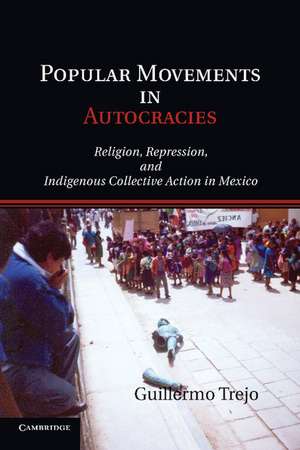
Popular Movements in Autocracies
Autor Guillermo Trejoen Limba Engleză Paperback – 19 feb 2014
Preț: 306.54 lei
Puncte Express: 460
Carte tipărită la comandă
Livrare economică 23 noiembrie-07 decembrie
Livrare prin curier în România Termenul estimat este afișat lângă disponibilitate.
Transport gratuit de la 400.00 lei Plată online sau ramburs, în funcție de opțiunile comenzii.
Retur gratuit în 14 zile Comandă securizată și suport în română.
Specificații
ISBN-13: 9781107680562
ISBN-10: 1107680565
Pagini: 334
Ilustrații: 28 b/w illus. 4 maps 12 tables
Dimensiuni: 156 x 234 x 20 mm
Greutate: 0.57 kg
Editura: Cambridge University Press
Locul publicării:New York, United States
ISBN-10: 1107680565
Pagini: 334
Ilustrații: 28 b/w illus. 4 maps 12 tables
Dimensiuni: 156 x 234 x 20 mm
Greutate: 0.57 kg
Editura: Cambridge University Press
Locul publicării:New York, United States
V-ar putea interesa
-
 -13%Preț: 292.80 lei335.18 lei
 -
 -28%Preț: 371.06 lei513.34 lei
 -
 Contesting Psychiatry: Social Movements in Mental HealthNick CrossleyPreț: 470.37 lei
 -
 Preț: 206.15 lei
 -
 Articulating Dissent: Protest and the Public SpherePollyanna RuizPreț: 263.04 lei
 -
 Against Austerity: How we Can Fix the Crisis they MadeRichard SeymourPreț: 203.86 lei
 -
 ProtestJames M JasperPreț: 186.68 lei
 -
 Social Movements in Times of AusterityDonatella Della PortaPreț: 218.57 lei
 -
 On Guerrilla GardeningRichard ReynoldsPreț: 75.07 lei
 -
 -19%Preț: 109.20 lei135.21 lei
 -
 Lineages of RevoltAdam HaniehPreț: 132.09 lei
 -
 Everyday Revolutions: Horizontalism and Autonomy in ArgentinaMarina A. Sitrin-21%Preț: 152.26 lei192.90 lei
 -
 Protest CampsAnna Feigenbaum-11%Preț: 158.95 lei178.07 lei
 -
 -23%Preț: 129.77 lei168.71 lei
 -
 -64%Preț: 77.34 lei215.78 lei
Cuprins
Part I. Theory: 1. A theory of popular collective action in autocracies; Part II. Protest: 2. Accounting for Mexico's cycle of indigenous protest: quantitative evidence; 3. Competing for souls: why the Catholic Church became a major promoter of indigenous mobilization; 4. Competing for votes: how elections and repression shaped Mexico's cycle of indigenous protest; Part III. Rebellion: 5. A call to arms: regime reversion threats and the escalation of protest into rebellion; 6. From social movement to armed rebellion: religion, repression, and the microdynamics of rebel recruitment; Part IV. The Politicization of Ethnicity: 7. Politicizing ethnicity: the breakdown of religious and political monopolies and the rise of indigenous identities; 8. The twilight of ethnicity: democratization as an elite strategy to avert Mexico's indigenous insurgency.
Recenzii
'This study offers a new perspective on the rise (and what Trejo sees a the post-democratisation 'twilight') of indigenous mobilisation in Mexico … this is a book that invites us to rethink historical processes in general terms that are also causal terms.' John Gledhill, Journal of Latin American Studies
Descriere
A new explanation of the rise, development and demise of social movements and cycles of protest in autocracies.