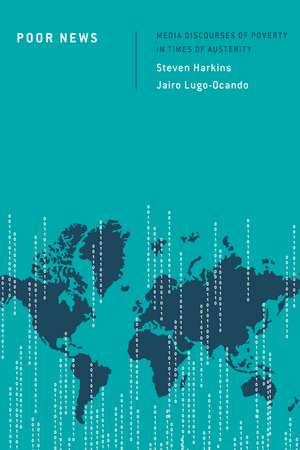
Poor News: Media Discourses of Poverty in Times of Austerity: Discourse, Power and Society
Autor Dr. Steven Harkins, Jairo Lugo-Ocandoen Limba Engleză Paperback – 23 noi 2018

Preț: 313.80 lei
Preț vechi: 406.97 lei
-23%
Puncte Express: 471
Carte tipărită la comandă
Livrare economică 27 noiembrie-11 decembrie
Livrare prin curier în România Termenul estimat este afișat lângă disponibilitate.
Transport gratuit de la 400.00 lei Plată online sau ramburs, în funcție de opțiunile comenzii.
Retur gratuit în 14 zile Comandă securizată și suport în română.
Specificații
ISBN-13: 9781783489275
ISBN-10: 1783489278
Pagini: 238
Dimensiuni: 163 x 232 x 19 mm
Greutate: 0.32 kg
Editura: Bloomsbury Publishing
Colecția Rowman & Littlefield
Seria Discourse, Power and Society
Locul publicării:New York, United States
ISBN-10: 1783489278
Pagini: 238
Dimensiuni: 163 x 232 x 19 mm
Greutate: 0.32 kg
Editura: Bloomsbury Publishing
Colecția Rowman & Littlefield
Seria Discourse, Power and Society
Locul publicării:New York, United States
V-ar putea interesa
-
 Media Studies 2.0William MerrinPreț: 406.08 lei
 -
 -15%Preț: 492.04 lei578.88 lei
 -
 Preț: 418.54 lei
 -
 Software Theory: A Cultural and Philosophical StudyFederica Frabetti-27%Preț: 276.27 lei378.01 lei
 -
 -23%Preț: 278.25 lei362.10 lei
 -
 Cultural Policy and East Asian Rivalry: The Hong Kong Gaming IndustryAnthony Y. H. Fung-33%Preț: 613.32 lei910.47 lei
 -
 Cultural Policy and East Asian Rivalry: The Hong Kong Gaming IndustryAnthony Y. H. Fung-18%Preț: 254.62 lei311.58 lei
 -
 Sites of ProtestStuart Price-24%Preț: 365.19 lei482.74 lei
 -
 -23%Preț: 312.45 lei406.27 lei
 -
 -33%Preț: 764.43 lei1146.95 lei
 -
 -30%Preț: 828.10 lei1184.11 lei
 -
 Preț: 224.18 lei
 -
 Preț: 448.95 lei
Cuprins
Introduction/ 1.The poverty revolution: From individualism to collectivism and back again/ 2. A poor 'fourth estate': The poverty of politics and the politics of poverty in the newsroom / 3. Blaming the Victims: Moral Panics, Welfare Reform and Scapegoating/ 4. Poor Sources: Giving a voice to the voiceless? How people living in poverty are excluded from the news/ 5. From Rags to Riches: Poverty and Ideology in the news/ 6. News after next: Resistance and adaptation in the digital age/ Conclusion/ Bibliography/ Index
Recenzii
Harkins (Fife College, UK) and Lugo-Ocando (Univ. of Leeds, UK) suggest that British journalists report about poverty as it is depicted by Britain's political and economic elites. The authors note that British news organizations occasionally challenge government and institutional claims about the status of the UK's impoverished populations. However, the authors suggest, overall news coverage reflects elite views about who deserves welfare and whether public policies to counter poverty are pragmatic. In a commendable use of mixed methods in mass communication research, some of the authors' conclusions are based on a content analysis of 2,214 articles published in four British national newspapers between 1985 and 2015, and some of the analysis is qualitative. The text provides helpful footnotes and a comprehensive bibliography. The book is an excellent companion to a recently published book by Michael Clay Carey, The News Untold: Community Journalism and Poverty in Appalachia (Univ. of West Virginia, 2017). Recommended for collections in sociology, social and economic disparities, journalism, and mass communication research.
Summing Up: Recommended. Upper-division undergraduates through faculty.
The granular content analysis offered by the book gives great insight into the normalisation of social inequality across the British media landscape [.] and will be of interest to those looking to formulate a more ethical and inclusive journalism. [.] Whilst avoiding detailed discussion of the modern media landscape, Poor News still provides a strong deconstruction of how debates on poverty in Britain have been shaped by the mainstream press. Its content analysis of a range of papers, including the Daily Telegraph, the Sun and the Guardian, is robust, offering a convincing exposé of how print outlets normalise social inequality, regardless of their political standpoints. What's more, its granular approach to various sub-debates and issues will give great insight to researchers interested in ethical journalism, public opinion on poverty and the British media landscape.
This book is timely and makes a valuable contribution to a lacuna in the field i.e. how journalists have over time engaged with value-laden and emotive issues of poverty. The authors have done particularly well in teasing out the ideational dimensions of the reporting, the nuances in coverage and contentious policies such as the "bedroom tax" and fuel poverty.
Poor News: Media Discourses of Poverty in Times of Austerity is a timely, highly engaging and thought-provoking contribution to the debates about news coverage of poverty and welfare in the age of neoliberalism. Situating the discourses of poverty in a historical context and exploring specific empirical examples, the book provides a fascinating analysis of the relationship between media, ideology and public perceptions about poverty and welfare.
This incisive analysis of the media's discursive complicity in fostering the neoliberal imagination is an important intervention. It exposes journalism's alignment with powerful interests and holds it accountable to the duties of social justice, truthtelling and the pursuit of human dignity. Its message resounds beyond the immediate context of analysis to a wider world marked by inequality and poverty.
Summing Up: Recommended. Upper-division undergraduates through faculty.
The granular content analysis offered by the book gives great insight into the normalisation of social inequality across the British media landscape [.] and will be of interest to those looking to formulate a more ethical and inclusive journalism. [.] Whilst avoiding detailed discussion of the modern media landscape, Poor News still provides a strong deconstruction of how debates on poverty in Britain have been shaped by the mainstream press. Its content analysis of a range of papers, including the Daily Telegraph, the Sun and the Guardian, is robust, offering a convincing exposé of how print outlets normalise social inequality, regardless of their political standpoints. What's more, its granular approach to various sub-debates and issues will give great insight to researchers interested in ethical journalism, public opinion on poverty and the British media landscape.
This book is timely and makes a valuable contribution to a lacuna in the field i.e. how journalists have over time engaged with value-laden and emotive issues of poverty. The authors have done particularly well in teasing out the ideational dimensions of the reporting, the nuances in coverage and contentious policies such as the "bedroom tax" and fuel poverty.
Poor News: Media Discourses of Poverty in Times of Austerity is a timely, highly engaging and thought-provoking contribution to the debates about news coverage of poverty and welfare in the age of neoliberalism. Situating the discourses of poverty in a historical context and exploring specific empirical examples, the book provides a fascinating analysis of the relationship between media, ideology and public perceptions about poverty and welfare.
This incisive analysis of the media's discursive complicity in fostering the neoliberal imagination is an important intervention. It exposes journalism's alignment with powerful interests and holds it accountable to the duties of social justice, truthtelling and the pursuit of human dignity. Its message resounds beyond the immediate context of analysis to a wider world marked by inequality and poverty.