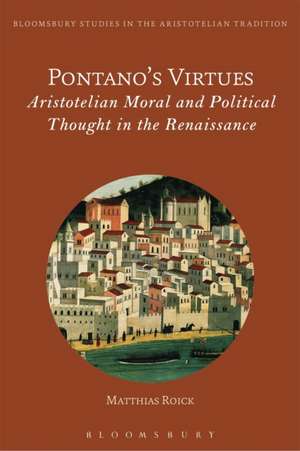
Pontano’s Virtues: Aristotelian Moral and Political Thought in the Renaissance: Bloomsbury Studies in the Aristotelian Tradition
Autor Matthias Roicken Limba Engleză Hardback – 23 feb 2017
Taking his defining inspiration from Aristotle, Pontano wrote on topics such as prudence, fortune, magnificence, and the art of pleasant conversation, rewriting Aristotle's Ethics in the guise of a new Latin philosophy, inscribed with the patterns of Renaissance culture. This book shows how Pontano's rewriting of Aristotelian ethics affected not only his philosophical views, but also his political life and his place in the humanist movement. Drawing on Pontano's treatises, dialogues, letters, poems and political writings, Matthias Roick presents us with the first comprehensive study of Pontano's moral and political thought, offering novel insights into the workings of Aristotelian virtue ethics in the early modern period.
Din seria Bloomsbury Studies in the Aristotelian Tradition
- 25%
 Preț: 255.43 lei
 - 24%
 Preț: 259.12 lei
 - 25%
 Preț: 249.03 lei
 - 27%
 Preț: 240.79 lei
 - 24%
 Preț: 234.41 lei
 - 26%
 Preț: 241.97 lei
 - 26%
 Preț: 215.10 lei
 - 24%
 Preț: 227.04 lei
 - 26%
 Preț: 214.53 lei
 - 36%
 Preț: 551.31 lei
 -
 Preț: 208.89 lei
 - 26%
 Preț: 207.19 lei
 - 25%
 Preț: 208.13 lei
 - 26%
 Preț: 206.62 lei
 - 27%
 Preț: 205.35 lei
 - 25%
 Preț: 209.30 lei
 - 25%
 Preț: 208.46 lei
Preț: 838.48 lei
Preț vechi: 1244.43 lei
-33%
Puncte Express: 1258
Carte tipărită la comandă
Livrare economică 18 noiembrie-02 decembrie
Livrare prin curier în România Termenul estimat este afișat lângă disponibilitate.
Transport gratuit pentru acest produs Plată online sau ramburs, în funcție de opțiunile comenzii.
Retur gratuit în 14 zile Comandă securizată și suport în română.
Specificații
ISBN-13: 9781474281850
ISBN-10: 1474281850
Pagini: 336
Dimensiuni: 164 x 236 x 24 mm
Greutate: 0.66 kg
Editura: Bloomsbury Publishing
Colecția Bloomsbury Academic
Seria Bloomsbury Studies in the Aristotelian Tradition
Locul publicării:London, United Kingdom
ISBN-10: 1474281850
Pagini: 336
Dimensiuni: 164 x 236 x 24 mm
Greutate: 0.66 kg
Editura: Bloomsbury Publishing
Colecția Bloomsbury Academic
Seria Bloomsbury Studies in the Aristotelian Tradition
Locul publicării:London, United Kingdom
V-ar putea interesa
-
 Selected Philosophical WritingsThomas Aquinas-18%Preț: 70.75 lei86.41 lei
 -
 Spheres of Reason: New Essays in the Philosophy of NormativitySimon Robertson-31%Preț: 741.04 lei1076.53 lei
 -
 Reasons from Within: Desires and ValuesAlan H. Goldman-28%Preț: 454.52 lei632.83 lei
 -
 Self-KnowledgeAnthony Hatzimoysis-31%Preț: 742.95 lei1077.68 lei
 -
 Weakness of Will in Renaissance and Reformation ThoughtRisto Saarinen-31%Preț: 646.74 lei937.89 lei
 -
 Aquinas on FriendshipDaniel Schwartz-17%Preț: 170.42 lei205.67 lei
 -
 Thomas Aquinas: A PortraitDenys TurnerPreț: 131.96 lei
 -
 On ExileFrancesco FilelfoPreț: 249.69 lei
 -
 Ockham ExplainedRondo KeelePreț: 135.22 lei
 -
 Mind in Nature: From Science to PhilosophyOlga Markič-27%Preț: 1332.44 lei1814.20 lei
 -
 Preț: 57.98 lei
 -
 The Great Humanists: An IntroductionJonathan Arnold-21%Preț: 187.80 lei238.31 lei
 -
 How To Read MachiavelliMaurizio ViroliPreț: 76.56 lei
 -
 -15%Preț: 645.88 lei759.85 lei
Cuprins
Introduction
Part I: The 'Great Pontano'
1. The Storms of Life
2. The Haven of Philosophy
Part II: Rewriting Moral Philosophy
3. Learned Authority
4. Latin Philosophy
Part III: The Secrets of Virtue
5. The Rule of Reason
6. Beyond the Veil
Conclusion
Appendix 1: Chronology of Pontano's Works
Appendix 2: Chronology pf Pontano's Life and Political Events
Appendix 3: Moral Virtues in Aristotle and Pontano
Notes
Bibliography
Index
Part I: The 'Great Pontano'
1. The Storms of Life
2. The Haven of Philosophy
Part II: Rewriting Moral Philosophy
3. Learned Authority
4. Latin Philosophy
Part III: The Secrets of Virtue
5. The Rule of Reason
6. Beyond the Veil
Conclusion
Appendix 1: Chronology of Pontano's Works
Appendix 2: Chronology pf Pontano's Life and Political Events
Appendix 3: Moral Virtues in Aristotle and Pontano
Notes
Bibliography
Index
Recenzii
This is a brilliant study of one of the most versatile minds that the humanist culture of Renaissance Italy has produced. Written in a superb style, Roick presents, for the first time, a comprehensive interpretation of Pontano as a political actor, diplomat, and philosopher, whose work can be seen as a creative rewriting of Aristotelian virtue ethics. To understand the world of Pontano, Roick has crossed different fields of inquiry including philosophy, history, literature, poetry, and astrology, and his book is an excellent guide through this neglected but important territory of intellectual history. It is thereby not only the first book on Pontano as a thinker in his own right. It also makes a convincing case for the inclusion of Renaissance humanism in the study of moral and political philosophy in early-modern Europe.
The subject of this interesting and innovative study by Matthias Roick is the moral and political thought of the prolific Neapolitan diplomat and humanist, Giovanni Pontano (1426-1503). It is based on the range of Pontano's various treatises and tracts, as well as on his better known dialogues and poems; and it approaches his thought not only in terms of individual doctrines and theses, but, more comprehensively, in terms of its re-envisioning of Aristotelian moral and political thought "in a humanist key." Centered as it is on the complex notion of virtue, Pontano's Aristotelianism emerges not just as an academic or "strained" Aristotelianism, but rather as a powerful guide to knowledge and to human action in the turbulent world of fifteenth century Italian politics.
As it follows the theme of virtue throughout Giovanni Pontano's philosophical production, Roick's book is an important contribution to current scholarship on Early Modern Aristotelianism, as well as an exemplary work in intellectual history. In Roick's hands, the "great Pontano", his relationship with Aristotle and Medieval scholasticism, his role in the Aragonese Kindgom of Naples and the history of Quattrocento Italy are not merely erudite topics, but parts of a thoughtful reflection on how historical contexts shape philosophical ideas as well as our own way to look at Renaissance culture.
The subject of this interesting and innovative study by Matthias Roick is the moral and political thought of the prolific Neapolitan diplomat and humanist, Giovanni Pontano (1426-1503). It is based on the range of Pontano's various treatises and tracts, as well as on his better known dialogues and poems; and it approaches his thought not only in terms of individual doctrines and theses, but, more comprehensively, in terms of its re-envisioning of Aristotelian moral and political thought "in a humanist key." Centered as it is on the complex notion of virtue, Pontano's Aristotelianism emerges not just as an academic or "strained" Aristotelianism, but rather as a powerful guide to knowledge and to human action in the turbulent world of fifteenth century Italian politics.
As it follows the theme of virtue throughout Giovanni Pontano's philosophical production, Roick's book is an important contribution to current scholarship on Early Modern Aristotelianism, as well as an exemplary work in intellectual history. In Roick's hands, the "great Pontano", his relationship with Aristotle and Medieval scholasticism, his role in the Aragonese Kindgom of Naples and the history of Quattrocento Italy are not merely erudite topics, but parts of a thoughtful reflection on how historical contexts shape philosophical ideas as well as our own way to look at Renaissance culture.