Cantitate/Preț
Produs

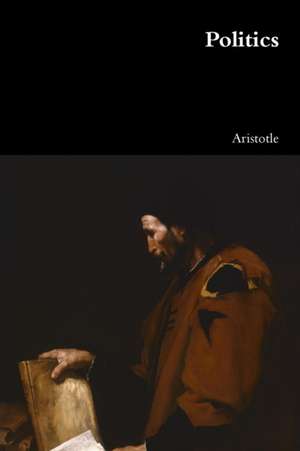
Politics

Autor Aristotle
en Limba Engleză Paperback – 6 apr 2017
Written over two thousand years ago, Aristotle's celebrated work discusses the various benefits and dangers of the major political systems of his time: republic, democracy, aristocracy, oligarchy and tyranny, with a view to deciding which constitutes the ideal polity. Along the way, we are treated to discussions on a wide swathe of topics, from music and the role of women, through warfare, slavery and the education of children, to the responsibilities of a citizen, and what constitutes the 'good life' (for Aristotle: "to achieve happiness and pursue virtue").

Not all of the great Philosopher's conclusions chime with our modern ideas, but his penetrating, thought-provoking analyses will stir your mind, and surprise with their continued relevance.
Citește tot Restrânge

Toate formatele și edițiile

Toate formatele și edițiile Preț Express
Paperback (4) 7232 lei  6-8 săpt.
  West Margin Press – 9 dec 2020 7247 lei  3-5 săpt.
  AZILOTH BOOKS – 28 iun 2018 7232 lei  6-8 săpt.
  Lulu.Com – 6 apr 2017 8873 lei  6-8 săpt.
  Outlook Verlag – 25 sep 2019 33439 lei  39-44 zile
Hardback (4) 10514 lei  3-5 săpt.
  Mint Editions – 24 noi 2020 10514 lei  3-5 săpt.
  Outlook Verlag – 25 sep 2019 41107 lei  3-5 săpt.
  Lulu.Com – 6 apr 2017 18943 lei  6-8 săpt.
  True Sign Publishing House – 20 ian 2023 21384 lei  6-8 săpt.

Preț: 8873 lei

Puncte Express: 133

Preț estimativ în valută:
1571 1832$ 1360£

Carte tipărită la comandă

Livrare economică 26 februarie-12 martie

Preluare comenzi: 021 569.72.76

Specificații

ISBN-13: 9781365877049
ISBN-10: 1365877043
Pagini: 192
Dimensiuni: 152 x 229 x 11 mm
Greutate: 0.29 kg
Editura: Lulu.Com

Descriere

Descriere de la o altă ediție sau format:

Similar to Nicomachean Ethics, Aristotle explores another facet of good living by outlining the best governing practices that benefit the majority, and not the minority. In The Politics, he defines various institutions and how they should operate within an established system.

The Politics provides an analysis of contemporary government as it relates to all people. Aristotle discusses the positive and negative qualities of authority and how they affect civilian life. In eight books, he details the tenets of the political community, including justice, the economy and household management. He recounts the actions of previous administrations, highlighting the differences between a democracy and oligarchy. He also examines the purpose of constitutions and how they can better serve the state.

By studying the past, politicians can navigate and overcome challenges that toppled previous regimes. The Politics contains a strategic framework that can be used in a modern-day context. It offers a comprehensive look at the people and processes expected to maintain law, order and prosperity.

With an eye-catching new cover, and professionally typeset manuscript, this edition of The Politics is both modern and readable. 


Notă biografică

Aristotle (Greek: ¿¿¿¿¿¿¿¿¿¿¿ Aristotél¿s, pronounced [aristotél¿¿s]; 384-322 BC)[A] was a Greek philosopher and polymath during the Classical period in Ancient Greece. Taught by Plato, he was the founder of the Lyceum, the Peripatetic school of philosophy, and the Aristotelian tradition. His writings cover many subjects. including physics, biology, zoology, metaphysics, logic, ethics, estheticspoetry, theatre, music, rhetoric, psychology, linguistics, economics, politics, and government. Aristotle provided a complex synthesis of the various philosophies existing prior to him. It was above all from his teachings that the West inherited its intellectual lexicon, as well as problems and methods of inquiry. As a result, his philosophy has exerted a unique influence on almost every form of knowledge in the West and it continues to be a subject of contemporary philosophical discussion. Little is known about his life. Aristotle was born in the city of Stagira in Northern Greece. His father, Nicomachus, died when Aristotle was a child, and he was brought up by a guardian. At seventeen or eighteen years of age he joined Plato's Academy in Athens and remained there until the age of thirty-seven (c. 347 BC).[4] Shortly after Plato died, Aristotle left Athens and, at the request of Philip II of Macedon, tutored Alexander the Great beginning in 343 BC.[5] He established a library in the Lyceum which helped him to produce many of his hundreds of books on papyrus scrolls. Though Aristotle wrote many elegant treatises and dialogues for publication, only around a third of his original output has survived, none of it intended for publication.[6] Aristotle's views on physical science profoundly shaped medieval scholarship. Their influence extended from Late Antiquity and the Early Middle Ages into the Renaissance, and were not replaced systematically until the Enlightenment and theories such as classical mechanics. Some of Aristotle's zoological observations found in his biology, such as on the hectocotyl (reproductive) arm of the octopus, were disbelieved until the 19th century. His works contain the earliest known formal study of logic, studied by medieval scholars such as Peter Abelard and John Buridan. Aristotle's influence on logic also continued well into the 19th century. He influenced Islamic thought during the Middle Ages, as well as Christian theology, especially the Neoplatonism of the Early Church and the scholastic tradition of the Catholic Church. Aristotle was revered among medieval Muslim scholars as "The First Teacher" and among medieval Christians like Thomas Aquinas as simply "The Philosopher". His ethics, though always influential, gained renewed interest with the modern advent of virtue ethics, such as in the thinking of Alasdair MacIntyre and Philippa Foot.