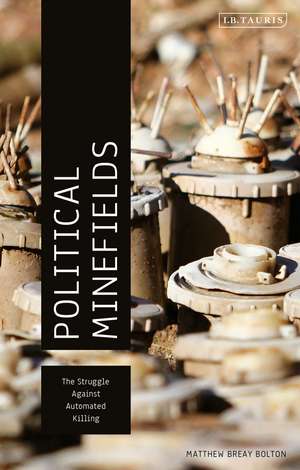
Political Minefields: The Struggle against Automated Killing
Autor Matthew Breay Boltonen Limba Engleză Hardback – 20 aug 2020
Preț: 536.47 lei
Preț vechi: 726.89 lei
-26%
Puncte Express: 805
Carte tipărită la comandă
Livrare economică 18 noiembrie-02 decembrie
Livrare prin curier în România Termenul estimat este afișat lângă disponibilitate.
Transport gratuit pentru acest produs Plată online sau ramburs, în funcție de opțiunile comenzii.
Retur gratuit în 14 zile Comandă securizată și suport în română.
Specificații
ISBN-13: 9781780761589
ISBN-10: 1780761589
Pagini: 248
Dimensiuni: 138 x 216 mm
Greutate: 0.44 kg
Editura: Bloomsbury Publishing
Colecția I.B.Tauris
Locul publicării:London, United Kingdom
ISBN-10: 1780761589
Pagini: 248
Dimensiuni: 138 x 216 mm
Greutate: 0.44 kg
Editura: Bloomsbury Publishing
Colecția I.B.Tauris
Locul publicării:London, United Kingdom
Cuprins
Foreword, Jody Williams, Chair, Nobel Women's Initiative, 1997 Nobel Peace Prize co-Laureate
1. Explosive Traps: An Introduction
2. Bombies: Automated Air War, Laos
3. Perfect Soldiers: Proxy War, Cambodia
4. Fragmentation: New War, Bosnia
5. Detritus: War on Terror, Afghanistan
6. Red Roads: Everywhere War, Sudan and South Sudan
7. Killer Robots: Digital War, USA
Survivorhood: Epilogue, United Nations
Acknowledgements
Acronyms
Notes
Index
1. Explosive Traps: An Introduction
2. Bombies: Automated Air War, Laos
3. Perfect Soldiers: Proxy War, Cambodia
4. Fragmentation: New War, Bosnia
5. Detritus: War on Terror, Afghanistan
6. Red Roads: Everywhere War, Sudan and South Sudan
7. Killer Robots: Digital War, USA
Survivorhood: Epilogue, United Nations
Acknowledgements
Acronyms
Notes
Index
Recenzii
Matthew Bolton documents his experience working in humanitarian fieldwork, diplomatic settings, and academia. He approaches efforts to eradicate landmines and tackle other problematic weapons through the inclusive lens of human security as opposed to more narrowly focused national security concerns. Bolton examines the "depersonalization of killing" that has accompanied the use of unmanned aerial vehicles or drones and flags the need to tackle the multiple challenges posed by fully autonomous armed robots. Throughout Bolton emphasizes the role of civil society to show how when ordinary people work together they can achieve extraordinary impact.
Matthew Bolton takes us on a very readable journey to what in Bosnia we used to call the Dark Side. He starts as an idealistic young aid worker and becomes almost by accident an expert on landmines and the politics of landmine clearance, which is minefield in itself. His account of unsettling experiences in Bosnia, Iraq, Afghanistan and South Sudan is a vivid snapshot of the dangerous times in which we live.
Bolton's beautifully written book portends a dehumanized future in which smart weapons stray beyond our control and lack of regulation will be our undoing. Chilling.
An interesting philosophical and personal reflection on mines and demining that shows how even the best-intentioned interventions can fall victim to local political and economic forces.
Matthew Bolton's book is well written, and very readable. Most importantly it doesn't rehash material that has been well-addressed in other books. There's an interesting balance between personal observations and substantial research, between the processes of landmine clearance and international advocacy. Local mine action people are given a voice. The book doesn't fight shy of highlighting when policy responses didn't match expectations. The segue into killer robots offers a view into the future challenges for civil society.
Matthew Bolton takes us on a very readable journey to what in Bosnia we used to call the Dark Side. He starts as an idealistic young aid worker and becomes almost by accident an expert on landmines and the politics of landmine clearance, which is minefield in itself. His account of unsettling experiences in Bosnia, Iraq, Afghanistan and South Sudan is a vivid snapshot of the dangerous times in which we live.
Bolton's beautifully written book portends a dehumanized future in which smart weapons stray beyond our control and lack of regulation will be our undoing. Chilling.
An interesting philosophical and personal reflection on mines and demining that shows how even the best-intentioned interventions can fall victim to local political and economic forces.
Matthew Bolton's book is well written, and very readable. Most importantly it doesn't rehash material that has been well-addressed in other books. There's an interesting balance between personal observations and substantial research, between the processes of landmine clearance and international advocacy. Local mine action people are given a voice. The book doesn't fight shy of highlighting when policy responses didn't match expectations. The segue into killer robots offers a view into the future challenges for civil society.