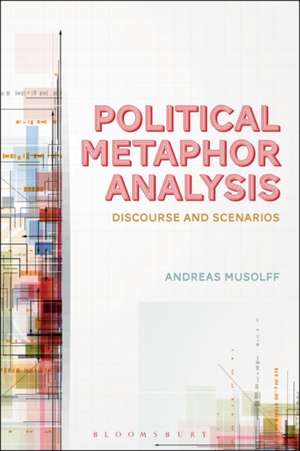
Political Metaphor Analysis: Discourse and Scenarios
Autor Professor Andreas Musolffen Limba Engleză Paperback – 25 aug 2016
Political Metaphor Analysis provides an innovative approach to the study of figurative language use in political discourse by presenting empirical analyses based on a large corpus of political metaphors and metonymies, linking these analyses to theoretical positions and assessing their limitations and perspectives for further exploration. The 'classic' model of conceptual metaphor analysis, pioneered by Lakoff and Johnson (1980) and expanded and amended over the past thirty-five years, is critically examined with regard to new findings about the variation, historicity, pragmatic exploitation, comprehension and interpretation of metaphors.
As a central new analytical category, the notion of "metaphor scenario" is proposed and tested against various sub-sets of data. It allows to link hypothesised conceptual metaphors to narrative, argumentative and evaluative patterns in actual discourse and understanding processes, so that their cognitive significance can be more reliably gauged and theoretically modelled.
Preț: 237.68 lei
Preț vechi: 286.75 lei
-17%
Puncte Express: 357
Carte tipărită la comandă
Livrare economică 09-23 iunie
Specificații
ISBN-13: 9781441160669
ISBN-10: 1441160663
Pagini: 208
Dimensiuni: 156 x 234 x 19 mm
Greutate: 0.3 kg
Editura: Bloomsbury Publishing
Colecția Bloomsbury Academic
Locul publicării:London, United Kingdom
ISBN-10: 1441160663
Pagini: 208
Dimensiuni: 156 x 234 x 19 mm
Greutate: 0.3 kg
Editura: Bloomsbury Publishing
Colecția Bloomsbury Academic
Locul publicării:London, United Kingdom
V-ar putea interesa
-
 A Lover's DiscourseRoland Barthes-20%Preț: 54.92 lei68.66 lei
 -
 Secondary Predication and Adverbial Modification: The Typology of DepictivesNikolaus P. Himmelmann-11%Preț: 447.10 lei502.35 lei
 -
 The Origins of Meaning: Language in the Light of EvolutionJames R. Hurford-13%Preț: 423.60 lei486.87 lei
 -
 Reflections on MeaningPaul Horwich-15%Preț: 302.38 lei355.19 lei
 -
 Semantics versus PragmaticsZoltan Gendler Szabo-14%Preț: 369.74 lei429.51 lei
 -
 -24%Preț: 384.26 lei508.65 lei
 -
 Two-Dimensional SemanticsManuel Garcia-Carpintero-14%Preț: 344.97 lei401.21 lei
 -
 The Sense of Structure: Writing from the Reader's PerspectiveGeorge D. Gopen-23%Preț: 671.72 lei872.36 lei
 -
 Knowledge of Language: Its Nature, Origins, and UseNoam Chomsky-24%Preț: 248.03 lei327.03 lei
 -
 Write Away: One Novelist's Approach To Fiction and the Writing LifeElizabeth George-28%Preț: 63.61 lei88.52 lei
 -
 The Language of PoliticsAdrian BeardPreț: 214.67 lei
 -
 Advances in Discourse StudiesVijay BhatiaPreț: 460.54 lei
 -
 The Semitic LanguagesJohn Huehnergard-15%Preț: 612.21 lei720.25 lei
 -
 Morphology and Lexical SemanticsRochelle LieberPreț: 289.67 lei
 -
 Discourse: A Critical IntroductionJan BlommaertPreț: 443.98 lei
 -
 Metaphor in DiscourseElena SeminoPreț: 384.67 lei
 -
 Preț: 453.21 lei
Cuprins
Acknowledgements
1.Introduction
2. Political conflict as war
2.1. Metaphors and concepts
2.2. Inferences from metaphors in relation to conceptual domains
2.3. Conceptual domains and metaphor corpora
2.4. Discursive frames in metaphor corpora
2.5. Summary
2. Metaphors, cognitive models and scenarios
3.1. Political metaphor and FAMILY models
3.2. Two metaphor models - one domain?
3.3. Family scenarios
3.4. Further scenario functions
3.5. Summary
4. The life and gimes of a metaphor scenario: Britain at the heart of Europe
4.1. Memories of a metaphor
4.2. The emergence of a metaphor scenario
4.3. Scenario development
4.4. Scenarios and blends
4.5. Summary
5. The belly and the body politic
5.1. Memories of a fable
5.2. The body politic tradition
5.3. Body politic, corps politique, politischer Korper: Traces of national discourse tradition in metaphor usage.
5.4. Historical explanations for the development of metaphor scenario
5.5. Summary
6. Parasites, scrounging, and the question of deliberate metaphor
6.1. Parasites, metaphor and etymology
6.2. Metaphorizations 'back and forth'
6.3. Metaphor and racism
6.4. Immigrants as 'parasites'
6.5. Metaphors as deliberately chosen scenario elements
6.6 Summary
7. Nations as persons: collective identity-construction
7.1. Introduction: speaking for a nation
7.2. From 'extended hands' to a 'new Nakba' in eight speeches
7.3. Nations as persons with social identities
7.4. Two case summaries
7.5. Summary
8. Understanding political metaphor
8.1. The unpredictability of metaphor as understanding
8.2. Interpretations of the NATION AS BODY metaphor
8.3. Interpretations of the NATIONS AS PERSON metaphor
8.4 Summary
Appendix I
Appendix II
Appendix III
Notes
Bibliography
Index
1.Introduction
2. Political conflict as war
2.1. Metaphors and concepts
2.2. Inferences from metaphors in relation to conceptual domains
2.3. Conceptual domains and metaphor corpora
2.4. Discursive frames in metaphor corpora
2.5. Summary
2. Metaphors, cognitive models and scenarios
3.1. Political metaphor and FAMILY models
3.2. Two metaphor models - one domain?
3.3. Family scenarios
3.4. Further scenario functions
3.5. Summary
4. The life and gimes of a metaphor scenario: Britain at the heart of Europe
4.1. Memories of a metaphor
4.2. The emergence of a metaphor scenario
4.3. Scenario development
4.4. Scenarios and blends
4.5. Summary
5. The belly and the body politic
5.1. Memories of a fable
5.2. The body politic tradition
5.3. Body politic, corps politique, politischer Korper: Traces of national discourse tradition in metaphor usage.
5.4. Historical explanations for the development of metaphor scenario
5.5. Summary
6. Parasites, scrounging, and the question of deliberate metaphor
6.1. Parasites, metaphor and etymology
6.2. Metaphorizations 'back and forth'
6.3. Metaphor and racism
6.4. Immigrants as 'parasites'
6.5. Metaphors as deliberately chosen scenario elements
6.6 Summary
7. Nations as persons: collective identity-construction
7.1. Introduction: speaking for a nation
7.2. From 'extended hands' to a 'new Nakba' in eight speeches
7.3. Nations as persons with social identities
7.4. Two case summaries
7.5. Summary
8. Understanding political metaphor
8.1. The unpredictability of metaphor as understanding
8.2. Interpretations of the NATION AS BODY metaphor
8.3. Interpretations of the NATIONS AS PERSON metaphor
8.4 Summary
Appendix I
Appendix II
Appendix III
Notes
Bibliography
Index
Recenzii
An engaging and provocative text ... I would recommend it not only to researchers of political discourse, but also to those who are interested in the persuasive power of metaphor in audience reception.
The author clearly feels strongly about the ideological implications of metaphorizing and writes in an engaging, pleasant style. Undoubtedly, therefore, this book will enthuse a new generation of students with interests straddling metaphor theory, critical discourse analysis, and pragmatics.
The book makes a convincing case for a discourse-historical approach in the study of political metaphors. In terms of structure and presentation, [it] is well-organized and shows a high degree of coherence and linguistic consistency. I am confident that the book will gain great interest and will motivate further studies on metaphors using the scenario-oriented approach.
Andreas Musolff's book takes great strides in Political Metaphor Analysis, exploring a wealth of exciting discourses to rethink old and define new research avenues. A must-read for students, cognitive scientists and critical scholars of all persuasions.
This is an amazingly informative and fascinating book on political metaphor. It teaches us about the significance and enormously complex reality of the use of metaphor in politics - and beyond. In doing so, it poses new challenges to our theories of how we think metaphorically.
Through an intriguing array of examples, Musolff provides a well-structured and interesting set of analyses of metaphoric language as used in the realm of current political discourse. He argues for the need to understand the historical, social, and political setting in which metaphors are used for the hearer/reader to appreciate their often powerful messages. This book builds on past work in metaphor theory, demonstrating an evolution to the next generation of analysis where generalities give way to careful consideration of more local and nuanced contexts. The result is a theoretical framework for the extended examples in the volume, but also a broader approach to contextualized metaphor which will serve well in a wide range of other semantic domains.
An insightful, clear and well-presented textbook - ideal for the classroom.
The author clearly feels strongly about the ideological implications of metaphorizing and writes in an engaging, pleasant style. Undoubtedly, therefore, this book will enthuse a new generation of students with interests straddling metaphor theory, critical discourse analysis, and pragmatics.
The book makes a convincing case for a discourse-historical approach in the study of political metaphors. In terms of structure and presentation, [it] is well-organized and shows a high degree of coherence and linguistic consistency. I am confident that the book will gain great interest and will motivate further studies on metaphors using the scenario-oriented approach.
Andreas Musolff's book takes great strides in Political Metaphor Analysis, exploring a wealth of exciting discourses to rethink old and define new research avenues. A must-read for students, cognitive scientists and critical scholars of all persuasions.
This is an amazingly informative and fascinating book on political metaphor. It teaches us about the significance and enormously complex reality of the use of metaphor in politics - and beyond. In doing so, it poses new challenges to our theories of how we think metaphorically.
Through an intriguing array of examples, Musolff provides a well-structured and interesting set of analyses of metaphoric language as used in the realm of current political discourse. He argues for the need to understand the historical, social, and political setting in which metaphors are used for the hearer/reader to appreciate their often powerful messages. This book builds on past work in metaphor theory, demonstrating an evolution to the next generation of analysis where generalities give way to careful consideration of more local and nuanced contexts. The result is a theoretical framework for the extended examples in the volume, but also a broader approach to contextualized metaphor which will serve well in a wide range of other semantic domains.
An insightful, clear and well-presented textbook - ideal for the classroom.