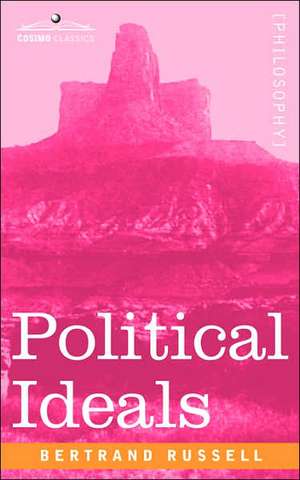
Political Ideals
Autor Bertrand Russellen Limba Engleză Paperback – 31 oct 2006
| Toate formatele și edițiile | Preț | Express |
|---|---|---|
| Paperback (9) | 42.40 lei 3-5 săpt. | |
| CREATESPACE – | 42.40 lei 3-5 săpt. | |
| CreateSpace Independent Publishing Platform – | 43.97 lei 3-5 săpt. | |
| Watchmaker Publishing – 8 iul 2010 | 47.34 lei 6-8 săpt. | |
| COSIMO CLASSICS – 31 oct 2006 | 50.13 lei 6-8 săpt. | |
| ARC MANOR – 4 feb 2008 | 51.15 lei 6-8 săpt. | |
| BOOK JUNGLE – 8 iun 2009 | 85.11 lei 6-8 săpt. | |
| CreateSpace Independent Publishing Platform – | 97.44 lei 6-8 săpt. | |
| Alpha Editions – 31 ian 2018 | 99.43 lei 6-8 săpt. | |
| Book Jungle – 13 mar 2009 | 118.53 lei 6-8 săpt. |
Preț: 50.13 lei
Puncte Express: 75
Preț estimativ în valută:
8.86€ • 10.31$ • 7.71£
8.86€ • 10.31$ • 7.71£
Carte tipărită la comandă
Livrare economică 17 aprilie-01 mai
Specificații
ISBN-13: 9781596054653
ISBN-10: 1596054654
Pagini: 100
Dimensiuni: 127 x 203 x 6 mm
Greutate: 0.12 kg
Editura: COSIMO CLASSICS
ISBN-10: 1596054654
Pagini: 100
Dimensiuni: 127 x 203 x 6 mm
Greutate: 0.12 kg
Editura: COSIMO CLASSICS
V-ar putea interesa
-
 Marx and EthicsPhilip J. Kain-15%Preț: 361.69 lei425.24 lei
 -
 Chinese Foreign Policy: Theory and PracticeThomas W. Robinson-34%Preț: 623.27 lei945.52 lei
 -
 Preț: 115.06 lei
 -
 Mortals and Others, Volume I: American Essays 1931-1935Bertrand RussellPreț: 372.03 lei
 -
 Principles of Social ReconstructionBertrand RussellPreț: 264.04 lei
 -
 History of Western PhilosophyBertrand RussellPreț: 197.95 lei
 -
 In Praise of Idleness: And Other EssaysBertrand RussellPreț: 165.53 lei
 -
 Power: A New Social AnalysisBertrand RussellPreț: 135.71 lei
 -
 A History of Western PhilosophyBertrand RussellPreț: 181.75 lei
 -
 First Measures of the Coming InsurrectionEric Hazan-25%Preț: 87.60 lei116.09 lei
 -
 Red RosaKate EvansPreț: 115.07 lei
 -
 Modernism in the Streets: A Life and Times in EssaysMarshall BermanPreț: 151.24 lei
 -
 Fear of MirrorsTariq AliPreț: 156.80 lei
 -
 Late MarxismFredric JamesonPreț: 110.87 lei
 -
 Marx's RevengeMeghnad DesaiPreț: 142.35 lei
 -
 The Prophet OutcastIsaac DeutscherPreț: 267.81 lei
 -
 -12%Preț: 157.66 lei179.27 lei
Notă biografică
Bertrand Arthur William Russell, 3rd Earl Russell, (18 May 1872 - 2 February 1970) was a British philosopher, logician, mathematician, historian, writer, essayist, social critic, political activist, and Nobel laureate. At various points in his life, Russell considered himself a liberal, a socialist and a pacifist, although he also confessed that his sceptical nature had led him to feel that he had "never been any of these things, in any profound sense. Russell was born in Monmouthshire into one of the most prominent aristocratic families in the United Kingdom
In the early 20th century, Russell led the British "revolt against idealism" He is considered one of the founders of analytic philosophy along with his predecessor Gottlob Frege, colleague G. E. Moore and protégé Ludwig Wittgenstein. He is widely held to be one of the 20th century's premier logicians.[67] With A. N. Whitehead he wrote Principia Mathematica, an attempt to create a logical basis for mathematics, the quintessential work of classical logic. His philosophical essay "On Denoting" has been considered a "paradigm of philosophy".[71] His work has had a considerable influence on mathematics, logic, set theory, linguistics, artificial intelligence, cognitive science, computer science (see type theory and type system) and philosophy, especially the philosophy of language, epistemology and metaphysics.
Russell was a prominent anti-war activist and he championed anti-imperialism. Occasionally, he advocated preventive nuclear war, before the opportunity provided by the atomic monopoly had passed and he decided he would "welcome with enthusiasm" world government.[74] He went to prison for his pacifism during World War I. Later, Russell concluded that war against Adolf Hitler's Nazi Germany was a necessary "lesser of two evils" and criticised Stalinist totalitarianism, attacked the involvement of the United States in the Vietnam War and was an outspoken proponent of nuclear disarmament. In 1950, Russell was awarded the Nobel Prize in Literature "in recognition of his varied and significant writings in which he champions humanitarian ideals and freedom of thought"