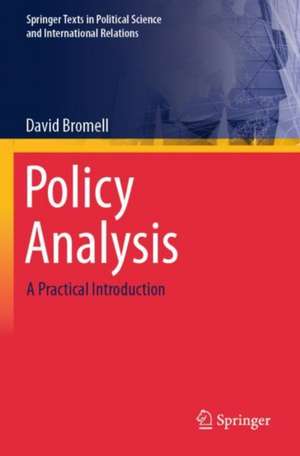
Policy Analysis: Springer Texts in Political Science and International Relations
Autor David Bromellen Limba Engleză Paperback – 10 apr 2025
In four concise chapters, Part I steps through doing policy analysis in practice: from clear commissioning and project planning, to doing analysis through collective thinking, to telling a compelling policy story, to peer review and quality assurance.
The six chapters in Part II are a resource for reflective practice, introducing theory to address questions policy analysts confront in the course of their work. What is the purpose of politics and public policy? How do I know I am making a difference? How do I tackle working with stakeholders with different, competing, or conflicting interests? How might I navigate conflicting claims relating to identity and culture? And how can I balance responsiveness to current demands with responsibility to future generations?
Every chapter closes with suggestions for group exercises and questions for individual reflection.




Preț: 472.50 lei
Puncte Express: 709
Carte tipărită la comandă
Livrare economică 17-23 noiembrie
Livrare prin curier în România Termenul estimat este afișat lângă disponibilitate.
Transport gratuit pentru acest produs Plată online sau ramburs, în funcție de opțiunile comenzii.
Retur gratuit în 14 zile Comandă securizată și suport în română.
Specificații
ISBN-13: 9783031553660
ISBN-10: 3031553667
Pagini: 256
Dimensiuni: 155 x 235 x 15 mm
Greutate: 0.39 kg
Editura: Springer
Colecția Springer Texts in Political Science and International Relations
Seria Springer Texts in Political Science and International Relations
ISBN-10: 3031553667
Pagini: 256
Dimensiuni: 155 x 235 x 15 mm
Greutate: 0.39 kg
Editura: Springer
Colecția Springer Texts in Political Science and International Relations
Seria Springer Texts in Political Science and International Relations
Notă biografică
David Bromell is a Senior Associate of the Institute for Governance and Policy Studies and teaches political philosophy and public policy in the School of Government at Victoria University of Wellington, New Zealand. Since July 2013, he has worked as Principal Advisor, Strategic Policy, at the Canterbury Regional Council (Environment Canterbury). Previously he worked in tertiary education, the community and voluntary sector, and for ten years in policy advice roles in central government, including as acting Chief Policy Advisor at the Ministry of Social Development, 2012-13.
He has been a visiting research fellow at Victoria University of Wellington and the University of Otago, and (in 2016) at the NRW School of Governance at the University of Duisburg-Essen, Germany.
Cuprins
Textul de pe ultima copertă
This text for students of politics and public policy, and for learning on the job by new policy analysts, provides a practical introduction grounded in the author’s experience of working in public policy. In four concise chapters, Part I steps through doing policy analysis in practice: from clear commissioning and project planning, to doing analysis through collective thinking, to telling a compelling policy story, to peer review and quality assurance.
The six chapters in Part II are a resource for reflective practice, introducing theory to address questions policy analysts confront in the course of their work. What is the purpose of politics and public policy? How do I know I am making a difference? How do I tackle working with stakeholders with different, competing, or conflicting interests? How might I navigate conflicting claims relating to identity and culture? And how can I balance responsiveness to current demands with responsibility to future generations?
Every chapter closes with suggestions for group exercises and questions for individual reflection.
“This is a splendid book that brings the author’s practical experience and exceptionally broad and deep scholarly knowledge (and wisdom) to the topic. It is beautifully written, presenting complex ideas clearly without oversimplifying them.”
—Prof. Karen Baehler, School of Public Affairs, American University, Washington D.C.
The six chapters in Part II are a resource for reflective practice, introducing theory to address questions policy analysts confront in the course of their work. What is the purpose of politics and public policy? How do I know I am making a difference? How do I tackle working with stakeholders with different, competing, or conflicting interests? How might I navigate conflicting claims relating to identity and culture? And how can I balance responsiveness to current demands with responsibility to future generations?
Every chapter closes with suggestions for group exercises and questions for individual reflection.
“This is a splendid book that brings the author’s practical experience and exceptionally broad and deep scholarly knowledge (and wisdom) to the topic. It is beautifully written, presenting complex ideas clearly without oversimplifying them.”
—Prof. Karen Baehler, School of Public Affairs, American University, Washington D.C.
Caracteristici
Provides a practical introduction to policy analysis, to complement existing texts Prepares new policy analysts to work in teams on collective problem-solving Offers mindsets, tools and techniques to succeed as a policy analyst