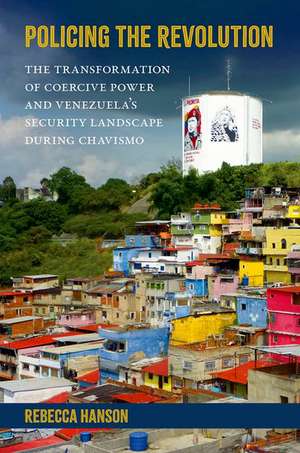
Policing the Revolution: The Transformation of Coercive Power and Venezuela's Security Landscape During Chavismo: Global and Comparative Ethnography
Autor Rebecca Hansonen Limba Engleză Hardback – 7 iul 2025
Din seria Global and Comparative Ethnography
- 16%
 Preț: 143.99 lei
 - 21%
 Preț: 145.19 lei
 - 25%
 Preț: 145.12 lei
 - 24%
 Preț: 144.18 lei
 -
 Preț: 234.02 lei
 - 19%
 Preț: 299.12 lei
 - 19%
 Preț: 305.55 lei
 - 20%
 Preț: 223.08 lei
 - 16%
 Preț: 234.64 lei
 -
 Preț: 293.68 lei
 - 17%
 Preț: 261.87 lei
 - 16%
 Preț: 246.82 lei
 - 12%
 Preț: 257.66 lei
 - 22%
 Preț: 193.56 lei
 - 21%
 Preț: 206.27 lei
Preț: 466.49 lei
Preț vechi: 651.25 lei
-28%
Puncte Express: 700
Carte tipărită la comandă
Livrare economică 04-09 decembrie
Livrare prin curier în România Termenul estimat este afișat lângă disponibilitate.
Transport gratuit pentru acest produs Plată online sau ramburs, în funcție de opțiunile comenzii.
Retur gratuit în 14 zile Comandă securizată și suport în română.
Specificații
ISBN-13: 9780197680834
ISBN-10: 0197680836
Pagini: 280
Dimensiuni: 156 x 20 x 235 mm
Greutate: 0.48 kg
Editura: Oxford University Press
Colecția OUP USA
Seria Global and Comparative Ethnography
Locul publicării:New York, United States
ISBN-10: 0197680836
Pagini: 280
Dimensiuni: 156 x 20 x 235 mm
Greutate: 0.48 kg
Editura: Oxford University Press
Colecția OUP USA
Seria Global and Comparative Ethnography
Locul publicării:New York, United States
Recenzii
Hanson's Policing the Revolution provides counterintuitive insights into the nature of politics and the state in Bolivarian Venezuela. The book addresses important and complex puzzles that fit Venezuela into debates about violence in Latin America, highlighting similarities but also key differences. Hanson perceptively shows that violence and crime in Venezuela emerge, in part, because of decisions made by state leaders that keep the police disorganized, thus reducing their capacity to engage in effective law enforcement and shifting the balance of police power in the country. Hanson's detailed and incisive ethnography of Venezuelan police provides critical insights into politics in that country and its police forces.
Our understanding of contemporary Venezuela has been impeded by broad brushstroke analyses that fail to penetrate some of the most important phenomena at play. Based on ten years of careful fieldwork-including participant observation with police officers in the most difficult of circumstances-Hanson provides one of the most insightful books that has been written on the Chavista period. Rather than the classic story of state-sponsored violence in service of authoritarian control, she reveals the pluralization of violent actors and the continual destabilization of relations between them. Hanson's access point is a focus on policing and security, but this is a book about the Bolivarian Revolution. All Venezuela scholars need to engage this text.
Policing the Revolution is a remarkable book offering an extraordinarily comprehensive account of the evolution of Venezuela's Bolivarian Revolution and Chavismo through the lens of policing and coercion, offering one of the few (and certainly the most robust) analysis to date on the left's approaches to security. The book's deep ethnographic approach masterfully pairs a focus on street-level officers with the vantage point of ordinary barrio residents to analyze how the revolution is experienced "from below." Rarely do we see ethnographies that consider police officers alongside the communities that bear the brunt of their abuses. By considering both perspectives jointly, we get a more nuanced and realistic understanding of the everyday practices that lay bare the contradictions of the Bolivarian Revolution
Our understanding of contemporary Venezuela has been impeded by broad brushstroke analyses that fail to penetrate some of the most important phenomena at play. Based on ten years of careful fieldwork-including participant observation with police officers in the most difficult of circumstances-Hanson provides one of the most insightful books that has been written on the Chavista period. Rather than the classic story of state-sponsored violence in service of authoritarian control, she reveals the pluralization of violent actors and the continual destabilization of relations between them. Hanson's access point is a focus on policing and security, but this is a book about the Bolivarian Revolution. All Venezuela scholars need to engage this text.
Policing the Revolution is a remarkable book offering an extraordinarily comprehensive account of the evolution of Venezuela's Bolivarian Revolution and Chavismo through the lens of policing and coercion, offering one of the few (and certainly the most robust) analysis to date on the left's approaches to security. The book's deep ethnographic approach masterfully pairs a focus on street-level officers with the vantage point of ordinary barrio residents to analyze how the revolution is experienced "from below." Rarely do we see ethnographies that consider police officers alongside the communities that bear the brunt of their abuses. By considering both perspectives jointly, we get a more nuanced and realistic understanding of the everyday practices that lay bare the contradictions of the Bolivarian Revolution
Notă biografică
Rebecca Hanson is Assistant Professor at the University of Florida, with a joint appointment in the Department of Sociology and Criminology & Law and the Center for Latin American Studies and director of UF's International Ethnography Lab. Her research focuses on how policies and political changes that seek to reduce inequality and violence end up contributing to these problems and how changing modalities of violence in the 21st century affect state building and capacity, with a specific focus on policing. She is the coauthor of Harassed: Gender, Bodies, and Ethnographic Research (2019, with Patricia Richards).
Cuprins
- List of Illustrations
- Chapter 1: Introduction
- Chapter 2: Research Design, Methods, and Embodied Ethnography
- Chapter 3: Reform and its Discontents
- Chapter 4: Securing the Revolution Part I
- Chapter 5: Malandros Uniformados: Masculinity, Marginalization, Insecurity, and Attitudes on Police Violence
- Chapter 6: The New Socialist Mother and Her Fight against Crime
- Chapter 7: Caiga quien Cagia: Systematic Killing in Maduro's Venezuela
- Chapter 8: Securing the Revolution Part II
- Chapter 9: Conclusion
- Index