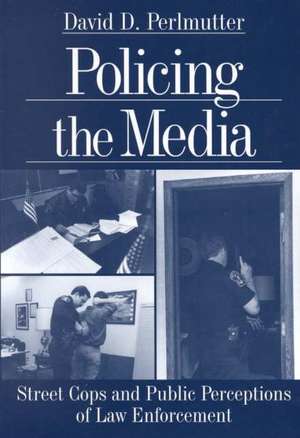
Policing the Media
Autor David D. Perlmutteren Limba Engleză Paperback – 15 feb 2000
Preț: 645.17 lei
Preț vechi: 759.02 lei
-15%
Puncte Express: 968
Carte tipărită la comandă
Livrare economică 12-26 iunie
Specificații
ISBN-13: 9780761911050
ISBN-10: 0761911057
Pagini: 180
Ilustrații: 1, black & white illustrations
Dimensiuni: 152 x 229 x 10 mm
Greutate: 0.27 kg
Ediția:1
Editura: SAGE Publications
Locul publicării:Thousand Oaks, United States
ISBN-10: 0761911057
Pagini: 180
Ilustrații: 1, black & white illustrations
Dimensiuni: 152 x 229 x 10 mm
Greutate: 0.27 kg
Ediția:1
Editura: SAGE Publications
Locul publicării:Thousand Oaks, United States
V-ar putea interesa
-
 Running with the FirmJames Bannon-31%Preț: 70.71 lei102.08 lei
 -
 Securing Transportation SystemsS Hakim-8%Preț: 613.90 lei667.28 lei
 -
 The SAGE Dictionary of PolicingAlison WakefieldPreț: 460.27 lei
 -
 PolicingJohn GrievePreț: 321.08 lei
 -
 The British Transport PoliceRichard Stacpoole-RydingPreț: 102.82 lei
 -
 -27%Preț: 64.65 lei89.17 lei
 -
 UndercoverPaul LewisPreț: 89.20 lei
 -
 Policing and Criminal JusticeChristopher BlakePreț: 327.12 lei
 -
 What is Policing?P. A. J. WaddingtonPreț: 320.78 lei
 -
 -27%Preț: 86.05 lei117.49 lei
 -
 Preț: 319.65 lei
 -
 Preț: 75.40 lei
 -
 Global PolicingBen BowlingPreț: 378.34 lei
 -
 A Likely Tale, LadMike PannettPreț: 63.64 lei
 -
 Intelligent PolicingSimon J. GuilfoylePreț: 217.40 lei
Recenzii
". . . a very good account of police working practices and philosophies that contributes to our understandings of contemporary police work."
Cuprins
Viewing and Picturing Cops
All the Street's a Stage
Prime Time Crime and Street Perceptions
Ethnography and Police Work
Front Stage and Back Stage
The (Real) Mean World
Real Cops and Mediated Cops
Can They 'Get Along'?
All the Street's a Stage
Prime Time Crime and Street Perceptions
Ethnography and Police Work
Front Stage and Back Stage
The (Real) Mean World
Real Cops and Mediated Cops
Can They 'Get Along'?
Descriere
Policing the Media is an investigation into one of the paradoxes of the mass media age. Issues, events, and people that we see most on our television screens are often those that we understand the least. David Perlmutter examined this issue as it relates to one of the most frequently portrayed groups of people on television: police officers. Policing the Media is a report on the ethnography of a police department, derived from the author's experience riding on patrol with officers and joining the department as a reserve policeman. Drawing upon interviews, Perlmutter describes the lives and philosophies of street patrol officers. He finds that cops hold ambiguous attitudes toward their television characters, for much of TV copland is fantastic and unrealistic. Moreover, the officers perceive that the public's attitudes toward law enforcement and crime are directly influenced by mass media. This in turn, he suggests, influences the way that they themselves behave and perform on the street, and that unreal and surreal expectations of them are propagated by television cop shows. This cycle of perceptual influence may itself profoundly impact the contemporary criminal justice system, on the street, in the courts, and in the hearts and minds of ordinary people.