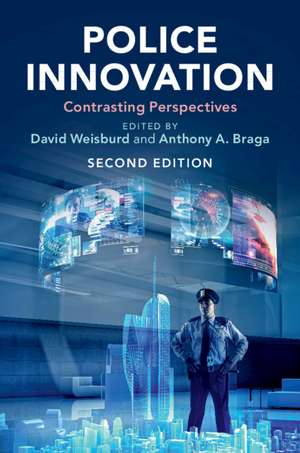
Police Innovation
Editat de David Weisburd, Anthony A. Bragaen Limba Engleză Hardback – 29 aug 2019
Preț: 838.67 lei
Preț vechi: 975.20 lei
-14%
Puncte Express: 1258
Carte tipărită la comandă
Livrare economică 05-19 decembrie
Livrare prin curier în România Termenul estimat este afișat lângă disponibilitate.
Transport gratuit pentru acest produs Plată online sau ramburs, în funcție de opțiunile comenzii.
Retur gratuit în 14 zile Comandă securizată și suport în română.
Specificații
ISBN-13: 9781108417815
ISBN-10: 1108417817
Pagini: 586
Ilustrații: 11 b/w illus. 6 tables
Dimensiuni: 157 x 235 x 39 mm
Greutate: 1.04 kg
Ediția:2Revizuită
Editura: Cambridge University Press
Locul publicării:New York, United States
ISBN-10: 1108417817
Pagini: 586
Ilustrații: 11 b/w illus. 6 tables
Dimensiuni: 157 x 235 x 39 mm
Greutate: 1.04 kg
Ediția:2Revizuită
Editura: Cambridge University Press
Locul publicării:New York, United States
V-ar putea interesa
-
 -26%Preț: 68.36 lei92.64 lei
 -
 Global Environment of PolicingDarren Palmer-18%Preț: 928.48 lei1132.29 lei
 -
 Policing: Key ReadingsTim Newburn-15%Preț: 566.69 lei666.69 lei
 -
 Policing Public DisorderDavid WaddingtonPreț: 425.04 lei
 -
 Handbook of PolicingTim Newburn-8%Preț: 625.66 lei680.06 lei
 -
 Police Work: Principles and PracticeColin Rogers-15%Preț: 458.36 lei539.25 lei
 -
 Policing and Criminal JusticeChristopher Blake-15%Preț: 518.48 lei609.98 lei
 -
 Morris, H: Up Tae My Neck in PaperworkHarry Morris-19%Preț: 44.87 lei55.57 lei
 -
 The FileTimothy Garton Ash-18%Preț: 76.20 lei93.17 lei
 -
 Global PolicingBen BowlingPreț: 396.71 lei
 -
 Preț: 411.72 lei
Cuprins
Introduction: the context of police innovation David Weisburd and Anthony Braga; Part I. Community Policing: 1. Advocate: community policing Wesley Skogan; 2. Critic: community policing: a skeptical view Stephen Mastroski; Part II. Broken Windows Policing: 3. Advocate: of 'broken windows' criminology and criminal justice William Sousa and George Kelling; 4. Critic: incivilities reduction policing, zero tolerance, and the retreat from coproduction: even weaker foundations and stronger pressures Ralph Taylor; Part III. Procedural Justice Policing: 5. Advocate: procedural justice policing Tom Tyler and Tracey Meares; 6. Critic: the limits of procedural justice David Thacher; Part IV. Problem-Oriented Policing: 7. Advocate: why problem-oriented policing John Eck; 8. Critic: problem-oriented policing: the disconnect between principles and practice Anthony Braga and David Weisburd; Part V. Pulling Levers (Focused Deterrence) Policing: 9. Advocate: policing and the lessons of focused deterrence David M. Kennedy; 10. Critic: partnership, accountability, and innovation: clarifying Boston's experience with focused deterrence Anthony Braga; Part VI. Third-Party Policing: 11. Advocate: third-party policing Lorraine Green Mazerolle and Janet Ransley; 12. Critic: third-party policing: a critical view Tracey L. Meares; Part VII. Compstat: 13. Advocate: Compstat's innovation Eli Silverman; 14. Critic: changing everything so that everything can remain the same: Compstat and American policing David Weisburd, Stephen Mastrofski, James J. Willis and Rosanne Greenspan; Part VIII. Hot Spots Policing: 15. Advocate: hot spots policing as a model for police innovation Anthony Braga and David Weisburd; 16. Critic: the limits of hot spots policing Dennis Rosenbaum; Part IX. Predictive Policing: 17. Advocate: predictive policing Jerry Ratcliffe; 18. Critic predictive policing: where's the evidence Rachel Boba; Part X. Evidence-Based / Risk-Focused Policing: 19. Advocate: evidence-based policing for crime prevention Brandon Welsh; 20. Critic which evidence? What knowledge? Broadening information about the police and their interventions Jack Greene; Part XI. Technology Policing: 21. Advocate technology in policing Barak Ariel; 22. Critic: the limits of police technology Cynthia Lum and Chris Koper; Conclusion: police innovation and the future of policing David Weisburd and Anthony Braga.
Descriere
Reviews innovations in policing over the last four decades, bringing together top policing scholars to discuss whether police should adopt these approaches.