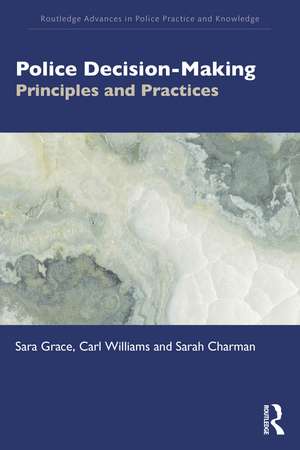
Police Decision-Making: Principles and Practices: Routledge Advances in Police Practice and Knowledge
Autor Sara Grace, Carl Williams, Sarah Charmanen Limba Engleză Paperback – 18 noi 2026
The book critically explores how and why police officers make decisions, and what principles should guide those decisions in modern policing, bringing together the authors’ research, wider literature and Williams’ extensive experience of police practice. Part 1, Understanding Policing and Police Decision-making covers police legitimacy, police discretion and policing cultures. Parts 2 and 3 focus on policing in England and Wales. Part 2 introduces Frameworks of Police Decision-making covering police decision models and ethical police decision-making (focusing on the National Decision Model and Code of Ethics). Part 3, Decision-making in Practice, presents case studies on decision-making drawn from the authors’ research and analysis on: student officers, stop and search and the night-time economy.
Aimed primarily at policing students, whether prospective police officers or social science students, the book will be of interest to all those involved in working with the police.
Din seria Routledge Advances in Police Practice and Knowledge
-
 Preț: 387.01 lei
 -
 Preț: 380.43 lei
 -
 Preț: 400.68 lei
 -
 Preț: 363.05 lei
 -
 Preț: 353.93 lei
 -
 Preț: 371.94 lei
 -
 Preț: 380.12 lei
 -
 Preț: 381.76 lei
 -
 Preț: 384.13 lei
 - nou
 Preț: 446.81 lei
Preț: 346.79 lei
Preț vechi: 387.90 lei
-11% Precomandă
Puncte Express: 520
Carte nepublicată încă
Livrare prin curier în România Precomanda se expediază când titlul devine disponibil.
Transport gratuit de la 400.00 lei Plată online sau ramburs, în funcție de opțiunile comenzii.
Retur gratuit în 14 zile Comandă securizată și suport în română.
Doresc să fiu notificat când acest titlu va fi disponibil:
Se trimite...
Specificații
ISBN-13: 9781032235295
ISBN-10: 1032235292
Pagini: 266
Ilustrații: 26
Dimensiuni: 156 x 234 mm
Greutate: 0.45 kg
Ediția:1
Editura: Taylor & Francis
Colecția Routledge
Seria Routledge Advances in Police Practice and Knowledge
Locul publicării:Oxford, United Kingdom
ISBN-10: 1032235292
Pagini: 266
Ilustrații: 26
Dimensiuni: 156 x 234 mm
Greutate: 0.45 kg
Ediția:1
Editura: Taylor & Francis
Colecția Routledge
Seria Routledge Advances in Police Practice and Knowledge
Locul publicării:Oxford, United Kingdom
Public țintă
Postgraduate and UndergraduateNotă biografică
Sara Grace is a Senior Lecturer in Criminology at the University of Salford. Her research interests include police decision-making, discretion, police misconduct and legitimacy. She is Editor of the British Society of Criminology Policing Network Blog and Co-Chair of the Network’s Police Misconduct Forum.
Carl Williams is a Senior British Police Officer with a Professional Doctorate in Ethical Decision-Making. He specialises in crisis management, firearms, strategic change, and neighbourhood policing. Carl has led on national policies on ethics and appropriate workplace relationships and has extensive experience in driving operational excellence and community trust.
Sarah Charman is Professor of Criminology and Co-Director of the Policing Academic Centre of Excellence at the University of Portsmouth, Editor-in-Chief of the International Journal of Law, Crime and Justice and Senior Associate Fellow at the Police Foundation. She has researched and published widely on the sociology of policing and the policing organisation.
Carl Williams is a Senior British Police Officer with a Professional Doctorate in Ethical Decision-Making. He specialises in crisis management, firearms, strategic change, and neighbourhood policing. Carl has led on national policies on ethics and appropriate workplace relationships and has extensive experience in driving operational excellence and community trust.
Sarah Charman is Professor of Criminology and Co-Director of the Policing Academic Centre of Excellence at the University of Portsmouth, Editor-in-Chief of the International Journal of Law, Crime and Justice and Senior Associate Fellow at the Police Foundation. She has researched and published widely on the sociology of policing and the policing organisation.
Cuprins
1. Introduction Part One: Understanding Policing and Police Decision-Making 2. Police Legitimacy Chapter 3. Police Discretion 4. Police Cultures Part Two: Frameworks of Police Decision-Making 5. Police Decision Models 6. Police Ethics, Ethical Decision-Making and the Code of Ethics Part three: Decision-Making in Practice Chapter 7. Decision-Making By New Police Recruits 8. Police Decision-Making and Stop and Search 9. Police Decision-Making in the Night-Time Economy 10. Conclusion
Recenzii
“Understanding decision-making is much more than an appreciation of the frameworks and flowcharts that organizations produce to guide the actions of their employees”: in this forensic analysis of decision-making in operational policing, the authors illustrate and explain why. They elucidate the “clear links between police decision-making and police legitimacy”.
Such is the utility of this deeply researched but eminently readable work, not only will its case-study analysis of decision-making be of high value to the intended policing practitioner and academic audiences, it is also a ‘must read’ for all those involved in making operational decisions in dynamic situations of varying certainty and risk.
Strategically punctuated with ‘think boxes’ in which scenarios offer the reader opportunity to embed learning through applied reflection, this book promotes understanding of the thinking and contexts that inform and influence police decision-making. Would that it had been available when I commenced my own policing career - it would have saved a few lessons being learned the hard way!
Given the moral significance of police discretion and decision-making, this should be required reading for all officers and police professional staff already serving, as well as new recruits embarking on their public service careers in the police.
Clive Harfield, Associate Professor of, and Discipline Lead for, Criminology & Criminal Justice, Australian Catholic University
Decision-making is central to police work and can have very significant consequences for victims, offenders and officers themselves. This book provides important insight and analysis of the breadth and depth of decision-making in a range of contexts and the strengths and weaknesses of current legal, training, and operational oversight. It will be of great use to students, officers and anyone interested in the exercise of police powers.
Michael Rowe, Professor, Northumbria University
Police Decision-Making: Principles and Practices, co-authored by Dr Sara Grace, Chief Superintendent Dr Carl Williams, and Professor Sarah Charman, provides a profound and critically engaging exploration into the mechanics of contemporary policing. Bridging the often-wide chasm between academic literature and the everyday realities of frontline police work, the authors have produced an invaluable text for understanding why and how police officers make choices that define the nature, experiences and impact of policing in society.
The book seamlessly blends theoretical and empirical approaches across three parts. It begins by laying out the conceptual foundations of police legitimacy, discretion, and police cultures. The narrative then shifts to formal structures, analysing established frameworks like the National Decision Model and the 2024 Code of Ethics. What elevates this text, however, is its third section, which applies these theories to rigorous case studies – examining student officer development, the contentious arena of stop and search, and the volatile environment of the night-time economy.
The book’s truly original contribution lies in its multi-layered ‘spheres of influence’ framework. Rather than treating decision-making as a purely psychological or rational choice, the authors evaluate decisions as a complex, collective exercise heavily dictated by a host of political, social, economic, legal, organisational, environmental, situational and individual factors. By dissecting how various factors bound an officer’s cognitive choices, the book provides a nuanced sociological analysis of how real-world policing operates under intense public scrutiny and shifting expectations.
This book is the most comprehensive examination of police decision-making to date and an essential addition to the field of police studies. It is highly recommended for undergraduate and postgraduate students of criminology, law and sociology. The knowledge check, reflective exercise and discussion questions sections in each chapter will prove very useful for learning and teaching purposes. Furthermore, the book serves as an indispensable resource for policymakers and police practitioners seeking to improve public trust in policing and the ethical governance of the police.
Matthew Bacon, Senior Lecturer in Criminology, University of Sheffield
Such is the utility of this deeply researched but eminently readable work, not only will its case-study analysis of decision-making be of high value to the intended policing practitioner and academic audiences, it is also a ‘must read’ for all those involved in making operational decisions in dynamic situations of varying certainty and risk.
Strategically punctuated with ‘think boxes’ in which scenarios offer the reader opportunity to embed learning through applied reflection, this book promotes understanding of the thinking and contexts that inform and influence police decision-making. Would that it had been available when I commenced my own policing career - it would have saved a few lessons being learned the hard way!
Given the moral significance of police discretion and decision-making, this should be required reading for all officers and police professional staff already serving, as well as new recruits embarking on their public service careers in the police.
Clive Harfield, Associate Professor of, and Discipline Lead for, Criminology & Criminal Justice, Australian Catholic University
Decision-making is central to police work and can have very significant consequences for victims, offenders and officers themselves. This book provides important insight and analysis of the breadth and depth of decision-making in a range of contexts and the strengths and weaknesses of current legal, training, and operational oversight. It will be of great use to students, officers and anyone interested in the exercise of police powers.
Michael Rowe, Professor, Northumbria University
Police Decision-Making: Principles and Practices, co-authored by Dr Sara Grace, Chief Superintendent Dr Carl Williams, and Professor Sarah Charman, provides a profound and critically engaging exploration into the mechanics of contemporary policing. Bridging the often-wide chasm between academic literature and the everyday realities of frontline police work, the authors have produced an invaluable text for understanding why and how police officers make choices that define the nature, experiences and impact of policing in society.
The book seamlessly blends theoretical and empirical approaches across three parts. It begins by laying out the conceptual foundations of police legitimacy, discretion, and police cultures. The narrative then shifts to formal structures, analysing established frameworks like the National Decision Model and the 2024 Code of Ethics. What elevates this text, however, is its third section, which applies these theories to rigorous case studies – examining student officer development, the contentious arena of stop and search, and the volatile environment of the night-time economy.
The book’s truly original contribution lies in its multi-layered ‘spheres of influence’ framework. Rather than treating decision-making as a purely psychological or rational choice, the authors evaluate decisions as a complex, collective exercise heavily dictated by a host of political, social, economic, legal, organisational, environmental, situational and individual factors. By dissecting how various factors bound an officer’s cognitive choices, the book provides a nuanced sociological analysis of how real-world policing operates under intense public scrutiny and shifting expectations.
This book is the most comprehensive examination of police decision-making to date and an essential addition to the field of police studies. It is highly recommended for undergraduate and postgraduate students of criminology, law and sociology. The knowledge check, reflective exercise and discussion questions sections in each chapter will prove very useful for learning and teaching purposes. Furthermore, the book serves as an indispensable resource for policymakers and police practitioners seeking to improve public trust in policing and the ethical governance of the police.
Matthew Bacon, Senior Lecturer in Criminology, University of Sheffield
Descriere
This book takes the topic of police decision-making, one that is so important to the everyday policing of all citizens, and examines it in depth. It does this, not just by describing the processes and mechanisms which govern decision-making, but also by considering the fundamental principles which underpin this.