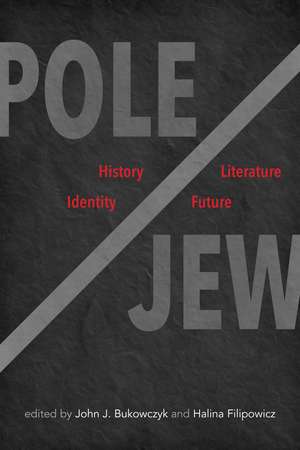
Pole/Jew: History, Literature, Identity, Future: Polish and Polish-American Studies Series
Editat de John J. Bukowczyk, Halina Filipowiczen Limba Engleză Hardback – 23 dec 2025
Pole/Jew brings together a group of scholars—about half of them Jewish, about half of them ethnic Poles—from the United States, Poland, the United Kingdom, and Canada and enlists their diverse methodological and generational perspectives to push debates over Polish-Jewish relations beyond entrenched and reductive positions. At the core of the volume are the following questions:
–What impact has the Holocaust had on Polish history and Polish literature?
–How has the Holocaust affected Polish-Jewish—and Polish—identity?
–What future is there for relations between Poland’s small Jewish minority and the country’s overwhelming ethnic Polish majority? Between Poland and Israel? Between Jews of the diaspora and ethnic Poles abroad?
–Which research areas have yet to be addressed or revisited and reexamined?
–Are there ways to move beyond the reductive notion of 1989 (i.e., the fall of the communist regime in Poland) as wall and fulcrum?
By addressing these compelling questions, this volume offers fresh perspectives and encourages a nuanced understanding of Polish-Jewish relations.
Contributors:
M. B. B. Biskupski
Robert Blobaum
John J. Bukowczyk
Patrice M. Dabrowski
Halina Filipowicz
Agnieszka Jezyk
Bozena Karwowska
Kamil Kijek
Kate Korycki
Elzbieta Kossewska
Grazyna J. Kozaczka
Stanislaw Krajewski
Adam Lipszyc
Wiktor Marzec
Alina Molisak
Stanislaw Obirek
Benjamin Paloff
Antony Polonsky
Brian Porter-Szucs
Piotr Puchalski
Roma Sendyka
Dariusz Stola
Katarzyna Zechenter
Joshua D. Zimmerman
Geneviève Zubrzycki
Slawomir Zurek
Preț: 500.80 lei
Preț vechi: 618.27 lei
-19%
Puncte Express: 751
Carte disponibilă
Livrare economică 18 noiembrie-02 decembrie
Livrare express 03-07 noiembrie pentru 39.36 lei
Livrare prin curier în România Termenul estimat este afișat lângă disponibilitate.
Transport gratuit pentru acest produs Plată online sau ramburs, în funcție de opțiunile comenzii.
Retur gratuit în 14 zile Comandă securizată și suport în română.
Specificații
ISBN-13: 9780821426487
ISBN-10: 0821426486
Pagini: 366
Dimensiuni: 152 x 229 x 38 mm
Greutate: 0.63 kg
Editura: Ohio University Press
Colecția Ohio University Press
Seria Polish and Polish-American Studies Series
ISBN-10: 0821426486
Pagini: 366
Dimensiuni: 152 x 229 x 38 mm
Greutate: 0.63 kg
Editura: Ohio University Press
Colecția Ohio University Press
Seria Polish and Polish-American Studies Series
Notă biografică
John J. Bukowczyk is a professor emeritus of history at Wayne State University and the author of numerous articles and books on immigration and ethnic history. He is the series editor for the Polish and Polish-American Studies Series from Ohio University Press and editor of Photographs from Detroit, 1975–2019.
Halina Filipowicz is a professor emerita in the Department of German, Nordic, and Slavic and the Department of Gender and Women’s Studies at the University of Wisconsin–Madison. Her main areas of research are Polish and Polish-Jewish literature, modern intellectual history, and gender studies. In 2020, she became the first woman to serve as editor in chief of The Polish Review.
Halina Filipowicz is a professor emerita in the Department of German, Nordic, and Slavic and the Department of Gender and Women’s Studies at the University of Wisconsin–Madison. Her main areas of research are Polish and Polish-Jewish literature, modern intellectual history, and gender studies. In 2020, she became the first woman to serve as editor in chief of The Polish Review.
Cuprins
Preface
Acknowledgments
Guide to Pronunciation
Introduction
JOHN J. BUKOWCZYK
PART I. IS THERE A HISTORY OF POLAND BEYOND THE HOLOCAUST?
1. On Forgetting, Displacement, and Historical Error in Polish History
PATRICE M. DABROWSKI
2. There Is a Polish-Jewish History beyond the Holocaust
DARIUSZ STOLA
3. Poles and Jews in the Late Nineteenth-Century Russian Empire
An Inevitable Clash?
M. B. B. BISKUPSKI
4. The Impact of Antisemitism on Political Cleavages in Twentieth-Century Poland
WIKTOR MARZEC
5. Away from the Holocaust through the Colonies
Reassessing the History of Modern Poland
PIOTR PUCHALSKI
6. Whose Holocaust? Whose Poland?
ROBERT BLOBAUM
7. In the Shadow of, or Buried under, the Holocaust?
On the Paradox of Presence and Nonpresence of Jewish History and Culture in Contemporary Polish Discourse
KAMIL KIJEK
PART II. IS THERE A POLISH LITERATURE BEYOND THE HOLOCAUST?
8. Strategies of Reconstructing the Jewish World in Polish Literature after 1989
ALINA MOLISAK
9. Identity and Postmemory in Polish Jewish Writing of the Twenty-First Century within Its Holocaust Legacy
KATARZYNA ZECHENTER
10. Bystanders or (Passive) Witnesses?
Unnoticed Perspectives on the Holocaust and Polish Literature
BOŻENA KARWOWSKA
11. Second-and Third-Generation Polish Writers and the Holocaust
SŁAWOMIR JACEK ŻUREK
12. Haunted Cinema
Holocaust Tropes in Polish Thriller and Horror Films of the 2010s
AGNIESZKA JEŻYK
13. Beyond Beyonding
Envisioning a New History of Holocaust Literature in Poland
HALINA FILIPOWICZ
PART III. JEWISH/POLISH AND POLISH IDENTITIES BEYOND THE HOLOCAUST
14. Betwixt Jerusalem and New York
Jakub Apenszlak’s Attempt at Fostering Polish-Jewish Rapprochement in the Midst of World War II
ELŻBIETA KOSSEWSKA
15. Invented Identity Pole after the Holocaust
STANISŁAW OBIREK
16. National Identity, Racial Imaginary, and a Productive Force of a “Communist Jew”
KATE KORYCKI
17. “New Jews” and the Reconstruction of Identity
GENEVIÈVE ZUBRZYCKI
18. Living as a Jew in Contemporary Poland
STANISŁAW KRAJEWSKI
19. As If I Were Some Stranger Jewishness as a Split
ADAM LIPSZYC
20. Between a Polish Shiksa and a Jewish Woman Ambiguous Identities in Eva Mekler’s Novels
GRAŻYNA J. KOZACZKA
21. The Polish Question
JOHN J. BUKOWCZYK
PART IV. IS THERE A FUTURE FOR POLISH/JEWISH RELATIONS BEYOND THE HOLOCAUST?
22. Explaining Antisemitic Violence The Perils of Understanding
BRIAN PORTER-SZŰCS
23. On the Origins of the Jewish Culture Festival in Krakόw
Conversations with Janusz Makuch
JOSHUA D. ZIMMERMAN
24. עכאָס | Echa
BENJAMIN PALOFF
25. Toward a New Life in an Old House
ROMA SENDYKA
26. “The Conquest of History?”
Toward a Usable Past in Poland
ANTONY POLONSKY
Postscript
HALINA FILIPOWICZ
Contributors
Index
Descriere
This volume fosters a dialogue on Polish-Jewish relations, gathering scholars from various countries and presenting diverse perspectives. It explores the Holocaust’s impact on Polish history and literature and on Polish-Jewish and Polish identities; speculates on future relations between Jewish and Polish communities; and examines underexplored research areas beyond the fall of communism in Poland in 1989.