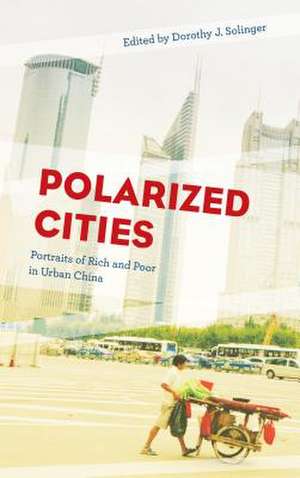
Polarized Cities: Portraits of Rich and Poor in Urban China
Editat de Dorothy J. Solingeren Limba Engleză Hardback – 14 sep 2018
Preț: 504.32 lei
Preț vechi: 688.19 lei
-27%
Puncte Express: 756
Carte tipărită la comandă
Livrare economică 05-19 decembrie
Livrare prin curier în România Termenul estimat este afișat lângă disponibilitate.
Transport gratuit pentru acest produs Plată online sau ramburs, în funcție de opțiunile comenzii.
Retur gratuit în 14 zile Comandă securizată și suport în română.
Specificații
ISBN-13: 9781538116470
ISBN-10: 1538116472
Pagini: 208
Ilustrații: 2 b/w photos; 7 tables; 3 graphs
Dimensiuni: 158 x 230 x 18 mm
Greutate: 0.48 kg
Editura: Bloomsbury Publishing
Colecția Rowman & Littlefield
Locul publicării:New York, United States
ISBN-10: 1538116472
Pagini: 208
Ilustrații: 2 b/w photos; 7 tables; 3 graphs
Dimensiuni: 158 x 230 x 18 mm
Greutate: 0.48 kg
Editura: Bloomsbury Publishing
Colecția Rowman & Littlefield
Locul publicării:New York, United States
Cuprins
Introduction: State Policies, Castes, and Agency
Dorothy J. Solinger
Part I: Polarization: Scope, Causes, Manifestations
1 China's Uphill Battle Against Inequality
Wang Feng
2 Convergence and Divergence Among the Rich and the Poor
Li Zhang
Part II: Portraits of the Urban Poor
3 Banish the Impoverished Past: The Predicament of the Abandoned Urban Poor
Dorothy J. Solinger
4 The Passionate Poor: Foxconn Workers Invited as Volunteers
Mun Young Cho
5 On the Rough Edge of Prosperity: Informal Migrant Recyclers in Beijing
Joshua Goldstein
Part III: The Upper Reaches of the Urban Rich
6 China's Party Kings: Shanghai Club Cultures and Status Consumption, 1920s-2010s
Andrew David Field and James Farrer
7 Corruption, Anti-Corruption, and the Dynamics of Class: Formation in Post-Mao China
John Osburg
Urban Polarities: Inequality, Social Mobility, and the Role of the State
David S. G. Goodman
About the Contributors
Dorothy J. Solinger
Part I: Polarization: Scope, Causes, Manifestations
1 China's Uphill Battle Against Inequality
Wang Feng
2 Convergence and Divergence Among the Rich and the Poor
Li Zhang
Part II: Portraits of the Urban Poor
3 Banish the Impoverished Past: The Predicament of the Abandoned Urban Poor
Dorothy J. Solinger
4 The Passionate Poor: Foxconn Workers Invited as Volunteers
Mun Young Cho
5 On the Rough Edge of Prosperity: Informal Migrant Recyclers in Beijing
Joshua Goldstein
Part III: The Upper Reaches of the Urban Rich
6 China's Party Kings: Shanghai Club Cultures and Status Consumption, 1920s-2010s
Andrew David Field and James Farrer
7 Corruption, Anti-Corruption, and the Dynamics of Class: Formation in Post-Mao China
John Osburg
Urban Polarities: Inequality, Social Mobility, and the Role of the State
David S. G. Goodman
About the Contributors
Recenzii
In this volume, Polarized Cities: Portraits of Rich and Poor in Urban China, the editor, Dorothy Solinger, employs a caste-like formation framework to examine the growing urban inequality in China. This book widens our understanding of rising urban inequality in contemporary China and would be an excellent teaching resource for China scholars who study social stratification, social mobility, and social inequality.
This book will be a good read for those who are interested in inequality and social mobility, China's post-reform transformations, or, more specifically, the daily lives of Chinese urban residents from across the socioeconomic spectrum. Hopefully this book will spur discussions on ways out of a polarized society among researchers, policy makers, and practitioners.
Dorothy Solinger, who has brought much attention to the plight of China's urban poor, here assembles a distinguished group of scholars to throw light on an underside of that country's vaunted economic miracle: the hardening of inequalities of income and wealth to form an increasingly polarized society. This revealing book explores the lives of both the ultra-rich and the destitute and makes clear that the state itself has played a large role in fostering polarization.
Going beyond the statistics on expanding social inequality, this important book, authored by world authorities on urban China, provides a stunning account of drastic social contrasts. The portraits of the rich and poor reveal not only their monumentally disparate lifestyles but also variegated agencies and life opportunities. Solinger's marvelous conceptual design brings the two social extremes under the same scrutiny.
This richly researched volume shows that, even though China's four decades of economic growth have lifted tens of millions of Chinese out of poverty, they have also created rigid structures of inequality and diverging mobility opportunities. China has also been rapidly urbanizing in recent decades, and today more than half of all Chinese live in cities. The dramatic contrasts between the fabulous and flaunted wealth of urban elites and the struggles of rural migrants and the urban poor documented by researchers in this volume will add fuel to debates about whether socialism any longer has meaning in contemporary China.
This is an important book, tackling the most salient feature of Chinese society today: its polarization between the wealthy and the poor. Solinger's insights into the caste-like 'hierarchy of agency' in contemporary China are fresh and illuminating, and the case study chapters provide fascinating-and unsettling-details about the daily lives of Chinese citizens from across the socio-economic spectrum.
This book will be a good read for those who are interested in inequality and social mobility, China's post-reform transformations, or, more specifically, the daily lives of Chinese urban residents from across the socioeconomic spectrum. Hopefully this book will spur discussions on ways out of a polarized society among researchers, policy makers, and practitioners.
Dorothy Solinger, who has brought much attention to the plight of China's urban poor, here assembles a distinguished group of scholars to throw light on an underside of that country's vaunted economic miracle: the hardening of inequalities of income and wealth to form an increasingly polarized society. This revealing book explores the lives of both the ultra-rich and the destitute and makes clear that the state itself has played a large role in fostering polarization.
Going beyond the statistics on expanding social inequality, this important book, authored by world authorities on urban China, provides a stunning account of drastic social contrasts. The portraits of the rich and poor reveal not only their monumentally disparate lifestyles but also variegated agencies and life opportunities. Solinger's marvelous conceptual design brings the two social extremes under the same scrutiny.
This richly researched volume shows that, even though China's four decades of economic growth have lifted tens of millions of Chinese out of poverty, they have also created rigid structures of inequality and diverging mobility opportunities. China has also been rapidly urbanizing in recent decades, and today more than half of all Chinese live in cities. The dramatic contrasts between the fabulous and flaunted wealth of urban elites and the struggles of rural migrants and the urban poor documented by researchers in this volume will add fuel to debates about whether socialism any longer has meaning in contemporary China.
This is an important book, tackling the most salient feature of Chinese society today: its polarization between the wealthy and the poor. Solinger's insights into the caste-like 'hierarchy of agency' in contemporary China are fresh and illuminating, and the case study chapters provide fascinating-and unsettling-details about the daily lives of Chinese citizens from across the socio-economic spectrum.