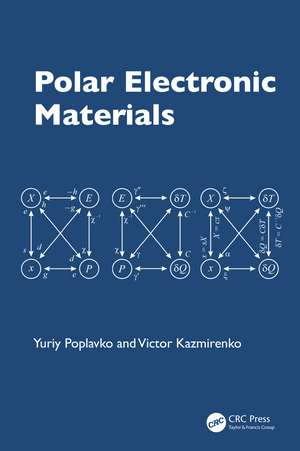
Polar Electronic Materials
Autor Yuriy Poplavko, Victor Kazmirenkoen Limba Engleză Hardback – 30 mar 2026
Features:
- Presents current research on polar materials using clear models that expand understanding of fundamental phenomena.
- Explores the transformative properties of polar materials with practical applications for electronic devices.
- Explains thermal transport peculiarities in ferroelectrics and antiferroelectrics, including negative thermal expansion.
- Analyses the relationship between electrical conductivity and polarization in various polar structures.
- Demonstrates methods for inducing and controlling polar properties in non-polar materials through electrical and mechanical effects.
Preț: 1311.52 lei
Preț vechi: 1599.41 lei
-18%
Puncte Express: 1967
Carte tipărită la comandă
Livrare economică 02-16 decembrie
Livrare prin curier în România Termenul estimat este afișat lângă disponibilitate.
Transport gratuit pentru acest produs Plată online sau ramburs, în funcție de opțiunile comenzii.
Retur gratuit în 14 zile Comandă securizată și suport în română.
Specificații
ISBN-13: 9781041193036
ISBN-10: 1041193033
Pagini: 282
Ilustrații: 492
Dimensiuni: 156 x 234 mm
Greutate: 0.68 kg
Ediția:1
Editura: CRC Press
Colecția CRC Press
ISBN-10: 1041193033
Pagini: 282
Ilustrații: 492
Dimensiuni: 156 x 234 mm
Greutate: 0.68 kg
Ediția:1
Editura: CRC Press
Colecția CRC Press
V-ar putea interesa
-
 Electrical Properties of MaterialsLaszlo Solymar-8%Preț: 390.15 lei424.28 lei
 -
 Optical Properties of SolidsMark FoxPreț: 383.52 lei
 -
 Awesome Electricity and Mad MagnetsBig MannyPreț: 64.82 lei
 -
 -15%Preț: 126.85 lei148.88 lei
 -
 -11%Preț: 668.13 lei750.70 lei
 -
 -20%Preț: 281.61 lei352.66 lei
 -
 -25%Preț: 387.36 lei518.54 lei
 -
 -30%Preț: 97.81 lei139.80 lei
 -
 A Concise Introduction to Polymer PhysicsReinhard Hentschke-11%Preț: 428.27 lei481.21 lei
 -
 -9%Preț: 854.46 lei938.96 lei
 -
 -14%Preț: 812.69 lei944.99 lei
 -
 Piezoelectric MaterialsJiagang Wu-14%Preț: 1135.85 lei1320.76 lei
 -
 -14%Preț: 1026.95 lei1194.13 lei
 -
 Functional Polyimide DielectricsJun-Wei Zha-23%Preț: 817.12 lei1061.18 lei
 -
 -18%Preț: 1383.63 lei1687.34 lei
 -
 Electron Holography for Electromagnetic MaterialsDaisuke Shindo-18%Preț: 981.33 lei1196.75 lei
Public țintă
AcademicCuprins
1 Brief Overview of Polar Materials Properties 2 Features of the Electronic Properties of Polar Solids 3 Nature of Crystal Internal Polarity 4 Thermal Transport in Polar Materials 5 Thermal Expansion Peculiarities 6 Charge Transfer in Polar Materials 7 Conduction and Polarization Relationship 8 Electrically Induced Piezoelectricity 9 Induced Pyroelectricity 10 Dielectric Permittivity Nonlinearity and Controllability
Notă biografică
Yuriy Poplavko serves as Professor at the Microelectronics Department of the National Technical University of Ukraine Igor Sikorsky Kyiv Polytechnic Institute. With over four decades of teaching experience in electronic materials science, he is recognized internationally for his pioneering work in the physics of ferroelectrics and dielectrics, particularly for developing microwave dielectric spectroscopy as a research method. He has mentored hundreds of students, supervised over 30 doctoral candidates, and has authored 13 books. He has delivered invited lectures internationally across North America, Europe, and Asia. Professor Poplavko holds Life Senior Member status in IEEE and has published extensively in leading journals in the field of polar materials and ferroelectrics.
Victor Kazmirenko serves as Associate Professor at the Electronic Engineering Department of National Technical University of Ukraine Igor Sikorsky Kyiv Polytechnic Institute, Faculty of Electronics. He earned his Master of Electronics in 1999 and Candidate of Sciences degree (local PhD equivalent) in solid-state electronics in 2003. Dr. Kazmirenko worked as research fellow at Pohang University of Science & Technology, South Korea, from 2000 to 2002. He spent his early research years focusing on study of various dielectric materials at microwave frequencies. He maintains an active membership at IEEE and has contributed to numerous publications examining the properties and applications of polar materials in electronics.
Victor Kazmirenko serves as Associate Professor at the Electronic Engineering Department of National Technical University of Ukraine Igor Sikorsky Kyiv Polytechnic Institute, Faculty of Electronics. He earned his Master of Electronics in 1999 and Candidate of Sciences degree (local PhD equivalent) in solid-state electronics in 2003. Dr. Kazmirenko worked as research fellow at Pohang University of Science & Technology, South Korea, from 2000 to 2002. He spent his early research years focusing on study of various dielectric materials at microwave frequencies. He maintains an active membership at IEEE and has contributed to numerous publications examining the properties and applications of polar materials in electronics.
Descriere
This book examines polar properties in electronic materials, presenting key concepts about their electrical, mechanical, and thermal effects. It explores the physics of polar materials through models that explain features of heat transfer, thermal expansion, and the interaction between polarization and electrical conductivity.