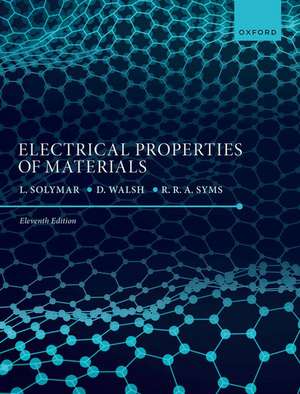
Electrical Properties of Materials
Autor Laszlo Solymar, Donald Walsh, Richard Symsen Limba Engleză Paperback – 12 noi 2024
Preț: 380.92 lei
Preț vechi: 416.93 lei
-9%
Puncte Express: 571
Carte disponibilă
Livrare economică 30 octombrie-04 noiembrie
Livrare express 15-21 octombrie pentru 109.20 lei
Livrare prin curier în România Termenul estimat este afișat lângă disponibilitate.
Transport gratuit de la 400.00 lei Plată online sau ramburs, în funcție de opțiunile comenzii.
Retur gratuit în 14 zile Comandă securizată și suport în română.
Specificații
ISBN-13: 9780198920977
ISBN-10: 0198920970
Pagini: 640
Ilustrații: 434 line illustrations and halftones
Dimensiuni: 190 x 245 x 28 mm
Greutate: 1.34 kg
Ediția:11
Editura: OUP OXFORD
Colecția OUP Oxford
Locul publicării:Oxford, United Kingdom
ISBN-10: 0198920970
Pagini: 640
Ilustrații: 434 line illustrations and halftones
Dimensiuni: 190 x 245 x 28 mm
Greutate: 1.34 kg
Ediția:11
Editura: OUP OXFORD
Colecția OUP Oxford
Locul publicării:Oxford, United Kingdom
V-ar putea interesa
-
 -24%Preț: 364.38 lei479.88 lei
 -
 Concepts in Organic ElectronicsStephen R. Forrest-9%Preț: 344.12 lei379.39 lei
 -
 Magnetism in Condensed MatterStephen Blundell-11%Preț: 332.06 lei374.31 lei
 -
 Waves in MetamaterialsLaszlo Solymar-21%Preț: 481.10 lei605.74 lei
 -
 Molecular Quantum MechanicsPeter W. Atkins-19%Preț: 546.55 lei674.76 lei
 -
 Optical Properties of SolidsMark Fox-10%Preț: 342.00 lei379.52 lei
 -
 Electricity and Magnetism, Volumes 1 and 2B. I. Bleaney-23%Preț: 603.75 lei786.29 lei
 -
 Materials: A Very Short IntroductionChristopher Hall-20%Preț: 56.62 lei70.82 lei
 -
 Awesome Electricity and Mad MagnetsBig MannyPreț: 63.67 lei
 -
 -15%Preț: 126.85 lei148.88 lei
 -
 -11%Preț: 668.13 lei750.70 lei
 -
 Electronics For Dummies, UK EditionCathleen ShamiehPreț: 145.47 lei
 -
 Electromagnetism 2eI. S. GrantPreț: 415.87 lei
 -
 Fundamentals of Semiconductor Materials and DevicesAdrian Kitai-23%Preț: 643.68 lei835.95 lei
 -
 The Materials Physics CompanionAnthony C. Fischer-Cripps-18%Preț: 1476.72 lei1800.89 lei
 -
 -25%Preț: 387.36 lei518.54 lei
 -
 Principles and Applications of Electrical Engineering ISEGiorgio Rizzoni-26%Preț: 386.30 lei519.88 lei
 -
 Preț: 422.79 lei
 -
 Electron Holography for Electromagnetic MaterialsDaisuke Shindo-18%Preț: 914.55 lei1115.31 lei
Recenzii
Review from previous edition An informal and highly accessible writing style, a simple treatment of mathematics, and a clear guide to applications have made this book a classic text in electrical and electronic engineering. Students will find it both readable and comprehensive.
This book is a delight! It is impossible to read it without a smile coming to your lips every few pages. It is a new edition of a well-known undergraduate text, intended for students of electrical engineering, but I am sure any physics student could benefit from reading it ... It is an excellent educational book, and I am sure that it will achieve the aim of the authors, which is to instill a sense of quantum mechanical reasoning into all its readers.
This book is a delight! It is impossible to read it without a smile coming to your lips every few pages. It is a new edition of a well-known undergraduate text, intended for students of electrical engineering, but I am sure any physics student could benefit from reading it ... It is an excellent educational book, and I am sure that it will achieve the aim of the authors, which is to instill a sense of quantum mechanical reasoning into all its readers.
Notă biografică
Laszlo Solymar was Emeritus Professor of Applied Electromagnetism at the University of Oxford and Visiting Professor and Senior Research Fellow at Imperial College, London. He graduated from the Technical University of Budapest in 1952 and received the equivalent of a PhD in 1956 from the Hungarian Academy of Sciences. In 1956, he settled in England where he worked first in industry and later at the University of Oxford. He conducted research on antennas, microwaves, superconductors, holographic gratings, photorefractive materials, and metamaterials. He has held visiting professorships at the Universities of Paris, Copenhagen, Osnabrück, Berlin, Madrid, Budapest, and Imperial College, London. He has published 9 books and over 400 papers. He has been a Fellow of the Royal Society since 1995, and received the Faraday Medal of the Institution of Electrical Engineers in 1992.The late Donald Walsh was an Emeritus fellow of Oriel College, Oxford. He graduated from King's College London during the second world war. He then worked for seven years at the Mullard Radio Valve Co, developing photocells and flash tubes, then for about the same period at the Services Electronics Research Labs (SERL) on travelling wave tubes, klystrons, and TR switches. He came to the Department of Engineering Science, Oxford in 1956 as a Research Fellow to help the newly appointed Reader in Electrical Engineering start a research group in microwave electronics, and later became a Lecturer and College Fellow.Richard R. A. Syms has been Professor of Microsystems Technology in the EEE Department at Imperial College London since 1996. He graduated in Engineering Science at Oxford University in 1979, and obtained a DPhil in 1982, also from Oxford. He carried out postgraduate work at University College London, Oxford University, and the Rutherford Appleton Laboratory before moving to Imperial. He has published over 200 journal papers and 2 books on holography, guided wave optics, electromagnetic theory, metamaterials, magnetic resonance imaging, and micro-electro-mechanical systems (MEMS). In 2001, he co-founded the Imperial College spin-out company Microsaic Systems. He is a Fellow of the Royal Academy of Engineering, the Institute of Electrical and Electronic Engineers, the Institute of Physics, and the Institute of Engineering and Technology.
Cuprins
- 1: The electron as a particle
- 2: The electron as a wave
- 3: The electron
- 4: The hydrogen atom and the periodic table
- 5: Bonds
- 6: The free electron theory of metals
- 7: The band theory of solids
- 8: Semiconductors
- 9: Principles of semiconductor devices
- 10: Dielectric materials
- 11: Magnetic materials
- 12: Lasers
- 13: Optoelectronics
- 14: Superconductivity
- 15: Metamaterials
- Epilogue
- Appendix I: Organic semiconductors
- Appendix II: Nobel laureates Appendix V: Thermoelectricity
- Appendix III: Physical constants
- Appendix IV: Variational calculus. Derivation of Euler s equation
- Appendix V: Thermoelectricity
- Appendix VI: Principles of the operation of computer memories
- Appendix VII: Medical imaging
- Appendix VIII: Suggestions for further reading
- Answers to exercises