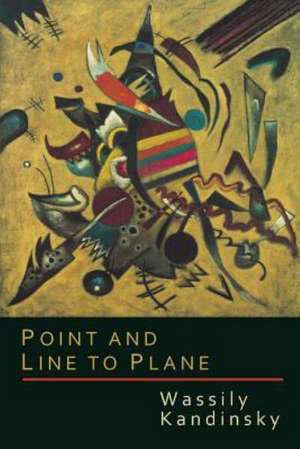
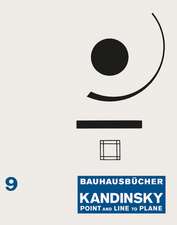
Point and Line to Plane
Autor Wassily Kandinskyen Limba Engleză Paperback – 11 dec 2013
Preț: 71.76 lei
Puncte Express: 108
Carte indisponibilă temporar
Livrare prin curier în România Termenul estimat este afișat lângă disponibilitate.
Transport gratuit de la 400.00 lei Plată online sau ramburs, în funcție de opțiunile comenzii.
Retur gratuit în 14 zile Comandă securizată și suport în română.
Specificații
ISBN-13: 9781614275466
ISBN-10: 1614275467
Pagini: 190
Dimensiuni: 156 x 234 x 11 mm
Greutate: 0.3 kg
Editura: Martino Fine Books
ISBN-10: 1614275467
Pagini: 190
Dimensiuni: 156 x 234 x 11 mm
Greutate: 0.3 kg
Editura: Martino Fine Books
V-ar putea interesa
-
 Preț: 114.84 lei
 -
 Basic Principles of Classical BalletAgrippina VaganovaPreț: 75.40 lei
 -
 Concerning the Spiritual in ArtWassily Kandinsky-19%Preț: 49.10 lei60.74 lei
 -
 NotanDorr BothwellPreț: 60.78 lei
 -
 Abstract Design and How to Create ItAmor FennPreț: 84.56 lei
 -
 Abstract ArtAnna MoszynskaPreț: 109.83 lei
 -
 Pedagogical SketchbookPaul KleePreț: 91.48 lei
 -
 The Dehumanization of Art and Other Essays on Art, Culture, and LiteratureJosé Ortega Y. GassetPreț: 90.47 lei
 -
 Preț: 243.97 lei
 -
 Vasily Kandinsky: Around the CircleTracey BashkoffPreț: 346.30 lei
 -
 Concerning the Spiritual in ArtWassily KandinskyPreț: 38.49 lei
 -
 -24%Preț: 83.98 lei110.63 lei
 -
 Interlock: Art, Conspiracy, and the Shadow Worlds of Mark LombardiPatricia Goldstone-17%Preț: 116.24 lei139.70 lei
 -
 -33%Preț: 614.81 lei911.32 lei
 -
 Kazimir Malevich - The Climax of DisclosureDavid Moos-27%Preț: 154.36 lei210.92 lei
 -
 Studies in Chromo TherapyErasmo Serretti-19%Preț: 453.06 lei559.33 lei
 -
 -12%Preț: 270.66 lei308.44 lei
 -
 Paul Klee—Ad Parnassum: Landmarks of Swiss ArtOskar BätschmannPreț: 203.78 lei
 -
 Picasso's AnimalsBoris Friedwald-11%Preț: 114.83 lei129.55 lei
 -
 Preț: 323.21 lei
 -
 Kandinsky (English Edition)Hajo DüchtingPreț: 130.99 lei
 -
 Mondrian (English Edition)Susanne DeicherPreț: 132.16 lei
Textul de pe ultima copertă
"I had the impression that here painting itself comes to the foreground; I wondered if it would not be possible to go further in this direction."
Thus did the young Russian painter Wassily Kandinsky (1866 1944) react to his first viewing of Monet's "Haystack," included in an 1895 Moscow exhibit of French Impressionists. It was his first perception of the dematerialization of an object and presaged the later development of his influential theories of non-objective art.
During study and travel in Europe, the young artist breathed the heady atmosphere of artistic experimentation. Fauvism, Cubism, Symbolism, and other movements played an important role in the development of his own revolutionary approach to painting. Decrying literal representation, Kandinsky emphasized instead the importance of form, color, rhythm, and the artist's inner need in expressing reality.
In "Point and Line to Plane," one of the most influential books in 20th-century art, Kandinsky presents a detailed exposition of the inner dynamics of non-objective painting. Relying on his own unique terminology, he develops the idea of point as the "proto-element" of painting, the role of point in nature, music, and other art, and the combination of point and line that results in a unique visual language. He then turns to an absorbing discussion of line the influence of force on line, lyric and dramatic qualities, and the translation of various phenomena into forms of linear expression. With profound artistic insight, Kandinsky points out the organic relationship of the elements of painting, touching on the role of texture, the element of time, and the relationship of all these elements to the basic material plane called upon to receive the content of a work of art.
Originally published in 1926, this essay represents the mature flowering of ideas first expressed in Kandinsky's earlier seminal book, "Concerning the Spiritual in Art." As an influential member of the Bauhaus school and a leading theoretician of abstract expressionism, Kandinsky helped formulate the modern artistic temperament. This book amply demonstrates the importance of his contribution and its profound effect on 20th-century art."
Thus did the young Russian painter Wassily Kandinsky (1866 1944) react to his first viewing of Monet's "Haystack," included in an 1895 Moscow exhibit of French Impressionists. It was his first perception of the dematerialization of an object and presaged the later development of his influential theories of non-objective art.
During study and travel in Europe, the young artist breathed the heady atmosphere of artistic experimentation. Fauvism, Cubism, Symbolism, and other movements played an important role in the development of his own revolutionary approach to painting. Decrying literal representation, Kandinsky emphasized instead the importance of form, color, rhythm, and the artist's inner need in expressing reality.
In "Point and Line to Plane," one of the most influential books in 20th-century art, Kandinsky presents a detailed exposition of the inner dynamics of non-objective painting. Relying on his own unique terminology, he develops the idea of point as the "proto-element" of painting, the role of point in nature, music, and other art, and the combination of point and line that results in a unique visual language. He then turns to an absorbing discussion of line the influence of force on line, lyric and dramatic qualities, and the translation of various phenomena into forms of linear expression. With profound artistic insight, Kandinsky points out the organic relationship of the elements of painting, touching on the role of texture, the element of time, and the relationship of all these elements to the basic material plane called upon to receive the content of a work of art.
Originally published in 1926, this essay represents the mature flowering of ideas first expressed in Kandinsky's earlier seminal book, "Concerning the Spiritual in Art." As an influential member of the Bauhaus school and a leading theoretician of abstract expressionism, Kandinsky helped formulate the modern artistic temperament. This book amply demonstrates the importance of his contribution and its profound effect on 20th-century art."
Cuprins
PREFACE FOREWORD INTRODUCTION POINT LINE BASIC PLANE APPENDIX INDEX
Descriere
Descriere de la o altă ediție sau format:
This famous work by a pioneer in the movement to free art from the bonds of tradition explores the role of the line, point, and other key elements of non-objective painting. 127 illustrations.