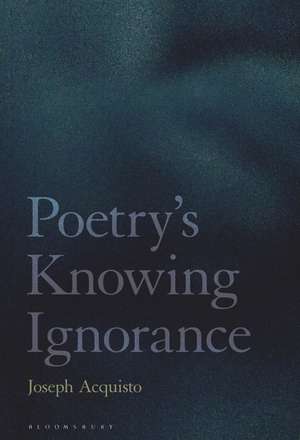
Poetry's Knowing Ignorance
Autor Professor Joseph Acquistoen Limba Engleză Paperback – 25 mar 2021
To resist concluding is to embrace a kind of productive ignorance, a knowledge that is first and foremost aware of poetic knowledge's own limits. Poetry's Knowing Ignorance shows, through an examination of French poetry, how it is this dialogue in response to a constant questioning, to an answer-turned-question, that continues to blur the boundary between poetry and writing about poetry, between poetry and criticism, and between poetry and other kinds of experience.
Preț: 223.10 lei
Preț vechi: 297.05 lei
-25%
Puncte Express: 335
Carte tipărită la comandă
Livrare economică 06-20 iunie
Specificații
ISBN-13: 9781501378379
ISBN-10: 1501378376
Pagini: 224
Dimensiuni: 152 x 229 mm
Greutate: 0.3 kg
Editura: Bloomsbury Publishing
Colecția Bloomsbury Academic
Locul publicării:New York, United States
ISBN-10: 1501378376
Pagini: 224
Dimensiuni: 152 x 229 mm
Greutate: 0.3 kg
Editura: Bloomsbury Publishing
Colecția Bloomsbury Academic
Locul publicării:New York, United States
Cuprins
Note on Translations
Introduction: "That Key That You Must Always Keep on Losing"
1 Knowledge, Truth, and Ignorance in Nineteenth-Century Poetry (Hugo and Baudelaire)
2 Saying the Ineffable: Poetry is Poetry (From the Romantics to Valéry)
3 Non-knowledge, Limit, and Productive Impossibility (Bataille and Blanchot)
4 "Moving forth from uncertainty all the same" (Jaccottet and Maulpoix)
5 Poetry, Community, Relation
Notes
Bibliography
Index
Introduction: "That Key That You Must Always Keep on Losing"
1 Knowledge, Truth, and Ignorance in Nineteenth-Century Poetry (Hugo and Baudelaire)
2 Saying the Ineffable: Poetry is Poetry (From the Romantics to Valéry)
3 Non-knowledge, Limit, and Productive Impossibility (Bataille and Blanchot)
4 "Moving forth from uncertainty all the same" (Jaccottet and Maulpoix)
5 Poetry, Community, Relation
Notes
Bibliography
Index
Recenzii
In a study that is at once thorough and highly engaging, Acquisto convincingly demonstrates how poetry has come to transform modern doubt into a creative force--an endless movement toward understanding that, in refusing certitude, is the richer for remaining open to possibility. His concluding reflections on the potential for fostering community are especially timely in this regard, in an era of informational impatience and deadlocked political discourse.
This is not just a brilliant book that unravels French poetics for specialists and non-specialists alike, but one that gives us invaluable heuristic tools--what Chamoiseau called 'poecepts'--to approach most other literary traditions related to modernism, across cultures and languages. Joseph Acquisto gracefully elucidates how French thought (Bataille, Blanchot, Nancy, and Rancière in particular) is conveyed through (and intertwined with) poetics and how poetry's most profound knowledge is also poetry's refusal to impose itself as an absolute form of knowing: 'Poetry is thus that song that you cannot grab, that space where you cannot dwell, that key you must always keep on losing' (Philippe Jaccottet).
Acquisto's sustained meditation on modern poetry's productive, rather than aporetic, engagement with ignorance delivers a surprise: self-reflexivity, in the form of poetry's restless self-definitional impulse, connects, rather than disconnects, poetry and the world. This incisive study is as deeply-searching as the poetic works it reads.
What emerges ... from these nuanced and thoughtful readings of prose essays on poetry is a persuasive narrative of how a certain strand of philosophical thinking in France developed an idea of poetry as the site of an endless questioning. What emerges ... from these nuanced and thoughtful readings of prose essays on poetry is a persuasive narrative of how a certain strand of philosophical thinking in France developed an idea of poetry as the site of an endless questioning.
This is not just a brilliant book that unravels French poetics for specialists and non-specialists alike, but one that gives us invaluable heuristic tools--what Chamoiseau called 'poecepts'--to approach most other literary traditions related to modernism, across cultures and languages. Joseph Acquisto gracefully elucidates how French thought (Bataille, Blanchot, Nancy, and Rancière in particular) is conveyed through (and intertwined with) poetics and how poetry's most profound knowledge is also poetry's refusal to impose itself as an absolute form of knowing: 'Poetry is thus that song that you cannot grab, that space where you cannot dwell, that key you must always keep on losing' (Philippe Jaccottet).
Acquisto's sustained meditation on modern poetry's productive, rather than aporetic, engagement with ignorance delivers a surprise: self-reflexivity, in the form of poetry's restless self-definitional impulse, connects, rather than disconnects, poetry and the world. This incisive study is as deeply-searching as the poetic works it reads.
What emerges ... from these nuanced and thoughtful readings of prose essays on poetry is a persuasive narrative of how a certain strand of philosophical thinking in France developed an idea of poetry as the site of an endless questioning. What emerges ... from these nuanced and thoughtful readings of prose essays on poetry is a persuasive narrative of how a certain strand of philosophical thinking in France developed an idea of poetry as the site of an endless questioning.