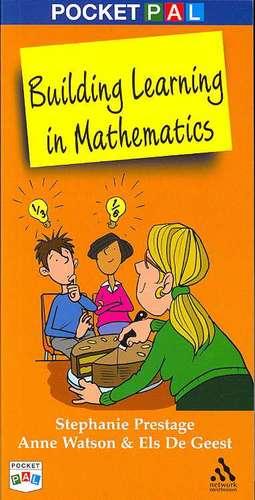
Pocket PAL: Building Learning in Mathematics: Pocket PAL
Autor Dr Stephanie Prestage, Els De Geest, Anne Watsonen Limba Engleză Paperback – 24 mai 2007



Preț: 43.33 lei
Preț vechi: 75.16 lei
-42%
Puncte Express: 65
Preț estimativ în valută:
7.66€ • 8.99$ • 6.65£
7.66€ • 8.99$ • 6.65£
Carte disponibilă
Livrare economică 17 februarie-03 martie
Specificații
ISBN-13: 9781855392281
ISBN-10: 1855392283
Pagini: 96
Ilustrații: 8
Dimensiuni: 100 x 198 x 8 mm
Greutate: 0.13 kg
Editura: Bloomsbury Publishing
Colecția Network Continuum Education
Seria Pocket PAL
Locul publicării:London, United Kingdom
ISBN-10: 1855392283
Pagini: 96
Ilustrații: 8
Dimensiuni: 100 x 198 x 8 mm
Greutate: 0.13 kg
Editura: Bloomsbury Publishing
Colecția Network Continuum Education
Seria Pocket PAL
Locul publicării:London, United Kingdom
V-ar putea interesa
-
 -14%Preț: 281.41 lei328.10 lei
 -
 Classroom Management MattersCarmen FarinaPreț: 212.13 lei
 -
 -18%Preț: 917.89 lei1119.38 lei
 -
 The Skillful TeacherStephen D BrookfieldPreț: 216.57 lei
 -
 Preț: 158.49 lei
 -
 Learning PersonalizedAllison ZmudaPreț: 155.32 lei
 -
 The Discussion BookStephen D BrookfieldPreț: 129.09 lei
 -
 Adapting and Extending Secondary Mathematics Activities: New Tasks FOr OldStephanie Prestage-18%Preț: 908.34 lei1107.72 lei
 -
 Dream StealersSuzanne O'NeilPreț: 138.35 lei
 -
 TExES Core Subjects Ec-6 291 Book and OnlineSharon A WynnePreț: 256.55 lei
 -
 Preț: 313.45 lei
 -
 Adapting and Extending Secondary Mathematics Activities: New Tasks FOr OldStephanie PrestagePreț: 295.10 lei
 -
 Accelerated Learning in PracticeAlistair Smith-41%Preț: 139.67 lei235.34 lei
 -
 Creating an Accelerated Learning SchoolMark Lovatt-40%Preț: 95.55 lei160.13 lei
 -
 Personalizing LearningJohn West-Burnham-17%Preț: 267.20 lei320.72 lei
 -
 Personalizing Learning in the 21st CenturyProfessor Sara de Freitas-18%Preț: 320.88 lei390.72 lei
 -
 -42%Preț: 82.40 lei142.36 lei
 -
 Atlas ShruggedTrisha LivelyPreț: 47.64 lei
Cuprins
Teaching low attaining students
Defining deep progress
Expected improvements
Establishing work habits
a) Behaviour
b) Challenge and struggle
c) Silent moments
Participation
a) Joining in with your mind
b) Learning and moving
c) Speaking and listening
d) Getting a good discussion
Interaction
a) Question types
b) Between teacher and students
c) Creating discussion between students
d) Working in pairs
Reacting to students to answers and non answers
a) Shifting responsibility to students
b) Focussing on questioning answers
c) Dealing with unexpected answers
d) Storing good ideas
Giving time to think and learn
a) Immersion in a topic world
b) Thinking is more important than finishing
c) I got rhythm
d) Working quickly and reflecting slowly
Developing memory
a) Structuring teaching to help memory
b) Explicit work
c) Doing the whole thing in your head
d) Using physical and visual memory
e) Combine words, symbols and actions
Visualising
a) Developing imagination
b) Using equipment
Students' writing
a) Writing helps learning
b) Writing hinders learning
Students' awareness of progress
a) Knowing what you have learned
Giving choice
a) Choosing what to do
b) Choosing how to do it
c) Choosing what to do next
Making mathematical connections
a) What is changing; what is staying the same?
b) Between tasks
Dealing with mathematical complexity
a) Really doing mathematics
b) Sorting out complexity
c) Doing your own maths
Bibliography and resources.
Defining deep progress
Expected improvements
Establishing work habits
a) Behaviour
b) Challenge and struggle
c) Silent moments
Participation
a) Joining in with your mind
b) Learning and moving
c) Speaking and listening
d) Getting a good discussion
Interaction
a) Question types
b) Between teacher and students
c) Creating discussion between students
d) Working in pairs
Reacting to students to answers and non answers
a) Shifting responsibility to students
b) Focussing on questioning answers
c) Dealing with unexpected answers
d) Storing good ideas
Giving time to think and learn
a) Immersion in a topic world
b) Thinking is more important than finishing
c) I got rhythm
d) Working quickly and reflecting slowly
Developing memory
a) Structuring teaching to help memory
b) Explicit work
c) Doing the whole thing in your head
d) Using physical and visual memory
e) Combine words, symbols and actions
Visualising
a) Developing imagination
b) Using equipment
Students' writing
a) Writing helps learning
b) Writing hinders learning
Students' awareness of progress
a) Knowing what you have learned
Giving choice
a) Choosing what to do
b) Choosing how to do it
c) Choosing what to do next
Making mathematical connections
a) What is changing; what is staying the same?
b) Between tasks
Dealing with mathematical complexity
a) Really doing mathematics
b) Sorting out complexity
c) Doing your own maths
Bibliography and resources.
Recenzii
'This book is well written, easy to read or dip into - a must for all mathematics teachers' Learning and Teaching Update, November 2008