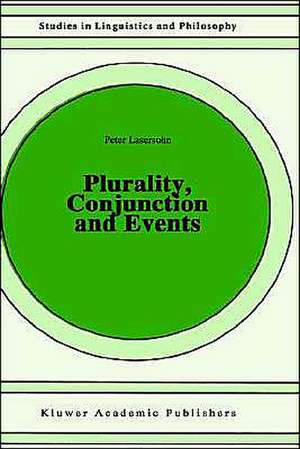
Plurality, Conjunction and Events: Studies in Linguistics and Philosophy, cartea 55
Autor P. Lasersohnen Limba Engleză Hardback – 31 dec 1994
Din seria Studies in Linguistics and Philosophy
- 18%
 Preț: 763.03 lei
 - 18%
 Preț: 978.49 lei
 -
 Preț: 381.80 lei
 - 18%
 Preț: 1369.72 lei
 - 18%
 Preț: 737.88 lei
 - 20%
 Preț: 573.45 lei
 - 20%
 Preț: 637.07 lei
 - 18%
 Preț: 700.24 lei
 - 15%
 Preț: 559.74 lei
 - 15%
 Preț: 624.35 lei
 - 18%
 Preț: 726.89 lei
 - 18%
 Preț: 1599.81 lei
 - 18%
 Preț: 919.36 lei
 - 20%
 Preț: 672.15 lei
 - 18%
 Preț: 990.14 lei
 - 18%
 Preț: 1889.94 lei
 - 15%
 Preț: 664.69 lei
 - 18%
 Preț: 982.58 lei
 -
 Preț: 374.59 lei
 - 18%
 Preț: 909.41 lei
 - 18%
 Preț: 951.85 lei
 - 18%
 Preț: 985.52 lei
 - 18%
 Preț: 1261.42 lei
 - 15%
 Preț: 673.19 lei
 - 15%
 Preț: 664.69 lei
 -
 Preț: 380.36 lei
 - 18%
 Preț: 909.99 lei
 -
 Preț: 372.96 lei
 - 18%
 Preț: 913.97 lei
 - 20%
 Preț: 1574.36 lei
 - 18%
 Preț: 981.22 lei
 - 18%
 Preț: 1186.80 lei
Preț: 981.32 lei
Preț vechi: 1196.72 lei
-18%
Puncte Express: 1472
Carte tipărită la comandă
Livrare economică 27 noiembrie-11 decembrie
Livrare prin curier în România Termenul estimat este afișat lângă disponibilitate.
Transport gratuit pentru acest produs Plată online sau ramburs, în funcție de opțiunile comenzii.
Retur gratuit în 14 zile Comandă securizată și suport în română.
Specificații
ISBN-13: 9780792332381
ISBN-10: 0792332385
Pagini: 324
Ilustrații: XII, 308 p.
Dimensiuni: 160 x 241 x 23 mm
Greutate: 0.6 kg
Ediția:1995
Editura: Springer
Colecția Studies in Linguistics and Philosophy
Seria Studies in Linguistics and Philosophy
Locul publicării:Dordrecht, Netherlands
ISBN-10: 0792332385
Pagini: 324
Ilustrații: XII, 308 p.
Dimensiuni: 160 x 241 x 23 mm
Greutate: 0.6 kg
Ediția:1995
Editura: Springer
Colecția Studies in Linguistics and Philosophy
Seria Studies in Linguistics and Philosophy
Locul publicării:Dordrecht, Netherlands
V-ar putea interesa
-
 Eats, Shoots and LeavesLynne TrussPreț: 77.06 lei
 -
 Preț: 114.96 lei
 -
 Common Errors and Problems in EnglishRobert AllenPreț: 114.94 lei
 -
 The King's EnglishKingsley AmisPreț: 78.92 lei
 -
 -28%Preț: 477.54 lei662.61 lei
 -
 The Origins of Vowel SystemsBart De Boer-21%Preț: 285.33 lei360.67 lei
 -
 Inflectional IdentityAsaf Bachrach-21%Preț: 453.55 lei575.83 lei
 -
 Serial Verb Constructions: A Cross-Linguistic TypologyAlexandra Y. Aikhenvald-21%Preț: 459.57 lei579.36 lei
 -
 Intransitive PredicationLeon Stassen-27%Preț: 464.80 lei638.85 lei
 -
 The Syntax of Aspect: Deriving Thematic and Aspectual InterpretationNomi Erteschik-Shir-21%Preț: 511.84 lei651.31 lei
 -
 SubordinationSonia Cristofaro-28%Preț: 500.01 lei697.50 lei
 -
 Lexical Plurals: A Morphosemantic ApproachPaolo Acquaviva-21%Preț: 374.29 lei474.37 lei
 -
 The Paradigmatic Structure of Person MarkingMichael Cysouw-22%Preț: 371.41 lei476.32 lei
 -
 -21%Preț: 373.89 lei474.13 lei
 -
 Auxiliary Verb ConstructionsGregory D. S. Anderson-22%Preț: 451.90 lei579.36 lei
 -
 Simple Sentences, Substitution, and IntuitionsJennifer M. Saul-13%Preț: 299.10 lei345.05 lei
 -
 -40%Preț: 138.52 lei232.72 lei
 -
 -39%Preț: 47.69 lei78.78 lei
Public țintă
ResearchCuprins
One. Collective and Distributive Readings: History and Range of Possible Analyses.- 1: Logical Form.- 2: The NP/S Analysis.- 3: The Relational/S Analysis.- 4: The S/S Analysis.- 5: Two Types of NP/NP Analysis.- 6: Interlude On Collective Action and Colors.- 7: Locating the Ambiguity.- 8: How Many Readings?.- 9: On The Structure of Groups.- 10: The Event-Free Fragment.- Two. Events in the Semantics of Plurality and Conjunction.- 11: Earlier Work on Collectivizing Adverbials.- 12: Return to an Event-Based Analysis.- 13: Pluractional Markers.- 14: Unifying the Semantics of Conjunction.- Conclusion.- References.