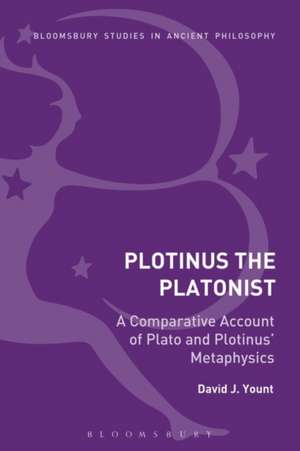
Plotinus the Platonist: A Comparative Account of Plato and Plotinus' Metaphysics: Bloomsbury Studies in Ancient Philosophy
Autor David J. Younten Limba Engleză Paperback – 27 oct 2016
Yount presents thorough explanations and quotations from the works of each classical philosopher to demonstrate his thesis, concluding comprehensively that Plato and Plotinus do not essentially differ on their metaphysical conceptions. This is an ideal text for Plato and Plotinus scholars and academics, and excellent supplementary reading for upper-level undergraduates students and postgraduate students of ancient philosophy.
| Toate formatele și edițiile | Preț | Express |
|---|---|---|
| Paperback (1) | 265.30 lei 43-57 zile | |
| Bloomsbury Publishing – 27 oct 2016 | 265.30 lei 43-57 zile | |
| Hardback (1) | 795.27 lei 43-57 zile | |
| Bloomsbury Publishing – 23 oct 2014 | 795.27 lei 43-57 zile |
Preț: 265.30 lei
Puncte Express: 398
Preț estimativ în valută:
46.97€ • 54.69$ • 40.80£
46.97€ • 54.69$ • 40.80£
Carte tipărită la comandă
Livrare economică 23 februarie-09 martie
Preluare comenzi: 021 569.72.76
Specificații
ISBN-13: 9781474283687
ISBN-10: 1474283683
Pagini: 304
Dimensiuni: 156 x 234 x 24 mm
Greutate: 0.42 kg
Ediția:NIPPOD
Editura: Bloomsbury Publishing
Colecția Bloomsbury Academic
Seria Bloomsbury Studies in Ancient Philosophy
Locul publicării:London, United Kingdom
ISBN-10: 1474283683
Pagini: 304
Dimensiuni: 156 x 234 x 24 mm
Greutate: 0.42 kg
Ediția:NIPPOD
Editura: Bloomsbury Publishing
Colecția Bloomsbury Academic
Seria Bloomsbury Studies in Ancient Philosophy
Locul publicării:London, United Kingdom
V-ar putea interesa
-
 History and Illusion in PoliticsRaymond GeussPreț: 193.16 lei
 -
 Invitation to Philosophy 2eM HollisPreț: 280.11 lei
 -
 Bigger than Chaos – Understanding Complexity Through ProbabilityMichael StrevensPreț: 318.96 lei
 -
 Alienation And FreedomRichard SchmittPreț: 366.56 lei
 -
 Preț: 464.18 lei
 -
 God Seen in the Mirror of the World: An Introduction to the Philosophy of GodPierre-Marie EmonetPreț: 139.24 lei
 -
 History of Philosophy Volume 11: Logical Postivism and ExistentialismFrederick Copleston-43%Preț: 119.34 lei207.79 lei
 -
 The Shorter Leibniz Texts: A Collection of New TranslationsDr Lloyd Strickland-19%Preț: 194.82 lei239.33 lei
 -
 PhilosophyB. Greetham-17%Preț: 466.46 lei561.99 lei
 -
 -23%Preț: 443.33 lei575.76 lei
 -
 10 Moral ParadoxesS SmilanskyPreț: 218.07 lei
 -
 Thinking of Answers: Questions in the Philosophy of Everyday LifeProfessor A. C. Grayling-29%Preț: 81.91 lei115.27 lei
 -
 R. G. Collingwood: A Research CompanionProfessor James Connelly-34%Preț: 975.35 lei1479.66 lei
 -
 Dying for Ideas: The Dangerous Lives of the PhilosophersCostica Bradatan-47%Preț: 74.69 lei141.37 lei
 -
 Pacifism: A Philosophy of NonviolenceProfessor Robert L. Holmes-17%Preț: 186.76 lei225.89 lei
 -
 Slow Philosophy: Reading against the InstitutionMichelle Boulous Walker-12%Preț: 165.27 lei188.48 lei
 -
 LacanSlavoj ZizekPreț: 262.95 lei
Cuprins
Introduction
1. The One or The Good: The Source of All Things
2. Beauty
3. Intellect: The Intelligible Region
4. The All-Soul or World-Soul
5. The Three Hypostases and Emanation
6. Matter: The Receptacle?
Conclusion
Bibliography
Index Locorum
General Index
1. The One or The Good: The Source of All Things
2. Beauty
3. Intellect: The Intelligible Region
4. The All-Soul or World-Soul
5. The Three Hypostases and Emanation
6. Matter: The Receptacle?
Conclusion
Bibliography
Index Locorum
General Index
Recenzii
To the unseasoned reader of late ancient philosophy, the book offers a good introduction to the main concepts, principles, and structure of what lies beyond the realm of sense-perception. ... It is warmly welcomed.
Virtually no-one has examined in detail how far Plotinus' metaphysics accurately represents the developed thought of Plato himself. Yount has made a bold and challenging attempt to do just that.
This book is plainly a labour of love, based on protracted and deep consideration of the works of both Plato and Plotinus, and a formidable command of the secondary authorities. Even if it will not convince all readers on all points, it will certainly provide all of us with much food for thought, and is warmly to be welcomed for that.
Yount makes a vigorous and painstakingly constructed case for a claim that was never questioned in late antiquity and is now widely viewed as wrongheaded: Plotinus was the consummate exegete of the "Platonic revelation".
This is a very welcome, scholarly addition to the growing literature on Plotinus as a serious philosopher, whose work contributed so much to our understanding of Plato as well as to philosophical practice.
This book is a concise but thorough treatment of a central issue in Plotinus scholarship - his fidelity to Plato's original texts and principles. Dr. Yount makes a compelling case for rethinking the relationship between Plotinus' so-called Neoplatonism and Classical Platonism. In so doing, he also provides a clear textually grounded introduction to Plotinus' and indirectly to Plato's philosophies.
Virtually no-one has examined in detail how far Plotinus' metaphysics accurately represents the developed thought of Plato himself. Yount has made a bold and challenging attempt to do just that.
This book is plainly a labour of love, based on protracted and deep consideration of the works of both Plato and Plotinus, and a formidable command of the secondary authorities. Even if it will not convince all readers on all points, it will certainly provide all of us with much food for thought, and is warmly to be welcomed for that.
Yount makes a vigorous and painstakingly constructed case for a claim that was never questioned in late antiquity and is now widely viewed as wrongheaded: Plotinus was the consummate exegete of the "Platonic revelation".
This is a very welcome, scholarly addition to the growing literature on Plotinus as a serious philosopher, whose work contributed so much to our understanding of Plato as well as to philosophical practice.
This book is a concise but thorough treatment of a central issue in Plotinus scholarship - his fidelity to Plato's original texts and principles. Dr. Yount makes a compelling case for rethinking the relationship between Plotinus' so-called Neoplatonism and Classical Platonism. In so doing, he also provides a clear textually grounded introduction to Plotinus' and indirectly to Plato's philosophies.