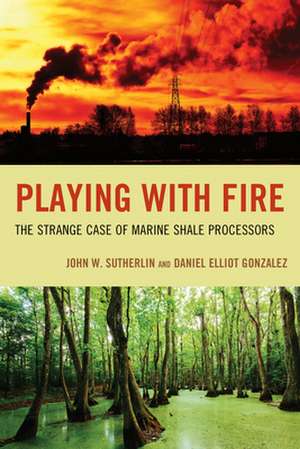
Playing with Fire: The Strange Case of Marine Shale Processors
Autor John W. Sutherlin, Daniel Elliot Gonzalezen Limba Engleză Paperback – 30 mar 2021
Preț: 181.42 lei
Preț vechi: 251.35 lei
-28%
Puncte Express: 272
Carte tipărită la comandă
Livrare economică 26 noiembrie-10 decembrie
Livrare prin curier în România Termenul estimat este afișat lângă disponibilitate.
Transport gratuit de la 400.00 lei Plată online sau ramburs, în funcție de opțiunile comenzii.
Retur gratuit în 14 zile Comandă securizată și suport în română.
Specificații
ISBN-13: 9780761872498
ISBN-10: 0761872493
Pagini: 362
Ilustrații: 14 b/w photos;
Dimensiuni: 155 x 230 x 21 mm
Greutate: 0.44 kg
Editura: Bloomsbury Publishing
Colecția Hamilton Books
Locul publicării:New York, United States
ISBN-10: 0761872493
Pagini: 362
Ilustrații: 14 b/w photos;
Dimensiuni: 155 x 230 x 21 mm
Greutate: 0.44 kg
Editura: Bloomsbury Publishing
Colecția Hamilton Books
Locul publicării:New York, United States
V-ar putea interesa
-
 Bioremediation of Petroleum Hydrocarbons in Cold RegionsDennis M. FillerPreț: 439.89 lei
 -
 Managing Ash from Municipal Waste IncineratorsAlyce M. UjiharaPreț: 223.63 lei
 -
 The Global Dynamics of Regenerative MedicineA. Webster-15%Preț: 614.43 lei722.85 lei
 -
 Linking People, Place, and PolicyStephen J. Walsh-15%Preț: 647.04 lei761.23 lei
 -
 Paraoxonase (PON1) in Health and DiseaseLucio G. Costa-15%Preț: 640.73 lei753.79 lei
 -
 Health Effects of Ambient Air PollutionJane Q Koenig-15%Preț: 645.13 lei758.98 lei
 -
 Reviews of Environmental Contamination and Toxicology Volume 210David M. Whitacre-39%Preț: 540.87 lei883.49 lei
 -
 Hazardous Waste Management, Volume ISengupta, SukalyanPreț: 257.70 lei
 -
 Waves and Tidal Flat EcosystemsEiichi BabaPreț: 384.90 lei
 -
 Springer UmweltlexikonMüfit Bahadir-11%Preț: 589.88 lei662.78 lei
 -
 Preț: 434.96 lei
 -
 Eco Targets, Goal Functions, and OrientorsFelix Müller-18%Preț: 923.62 lei1126.36 lei
 -
 Atmosphärische AusbreitungsmodellierungAxel ZengerPreț: 350.23 lei
 -
 PVC und Umwelt: Eine BestandsaufnahmeHorst PohlePreț: 402.16 lei
 -
 UmweltchemieVolker KoßPreț: 286.30 lei
 -
 Schadstoffe im BodenJörg LewandowskiPreț: 328.63 lei
 -
 Integrated Assessment of Running Waters in EuropeDaniel Hering-24%Preț: 870.99 lei1146.04 lei
 -
 Integrated Soil and Sediment Research: A Basis for Proper ProtectionHerman J P Eijsackers-18%Preț: 1913.10 lei2333.04 lei
 -
 Animal Biomarkers as Pollution IndicatorsDavid B. Peakall-18%Preț: 1171.77 lei1428.99 lei
 -
 Monitoring Ecological Condition in the Western United StatesShabeg S Sandhu-15%Preț: 656.02 lei771.79 lei
 -
 -18%Preț: 912.85 lei1113.23 lei
Cuprins
List of Figures
Foreword
Preface
Introduction. Sound and Fury, Signifying Everything
Chapter One. Something about Saint Mary
Chapter Two. The Bacon Gets Burnt
Chapter Three. A Fire from Within
Chapter Four. Not a Sentimental Journey
Chapter Five. Back to Louisiana
Charter Six. The People vs. Marine Shale: Building the Case
Chapter Seven. Case Closed, Pt. 1
Chapter Eight. Case Closed, Pt. 2: Verdict Rendered
Chapter Nine. Putting Out the Fire
Conclusions. So, What Did We Learn?
Index
Selected Bibliography
About the Authors
Foreword
Preface
Introduction. Sound and Fury, Signifying Everything
Chapter One. Something about Saint Mary
Chapter Two. The Bacon Gets Burnt
Chapter Three. A Fire from Within
Chapter Four. Not a Sentimental Journey
Chapter Five. Back to Louisiana
Charter Six. The People vs. Marine Shale: Building the Case
Chapter Seven. Case Closed, Pt. 1
Chapter Eight. Case Closed, Pt. 2: Verdict Rendered
Chapter Nine. Putting Out the Fire
Conclusions. So, What Did We Learn?
Index
Selected Bibliography
About the Authors
Recenzii
It has been said that, from an environmental justice movement perspective, Louisiana remains a hotbed of grassroots community activism, and that many women have emerged as leaders from groups of concerned citizens. Playing With Fire examines the protracted fight led by women against Louisiana's political leaders, the Department of Environmental Quality's regulators, and the company, Marine Shale Processors, that operated the world's largest hazardous waste incinerator. This well-written book examines the racial and class dynamics that were present in that struggle, and offers lessons learned for grassroots organizing, citizen participation, and community activism.
Crossing over the Amelia Bridge, one no longer sees the Marine Shale Kiln releasing toxic emissions into the air and there is no longer a threat that another company will try to reopen the facility. May the children, who were the Neuroblastoma victims, never be forgotten.
Acknowledging environmental consequences of a lax regulatory tradition has long been a hard sell in Louisiana. Playing with Fire greatly advances our understanding of what has been a neglected topic in public discourse. Politicians, regulators, and indeed industry leaders should have a list of required readings, and this book should be on that list.
The authors deliver the most comprehensive case study of hazardous waste management to date by weaving a narrative that shows a comprehensive understanding of the intersection of economics, environmental concerns, politics, history, culture, race, gender, class, religion and policy-making in the unique mélange that is Louisiana.This is a must read for every policy-maker, and educator.
Playing with Fire captures the labyrinthine web of power and influence that directs politics in the Pelican State. Telling a near-apocalyptic story, Playing with Fire probes Louisiana's disastrous environmental and regulatory past while forecasting an uncertain future.
The public relies on its leadership to get the balancing act right-on economic factors, on environmental factors, on health and quality of life factors, among others. Playing with Fire presents a cautionary tale on what happens when whoever's doing that balancing act falls short of what's needed to protect those most vulnerable.
Crossing over the Amelia Bridge, one no longer sees the Marine Shale Kiln releasing toxic emissions into the air and there is no longer a threat that another company will try to reopen the facility. May the children, who were the Neuroblastoma victims, never be forgotten.
Acknowledging environmental consequences of a lax regulatory tradition has long been a hard sell in Louisiana. Playing with Fire greatly advances our understanding of what has been a neglected topic in public discourse. Politicians, regulators, and indeed industry leaders should have a list of required readings, and this book should be on that list.
The authors deliver the most comprehensive case study of hazardous waste management to date by weaving a narrative that shows a comprehensive understanding of the intersection of economics, environmental concerns, politics, history, culture, race, gender, class, religion and policy-making in the unique mélange that is Louisiana.This is a must read for every policy-maker, and educator.
Playing with Fire captures the labyrinthine web of power and influence that directs politics in the Pelican State. Telling a near-apocalyptic story, Playing with Fire probes Louisiana's disastrous environmental and regulatory past while forecasting an uncertain future.
The public relies on its leadership to get the balancing act right-on economic factors, on environmental factors, on health and quality of life factors, among others. Playing with Fire presents a cautionary tale on what happens when whoever's doing that balancing act falls short of what's needed to protect those most vulnerable.