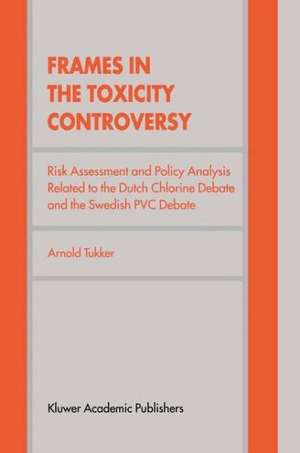
Frames in the Toxicity Controversy: Risk Assessment and Policy Analysis Related to the Dutch Chlorine Debate and the Swedish PVC Debate
Autor Arnold Tukkeren Limba Engleză Paperback – 4 oct 2012
Preț: 912.85 lei
Preț vechi: 1113.23 lei
-18%
Puncte Express: 1369
Carte tipărită la comandă
Livrare economică 28 noiembrie-12 decembrie
Livrare prin curier în România Termenul estimat este afișat lângă disponibilitate.
Transport gratuit pentru acest produs Plată online sau ramburs, în funcție de opțiunile comenzii.
Retur gratuit în 14 zile Comandă securizată și suport în română.
Specificații
ISBN-13: 9789401059985
ISBN-10: 9401059985
Pagini: 408
Ilustrații: XVIII, 382 p.
Dimensiuni: 155 x 235 x 21 mm
Greutate: 0.57 kg
Ediția:1999
Editura: SPRINGER NETHERLANDS
Colecția Springer
Locul publicării:Dordrecht, Netherlands
ISBN-10: 9401059985
Pagini: 408
Ilustrații: XVIII, 382 p.
Dimensiuni: 155 x 235 x 21 mm
Greutate: 0.57 kg
Ediția:1999
Editura: SPRINGER NETHERLANDS
Colecția Springer
Locul publicării:Dordrecht, Netherlands
V-ar putea interesa
-
 Biological Degradation and Bioremediation of Toxic ChemicalsRasul Chaudhry-18%Preț: 1280.22 lei1561.25 lei
 -
 -18%Preț: 985.87 lei1202.27 lei
 -
 -15%Preț: 625.26 lei735.60 lei
 -
 Product Innovation and Eco-EfficiencyJudith E. M. Klostermann-18%Preț: 980.56 lei1195.80 lei
 -
 Strategic Environmental Assessment in EuropeDieter Wagner-20%Preț: 654.16 lei817.69 lei
 -
 Environment and Chemicals in AgricultureWinteringham-18%Preț: 1884.65 lei2298.35 lei
 -
 Environmental Impacts & Policies for the EEC Tanning IndustryUrwick Technology Management Ltd.Preț: 372.67 lei
 -
 Partnership and LeadershipArnold Tukker-18%Preț: 981.53 lei1196.99 lei
 -
 The Environmental Movement in IrelandLiam Leonard-15%Preț: 667.45 lei785.24 lei
 -
 -18%Preț: 1227.74 lei1497.25 lei
 -
 -23%Preț: 895.07 lei1162.44 lei
 -
 Public CommunicationLinda Blankenship-18%Preț: 1024.23 lei1249.06 lei
 -
 -18%Preț: 1023.29 lei1247.91 lei
 -
 -18%Preț: 1013.90 lei1236.46 lei
 -
 -18%Preț: 1014.41 lei1237.08 lei
 -
 Trace Organic Chemicals in Biosolids-Amended SoilsHiggins, Christopher P.-18%Preț: 755.36 lei921.17 lei
 -
 -18%Preț: 1013.34 lei1235.79 lei
 -
 -18%Preț: 753.21 lei918.55 lei
 -
 Nutrient ManagementDavid Clark-18%Preț: 753.99 lei919.50 lei
 -
 Ecological Effects of Thermal DischargesT. Langford-18%Preț: 1881.88 lei2294.98 lei
 -
 -18%Preț: 1769.96 lei2158.49 lei
 -
 -15%Preț: 518.31 lei609.78 lei
 -
 -18%Preț: 1396.20 lei1702.68 lei
Public țintă
ResearchCuprins
1 Introduction.- 1.1 Man-made chemicals and society.- 1.2 The context of the toxicity controversy.- 1.3 The problem.- 1.4 Study approach.- 1.5 Structure of this book.- 2 The role of science in controversies.- 2.1 Introduction.- 2.2 The status of knowledge.- 2.3 Robustness of knowledge claims in environmental controversies.- 2.4 Views on frame conflict and its drivers.- 2.5 Decision making in frame conflict.- 2.6 Problem definition.- 3 The toolbox for evaluations of environmental performance.- 3.1 Introduction.- 3.2 The toolbox for environmental evaluations.- 3.3 System definition.- 3.4 Interpretation: a general framework.- 3.5 Interpretation: toxic effects.- 3.6 Conclusion: a review of the toolbox and its robustness.- 4 Chlorine in the Netheriands: an analysis of environmental bottlenecks and uncertainties.- 4.1 The chlorine debate.- 4.2 Goal and approach.- 4.3 Methodology.- 4.4 Results: identifiable environmental bottlenecks.- 4.5 Results: the uncertainties concerning the impacts of chlorine.- 4.6 Conclusions.- 5 PVC in Sweden: an analysis of environmental bottlenecks.- 5.1 The PVC debate.- 5.2 Goal and approach.- 5.3 Methodology.- 5.4 Results.- 5.5 Conclusions.- 6 The Dutch chlorine debate.- 6.1 Introduction.- 6.2 Approach of the analysis.- 6.3 The actors in the Dutch chlorine debate.- 6.4 The Dutch chlorine debate.- 6.5 Analysis and conclusions.- 7 The Swedish PVC-debate.- 7.1 Introduction.- 7.2 Approach of the analysis.- 7.3 The actors in the Swedish PVC debate.- 7.4 The Swedish PVC debate.- 7.5 Analysis and conclusions.- 8 Conclusions.- 8.1 Introduction.- 8.2 The frames and driving factors.- 8.3 Robustness of knowledge claims and environmental evaluation tools.- 8.4 The process of decision making.- 9 Reflections and recommendations.- 9.1 Introduction.- 9.2 Suggestions for decision making in toxicity policy.- 9.3 Suggestions for decision making about chlorine and PVC.- 9.4 Recommendations for the generation of robust knowledge.- 9.5 Recommendations on the process of decision making.- 9.6 The final word: towards robust decision making in toxicity policy?.- Literature.