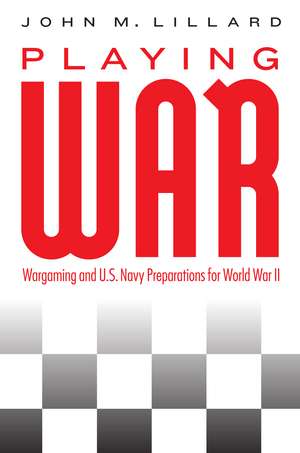
Playing War: Wargaming and U.S. Navy Preparations for World War II
Autor John M. Lillarden Limba Engleză Hardback – mai 2016
Between the First and Second World Wars, the U.S. Navy used the experience it had gained in battle to prepare for future wars through simulated conflicts, or war games, at the Naval War College. In Playing War John M. Lillard analyzes individual war games in detail, showing how players tested new tactics and doctrines, experimented with advanced technology, and transformed their approaches through these war games, learning lessons that would prepare them to make critical decisions in the years to come.
Recent histories of the interwar period explore how the U.S. Navy digested the impact of World War I and prepared itself for World War II. However, most of these works overlook or dismiss the transformational quality of the War College war games and the central role they played in preparing the navy for war. To address that gap, Playing War details how the interwar navy projected itself into the future through simulated conflicts. Playing War recasts the reputation of the interwar War College as an agent of preparation and innovation and the war games as the instruments of that agency.
Recent histories of the interwar period explore how the U.S. Navy digested the impact of World War I and prepared itself for World War II. However, most of these works overlook or dismiss the transformational quality of the War College war games and the central role they played in preparing the navy for war. To address that gap, Playing War details how the interwar navy projected itself into the future through simulated conflicts. Playing War recasts the reputation of the interwar War College as an agent of preparation and innovation and the war games as the instruments of that agency.
Preț: 246.61 lei
Puncte Express: 370
Carte disponibilă
Livrare economică 17 noiembrie-01 decembrie
Livrare prin curier în România Termenul estimat este afișat lângă disponibilitate.
Transport gratuit de la 400.00 lei Plată online sau ramburs, în funcție de opțiunile comenzii.
Retur gratuit în 14 zile Comandă securizată și suport în română.
Specificații
ISBN-13: 9781612347738
ISBN-10: 1612347738
Pagini: 224
Ilustrații: 22 illustrations, 7 tables, 8 graphs, index
Dimensiuni: 152 x 229 x 23 mm
Greutate: 0.48 kg
Editura: Potomac Books Inc
Colecția Potomac Books
Locul publicării:United States
ISBN-10: 1612347738
Pagini: 224
Ilustrații: 22 illustrations, 7 tables, 8 graphs, index
Dimensiuni: 152 x 229 x 23 mm
Greutate: 0.48 kg
Editura: Potomac Books Inc
Colecția Potomac Books
Locul publicării:United States
V-ar putea interesa
-
 -21%Preț: 101.43 lei128.93 lei
 -
 Brassey's Air Combat Reader: Historic Feats and Aviation LegendsPhilip HandlemanPreț: 60.62 lei
 -
 Patton's Photographs: War as He Saw ItKevin HymelPreț: 136.03 lei
 -
 Preț: 310.33 lei
 -
 Preț: 238.18 lei
 -
 Beyond the Killing Fields: War WritingsSydney SchanbergPreț: 234.75 lei
 -
 Global Air PowerJohn Andreas OlsenPreț: 242.62 lei
 -
 King of Poisons: A History of ArsenicJohn ParascandolaPreț: 163.15 lei
 -
 Preț: 250.69 lei
Notă biografică
John M. Lillard is a manager at Newport News Shipbuilding in Virginia and an adjunct professor of history at Tidewater Community College. He served fifteen years as a naval officer, was previously an operations analyst who worked in support of numerous navy, marine corps, and air force acquisition programs, and has worked in the field of wargaming, modeling, and simulation since 1995. His work has appeared in the Naval Institute’s Proceedings magazine and Rotor and Wing.
Cuprins
List of Illustrations
List of Tables
Acknowledgments
Introduction
1. The Players
2. The Game Process
3. The Early Phase, 1919–27
4. The Middle Phase, 1928–34
5. The Late Phase, 1935–41
Conclusion
Appendix A. Naval War College Class Demographics
Appendix B. Naval War College Wargames
Appendix C. The World Naval Balance, 1919–41
Notes
Bibliography
Index
Recenzii
“Playing War: Wargaming and US Navy Preparations for World War II should be on the bookshelf of every serviceman or woman who organizes, trains, and equips their subordinates. Wargaming, regardless of function (air, land, sea, cyber, space) will be increasingly relevant. Moreover, nuclear professionals must understand the effort it took the Navy to prepare for World War II, using wargaming as a tool, and apply this knowledge to the nuclear triad in an attempt to maintain a continuing deterrent advantage.”—Ethan Simantel, H-War
"I highly recommend that military professionals read this book."—Phillip G. Pattee, Naval Historical Foundation
"Playing War successfully bridges an interwar gap in naval historiography, and would be a useful research tool for those interested in the academic side of US naval officer preparations for the Second World War."—Charles Ross Patterson II, Northern Mariner
"John M. Lillard's study of war games, aptly titled Playing War: Wargaming and U.S. Navy Preparations for World War II, dissects the players, game processes, and phases of wargaming during the interwar period."—Courtney Webb, Nautical Research Guild's Model Ship World
"This is an important book. It fills a gap in the scholarship of a period. Just as the future admirals made their mistakes on the gaming surfaces at Newport instead of the waters of the Pacific, so this book may help us prepare for future wars. It does this not by telling readers what to think, but by showing us how we can learn to think."—Matthew Caffrey, Technology and Culture
“The best compilation of information and analysis of the wargaming efforts at the Naval War College between the wars [that is] currently available. It provides a needed corrective to some of the inaccurate mythology that has come to surround this subject.”—Peter Perla, author of The Art of Wargaming: A Guide for Professionals and Hobbyists
“A valuable book with a lot of detail that has never been assembled in one place before, and Lillard’s appraisal of the roles of the wargames is on target.”—Capt. Wayne P. Hughes Jr., U.S. Navy, Ret., professor of practice at the Naval Postgraduate School and author of Fleet Tactics: Theory and Practice
“Playing War is an outstanding study of the U.S. Naval War College’s interwar institutional culture. More than that, this book fills a major historiographical gap when it comes to not only the college’s history but also that of the navy and its war-planning methods. . . . This book is a must-read for any historian of the U.S. Navy or U.S. national security policy history.”—Hal M. Friedman, author of Digesting History: The U.S. Naval War College, the Lessons of World War Two, and Future Naval Warfare, 1945–1947
“Lillard makes an excellent case that the Pacific War was won on the game floor of the Naval War College.”—Albert A. Nofi, author of To Train the Fleet for War: The U.S. Navy Fleet Problems, 1923–1940