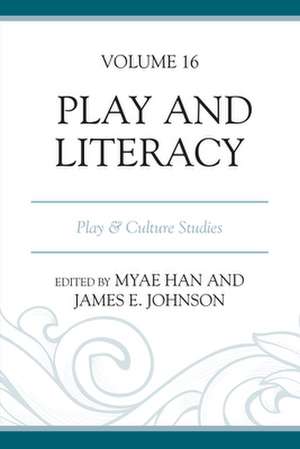
Play and Literacy: Play & Culture Studies, Volume 16: Play and Culture Studies
Editat de Myae Han, James E. Johnson Contribuţii de Kathleen A. Roskos, Renée Casbergue, Julie Parrish, M. Angel Bestwick, Tori K. Flint, Sandra J. Stone, Brian A. Stone, Sohyun Meacham, Timothy M. Vetere, Matthew E. Poehner, Marine Pepanyanen Limba Engleză Paperback – 4 feb 2021




Preț: 254.91 lei
Preț vechi: 333.83 lei
-24%
Puncte Express: 382
Carte tipărită la comandă
Livrare economică 28 noiembrie-12 decembrie
Livrare prin curier în România Termenul estimat este afișat lângă disponibilitate.
Transport gratuit de la 400.00 lei Plată online sau ramburs, în funcție de opțiunile comenzii.
Retur gratuit în 14 zile Comandă securizată și suport în română.
Specificații
ISBN-13: 9780761872313
ISBN-10: 0761872310
Pagini: 206
Ilustrații: 10 b/w photos; 12 tables
Dimensiuni: 153 x 230 x 13 mm
Greutate: 0.27 kg
Editura: Bloomsbury Publishing
Colecția Hamilton Books
Seria Play and Culture Studies
Locul publicării:New York, United States
ISBN-10: 0761872310
Pagini: 206
Ilustrații: 10 b/w photos; 12 tables
Dimensiuni: 153 x 230 x 13 mm
Greutate: 0.27 kg
Editura: Bloomsbury Publishing
Colecția Hamilton Books
Seria Play and Culture Studies
Locul publicării:New York, United States
Cuprins
List of Figures
List of Tables
Preface
Acknowledgments
Introduction
Section I. Foundation of Play and Literacy
Chapter 1. History of Play and Literacy Research: Contribution of Dr. James F. Christie
Myae Han
Chapter 2. The Book-Play Paradigm in Early Literacy Pedagogy
Kathleen A. Roskos
Section II. Play and Books
Chapter 3. "I wrote a Mona Lisa!" Preschoolers' Play During Traditional and Digital Writing
Renée Casbergue and Julie Parrish
Chapter 4. Children's Literature as a Means to Provide Time for Playful Learning While Meeting Academic Standards
M. Angel Bestwick
Chapter 5. Responsive Play: Exploring Language and Literacy Through Play as Reader Response
Tori K. Flint
Section III. Classroom Dynamics
Chapter 6. Play and Emerging Literacy: A Comparative Analysis of Kindergarten and Mixed-Age (K-2) Children's Scaffolding During Symbolic Play Transformations
Sandra J. Stone & Brian A. Stone
Chapter 7. Preschool Teachers' Responsive Interactions in the Dramatic Play Center and Children's Vocabulary Outcomes
Sohyun Meacham & Myae Han
Section IV. Teacher and Adult Education
Chapter 8. Re-Learning to Play: Mediating Pre-Service Teachers' Exploration of Drama-Based Instruction
Timothy M. Vetere & Matthew E. Poehner
Chapter 9. Play Element and Dynamics of Interaction in an Adult L2 Classroom with the Communicative Language Teaching (CLT) Approach
Marine Pepanyan & Sohyun Meacham
Index
About the Contributors
List of Tables
Preface
Acknowledgments
Introduction
Section I. Foundation of Play and Literacy
Chapter 1. History of Play and Literacy Research: Contribution of Dr. James F. Christie
Myae Han
Chapter 2. The Book-Play Paradigm in Early Literacy Pedagogy
Kathleen A. Roskos
Section II. Play and Books
Chapter 3. "I wrote a Mona Lisa!" Preschoolers' Play During Traditional and Digital Writing
Renée Casbergue and Julie Parrish
Chapter 4. Children's Literature as a Means to Provide Time for Playful Learning While Meeting Academic Standards
M. Angel Bestwick
Chapter 5. Responsive Play: Exploring Language and Literacy Through Play as Reader Response
Tori K. Flint
Section III. Classroom Dynamics
Chapter 6. Play and Emerging Literacy: A Comparative Analysis of Kindergarten and Mixed-Age (K-2) Children's Scaffolding During Symbolic Play Transformations
Sandra J. Stone & Brian A. Stone
Chapter 7. Preschool Teachers' Responsive Interactions in the Dramatic Play Center and Children's Vocabulary Outcomes
Sohyun Meacham & Myae Han
Section IV. Teacher and Adult Education
Chapter 8. Re-Learning to Play: Mediating Pre-Service Teachers' Exploration of Drama-Based Instruction
Timothy M. Vetere & Matthew E. Poehner
Chapter 9. Play Element and Dynamics of Interaction in an Adult L2 Classroom with the Communicative Language Teaching (CLT) Approach
Marine Pepanyan & Sohyun Meacham
Index
About the Contributors
Recenzii
The book's reader friendly writing makes it an easy read for professors, graduate students, practicing teachers, and other professionals. The research studies are well grounded in decades of literature and showcase the benefits of play in literacy learning. Each chapter addresses the need to challenge hegemonic educational systems that have relentlessly eliminated play from early childhood curricula. The most beneficial portion of the text can be found at the end of each chapter where the authors make recommendations that provide play opportunities leading intentionally to the development of various literacy skills. This edited volume will inspire readers to rethink existing practices and revalue play.