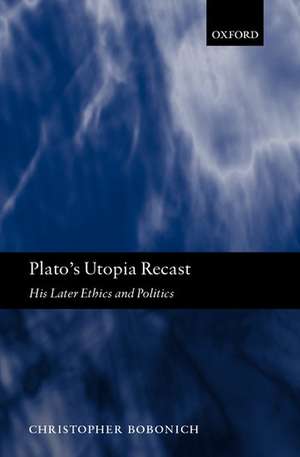
Plato's Utopia Recast: His Later Ethics and Politics
Autor Christopher Bobonichen Limba Engleză Hardback – 11 iul 2002
Preț: 1224.92 lei
Preț vechi: 1817.21 lei
-33%
Puncte Express: 1837
Carte tipărită la comandă
Livrare economică 13-18 noiembrie
Livrare prin curier în România Termenul estimat este afișat lângă disponibilitate.
Transport gratuit pentru acest produs Plată online sau ramburs, în funcție de opțiunile comenzii.
Retur gratuit în 14 zile Comandă securizată și suport în română.
Specificații
ISBN-13: 9780199251438
ISBN-10: 0199251436
Pagini: 656
Dimensiuni: 164 x 242 x 40 mm
Greutate: 1.05 kg
Ediția:New.
Editura: OUP OXFORD
Colecția OUP Oxford
Locul publicării:Oxford, United Kingdom
ISBN-10: 0199251436
Pagini: 656
Dimensiuni: 164 x 242 x 40 mm
Greutate: 1.05 kg
Ediția:New.
Editura: OUP OXFORD
Colecția OUP Oxford
Locul publicării:Oxford, United Kingdom
V-ar putea interesa
-
 Socrates' DefencePlato-39%Preț: 17.05 lei28.08 lei
 -
 PoeticsAristotle-29%Preț: 423.60 lei595.18 lei
 -
 Aristotle's Physics: A Collection of EssaysLindsay Judson-28%Preț: 405.01 lei565.77 lei
 -
 The Fabric of Character: Aristotle's Theory of VirtueNancy Sherman-20%Preț: 372.57 lei463.01 lei
 -
 Plato's TheaetetusDavid Bostock-29%Preț: 463.41 lei648.89 lei
 -
 Aristotle's First PrinciplesTerence Irwin-27%Preț: 411.06 lei563.91 lei
 -
 Determinism and Freedom in Stoic PhilosophySusanne Bobzien-28%Preț: 514.53 lei717.64 lei
 -
 Aristotle's De Interpretatione: Contradiction and DialecticC. W. A. Whitaker-29%Preț: 501.12 lei706.17 lei
 -
 Anecdotes of the CynicsRobert Dobbin-39%Preț: 17.03 lei28.07 lei
 -
 A Companion to SophoclesKirk OrmandPreț: 421.10 lei
 -
 Plato: A Complete Introduction: Teach YourselfRoy Jackson-28%Preț: 76.20 lei105.29 lei
 -
 World Mythology in Bite-sized ChunksMark DanielsPreț: 47.59 lei
 -
 Interest and Self-Interest in Ancient AthensVasileios I. Anastasiadis-11%Preț: 386.05 lei433.77 lei
Recenzii
In this careful, illuminating and fascinating book Bobonich demonstrates that Laws marks an important stage in Plato's philosophical development, and constitutes a major contribution to moral and political philosophy ... Bobonich's book is an important contribution. With its help, students of Plato's and Aristotle's moral and political philosophy can now do justice to Laws.
Bobonich's discussion is rich and dense, and it covers an extremely wide range of topics. Since his interpretation is supported by careful exegesis of many texts and by keen philosophical argument, the result is a book of exceptional importance for our understanding of Plato's work. . . . by far the best account we have of the ethics and political philosophy of the Laws. It is also a major contribution to our understanding of the philosophy of mind and metaphysics of value in Plato's later dialogues.
Over the last decade Professor Bobonich has built up, through a series of significant articles, a reputation as one of the most authoritative writers in English on Plato's Laws and more widely on the psychological and ethical theories of the later dialogues. With this, his first, book he establishes that reputation yet more securely and indeed enhances it.
This is by any standards a major work, which does for the later dialogues what Terence Irwin's Plato's Ethics did for the earlier and middle. The comparison is in my view a fair measure not only of its scope, but also of its quality.
Professor Bobonich marshals his arguments with subtlety and skill and carefully considers countervailing scholarly interpretations.
... turns on its head the traditional scholarly utopian interpretation of Plato's middle and later work.
... a book that should be of paramount interest to all students of utopian thought ... magisterial in its scope and scholarly in its erudition.
The ambition of Bobonich's project is likely to provoke a great deal of further debate, as much about psychology as about freedom and community, and is what makes the publication of Plato's Utopia Recast a memorable event in Plato scholarship.
Bobonich's study of the Laws (along with related aspects of other post-Republic dialogues, such as Phaedrus and Statesman) is truly brilliant and extraordinarily innovative. There is no doubt but that it will be seen immediately on publication to have revolutionized our understanding of this sprawling, difficult work ... The result is a challenging new view of Platonic politics, based upon the most complete, most insightful account of Plato's moral psychology - and its development - that anyone has yet provided.
... one of those rare things, a really exciting work of philosophical scholarship, which has me wanting to turn every page ... one of the best things that I have read on Plato for a very long time ... a thoroughly original book, not just in terms of its thesis, but in terms of its strikingly clear approach - which allows fresh meaning to shine out.
... an extraordinarily ambitious study of Plato's growth as an ethical and political philosopher from the Phaedo to the Laws. Its principal theme is that Plato came to regard the moral psychology and theory of cognition in the IRepublic as a failure in its own terms; that he therefore radically revised his views in the later dialogues; and that these changes reach their culmination in the Laws. This is a work of great scope and boldness, and is bound to be controversial. Whether readers agree with Bobonich or not, they will inevitably learn a great deal by having to come to terms with his admirably detailed and systematic account of Plato's development.
Bobonich's discussion is rich and dense, and it covers an extremely wide range of topics. Since his interpretation is supported by careful exegesis of many texts and by keen philosophical argument, the result is a book of exceptional importance for our understanding of Plato's work. . . . by far the best account we have of the ethics and political philosophy of the Laws. It is also a major contribution to our understanding of the philosophy of mind and metaphysics of value in Plato's later dialogues.
Over the last decade Professor Bobonich has built up, through a series of significant articles, a reputation as one of the most authoritative writers in English on Plato's Laws and more widely on the psychological and ethical theories of the later dialogues. With this, his first, book he establishes that reputation yet more securely and indeed enhances it.
This is by any standards a major work, which does for the later dialogues what Terence Irwin's Plato's Ethics did for the earlier and middle. The comparison is in my view a fair measure not only of its scope, but also of its quality.
Professor Bobonich marshals his arguments with subtlety and skill and carefully considers countervailing scholarly interpretations.
... turns on its head the traditional scholarly utopian interpretation of Plato's middle and later work.
... a book that should be of paramount interest to all students of utopian thought ... magisterial in its scope and scholarly in its erudition.
The ambition of Bobonich's project is likely to provoke a great deal of further debate, as much about psychology as about freedom and community, and is what makes the publication of Plato's Utopia Recast a memorable event in Plato scholarship.
Bobonich's study of the Laws (along with related aspects of other post-Republic dialogues, such as Phaedrus and Statesman) is truly brilliant and extraordinarily innovative. There is no doubt but that it will be seen immediately on publication to have revolutionized our understanding of this sprawling, difficult work ... The result is a challenging new view of Platonic politics, based upon the most complete, most insightful account of Plato's moral psychology - and its development - that anyone has yet provided.
... one of those rare things, a really exciting work of philosophical scholarship, which has me wanting to turn every page ... one of the best things that I have read on Plato for a very long time ... a thoroughly original book, not just in terms of its thesis, but in terms of its strikingly clear approach - which allows fresh meaning to shine out.
... an extraordinarily ambitious study of Plato's growth as an ethical and political philosopher from the Phaedo to the Laws. Its principal theme is that Plato came to regard the moral psychology and theory of cognition in the IRepublic as a failure in its own terms; that he therefore radically revised his views in the later dialogues; and that these changes reach their culmination in the Laws. This is a work of great scope and boldness, and is bound to be controversial. Whether readers agree with Bobonich or not, they will inevitably learn a great deal by having to come to terms with his admirably detailed and systematic account of Plato's development.
Notă biografică
Christopher Bobonich is Assistant Professor of Philosophy at Stanford University.