Plant Litter
Autor Björn Berg, Charles McClaughertyen Limba Engleză Paperback – 4 dec 2021
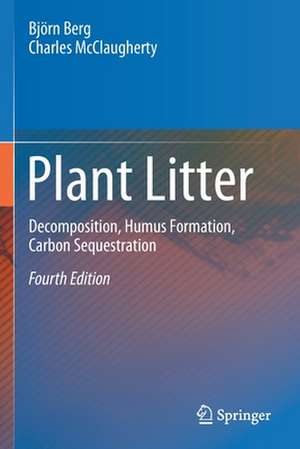
New knowledge in the fields of phytochemistry and microbial ecology has given a new baseline for discussing the concepts ‘litter decomposition’ and ‘carbon sequestration’. We can also see a rich literature on litter decomposition studies using roots and wood as substrates. These have given new insights in factors that regulate the decomposition rate and as regards roots their contribution to sequestered carbon in humus. Additional facts on the role of temperature vs the litters’ chemical compositionmay in part change our view on effects of climate change.
Further information on applications of the new analytical technique (13C-NMR) for determining organic-chemical compounds has allowed us to develop these parts.
Focus is laid on needle litter of Scots pine as a model substrate as this species has been considerably more studied than other litter species. Also the boreal/northern temperate coniferous forest has in part been given this role. Still, new information may allow us to develop information about litter from further tree species.
Preț: 1115.04 lei
Preț vechi: 1359.81 lei
-18%
Puncte Express: 1673
Carte tipărită la comandă
Livrare economică 30 noiembrie-14 decembrie
Livrare prin curier în România Termenul estimat este afișat lângă disponibilitate.
Transport gratuit pentru acest produs Plată online sau ramburs, în funcție de opțiunile comenzii.
Retur gratuit în 14 zile Comandă securizată și suport în română.
Specificații
ISBN-13: 9783030596330
ISBN-10: 3030596338
Pagini: 348
Ilustrații: XVI, 332 p. 99 illus., 6 illus. in color.
Dimensiuni: 155 x 235 x 19 mm
Greutate: 0.53 kg
Ediția:Fourth Edition 2020
Editura: Springer
Locul publicării:Cham, Switzerland
ISBN-10: 3030596338
Pagini: 348
Ilustrații: XVI, 332 p. 99 illus., 6 illus. in color.
Dimensiuni: 155 x 235 x 19 mm
Greutate: 0.53 kg
Ediția:Fourth Edition 2020
Editura: Springer
Locul publicării:Cham, Switzerland
Cuprins
Chapter 1 - Introduction.- Chapter 2 - Decomposition as a process: Some main features.- Chapter 3 - Decomposer organisms.- Chapter 4 - Initial litter chemical composition.- Chapter 5 - Changes in substrate composition during decomposition.- Chapter 6 - Chemical constituents as rate regulating: Initial variation and changes during decomposition.- Chapter 7 - Climatic environment.- Chapter 8 - Decomposition of fine root and woody root litter.- Chapter 9 - Decomposition of woody litter and cones.- Chapter 10 - Models that describe litter decomposition and influences on decomposition patterns.- Chapter 11 - Influences on stable litter fractions and carbon sequestration in organic layers.- Chapter 12 - Carbon sequestration rates on a regional scale.
Textul de pe ultima copertă
This book gives basic facts about litter decomposition studies, which are of guidance for scientists who start studies. Since the publication of the third edition, there has been quite a development not only in the field of litter decomposition but also in supporting branches of science, which are important for fruitful work on and understanding of decomposition of plant litter and sequestration of carbon. A consequence is that ‘old established truths’ are becoming outdated.
New knowledge in the fields of phytochemistry and microbial ecology has given a new baseline for discussing the concepts ‘litter decomposition’ and ‘carbon sequestration’. We can also see a rich literature on litter decomposition studies using roots and wood as substrates. These have given new insights in factors that regulate the decomposition rate and as regards roots their contribution to sequestered carbon in humus. Additional facts on the role of temperature vs the litters’ chemical composition may in part change our view on effects of climate change.
Further information on applications of the new analytical technique (13C-NMR) for determining organic-chemical compounds has allowed us to develop these parts.
Focus is laid on needle litter of Scots pine as a model substrate as this species has been considerably more studied than other litter species. Also the boreal/northern temperate coniferous forest has in part been given this role. Still, new information may allow us to develop information about litter from further tree species.
New knowledge in the fields of phytochemistry and microbial ecology has given a new baseline for discussing the concepts ‘litter decomposition’ and ‘carbon sequestration’. We can also see a rich literature on litter decomposition studies using roots and wood as substrates. These have given new insights in factors that regulate the decomposition rate and as regards roots their contribution to sequestered carbon in humus. Additional facts on the role of temperature vs the litters’ chemical composition may in part change our view on effects of climate change.
Further information on applications of the new analytical technique (13C-NMR) for determining organic-chemical compounds has allowed us to develop these parts.
Focus is laid on needle litter of Scots pine as a model substrate as this species has been considerably more studied than other litter species. Also the boreal/northern temperate coniferous forest has in part been given this role. Still, new information may allow us to develop information about litter from further tree species.
Caracteristici
Is the fourth edition, fully revised and updated with much new material Presents the latest research in the fields of phytochemistry and microbial ecology with regard to litter decomposition and carbon sequestration Provides information on the role of "climate" versus the litter's chemical composition Focuses on needle litter of Scots pine as model substrate Exhibits state-of-the-art information on the new analytical technique 13C-NMR
Notă biografică
Gregor Sandhaus studierte nach seiner Ausbildung zum Bankkaufmann Wirtschaftsingenieurwesen mit Schwerpunkt Informatik. Sein anschließende Promotion an der University of Wales zum Thema "Neural Networks for Cost Estimating in Project Management", die in Zusammenarbeit mit Airbus entstand, wurde vom Deutschen Akademischen Austauschdienst durch ein Stipendiat ausgezeichnet. Nach Tätigkeiten als Geschäftsführer bei entercom consulting GmbH und Seniorberater für IT-Strategien bei plenum war er bis 2007 als Alliance Manager bei Sybase für die Entwicklung strategischer Kooperationen (insbesondere mit SAP) verantwortlich.
Seit 2007 ist Professor Sandhaus als Hochschuldozent tätig und wurde 2008 zum hauptberuflichen Professor im Fachbereich Wirtschaftsinformatik der Hochschule für Oekonomie & Management berufen und lehrt in den Fächern Softwareentwicklung, Projektmanagement und Datenbanken. Zusätzlich leitet er das Kompetenzfeld Softwareentwicklung am Institut für Logistik und Dienstleitungen.
Philip Knott begann seine Ausbildung zum Fachinformatiker mit Schwerpunkt Anwendungsentwicklung im Jahr 2003 bei der Sparkassen Informatik. Im Anschluss daran begann er berufsbegleitend zu seiner Tätigkeit als Software-Entwickler ein Studium der Wirtschaftsinformatik an der Rheinischen Fachhochschule (RFH) in Köln. Im Jahr 2008 wechselte er zur id Media GmbH. Dort sammelte er erste Erfahrungen in den Bereichen Projektleitung und Prozessoptimierung. Nach dem Abschluss seines Studiums im Jahr 2010 wechselte er schließlich zu den DEVK Versicherungen, wo er bald die Leitung eines Software-Entwicklungsteams übernahm. Parallel zu dieser Tätigkeit absolvierte er von 2011 bis 2013 berufsbegleitend noch ein Studium zum Master of Arts IT-Management an der Hochschule für Oekonomie & Management (FOM). Aktuell unterstützt er den IT-Leiter in einer Stabsfunktion bei zentralen Themen und der strategischen Weiterentwicklung der IT.Björn Berg studierte nach seiner Ausbildung zum Fachinformatiker Systemintegration Wirtschaftsinformatik und IT-Management an der Hochschule für Oekonomie und Management (FOM) in Essen. Sein Studium schloss er 2013 als Master of Arts ab. Nach verschiedenen IT-Stationen beim Chemischen und Veterinäruntersuchungsamt Rhein-Ruhr-Wupper als Systemadministrator sowie beim Landesamt für Personaleinsatzmanagement NRW als Application Manager wechselte er 2009, zunächst als Software-Entwickler, zur heutigen numetris AG. Seit 2011 ist der Wirtschaftsinformatiker als Vorstand des Essener Unternehmens vorrangig für die Bereiche Software-Entwicklung, Messdienstleistung und Marketing verantwortlich.