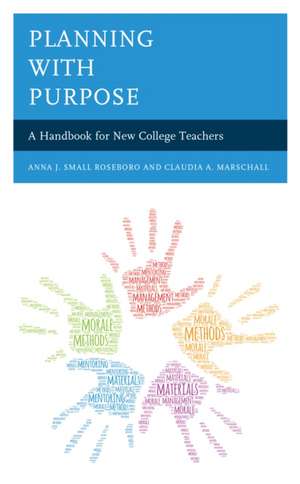
Planning with Purpose: A Handbook for New College Teachers
Autor Anna J. Small Roseboro, Claudia A. Marschallen Limba Engleză Paperback – 13 mar 2021
Graduate teaching assistants and new college instructors often are advised, coached, and mentored by department professors with little time to meet regularly with their novice educators. This book meets many of the principles outlined in the position statements of the Conference on College Composition and Communications and the Council of Writing Program Administrators. The pedagogical stances on which Planning with Purpose lessons are based will support the work of college supervisors. Using Planning with Purpose: A Handbook for New College Teachers can make pedagogical meetings with new colleagues more efficient and effective.
Preț: 218.25 lei
Preț vechi: 291.52 lei
-25%
Puncte Express: 327
Carte tipărită la comandă
Livrare economică 03-17 decembrie
Livrare prin curier în România Termenul estimat este afișat lângă disponibilitate.
Transport gratuit de la 400.00 lei Plată online sau ramburs, în funcție de opțiunile comenzii.
Retur gratuit în 14 zile Comandă securizată și suport în română.
Specificații
ISBN-13: 9781475858211
ISBN-10: 1475858213
Pagini: 148
Dimensiuni: 148 x 228 x 10 mm
Greutate: 0.22 kg
Editura: Bloomsbury Publishing
Colecția Rowman & Littlefield
Locul publicării:New York, United States
ISBN-10: 1475858213
Pagini: 148
Dimensiuni: 148 x 228 x 10 mm
Greutate: 0.22 kg
Editura: Bloomsbury Publishing
Colecția Rowman & Littlefield
Locul publicării:New York, United States
Cuprins
Acknowledgments
Introduction
Chapter One: Preparing to Be Effective and Efficient
Chapter Two: Networking with Narratives to Cultivate Community
Chapter Three: Understanding Grammars to Negotiate Conventions
Chapter Four: Writing to Clarify Thinking
Chapter Five: Engaging Expository Writing
Chapter Six: Composing Compelling Arguments
Chapter Seven: Writing Persuasively to Impact Thinking and Behavior
Chapter Eight: Writing for Speaking and Multimodal Presentations
Afterword
Bibliography
Index
About the Contributors
About the Authors
Introduction
Chapter One: Preparing to Be Effective and Efficient
Chapter Two: Networking with Narratives to Cultivate Community
Chapter Three: Understanding Grammars to Negotiate Conventions
Chapter Four: Writing to Clarify Thinking
Chapter Five: Engaging Expository Writing
Chapter Six: Composing Compelling Arguments
Chapter Seven: Writing Persuasively to Impact Thinking and Behavior
Chapter Eight: Writing for Speaking and Multimodal Presentations
Afterword
Bibliography
Index
About the Contributors
About the Authors
Recenzii
Here's the twenty-four-hour resourceful mentor that every English teacher wants on call from the moment of planning the first class meeting to the final assessment. From the beginning, these two talented English teachers with decades of experience and current in-put from first year college teachers guide these new instructors on how to achieve the college's academic goals while focusing directly on the individuals in their classes-repeatedly describing a range of methods beginning with the students' knowledge and interests and developing those into the practices of critical thinking and various modes of writing essential to achieve success in their field. Each chapter establishes goals, strategies, practical step-by-step processes, reinforcement, and self-assessment for the assignment all designed to encourage students to build their best skill
sets possible and guiding the college instructor how to succeed at each stage.
What a terrific boon for both new and experienced English educators!
Students deserve graduate teaching assistants and professors with basic knowledge of learning theory and pedagogy. Planning with Purpose, written primarily from an introductory writing and speaking perspective, can be a valuable resource for scholars in math, science, and engineering. Roseboro and Marshall have laid out a guide, a roadmap useful for first-year or early-career graduate student instructors, adjuncts, lecturers, fixed-term or assistant professors. Readers can return to Planning with Purpose to write teaching philosophy statements, to prepare for an interview with a search committee, or to design a teaching demonstration. Such a teaching mentor is right here.
This book is a gem. A practical guide for new college and community college instructors and graduate teaching assistants, it is a sorely needed resource, especially in fluctuating hiring processes. New English composition and literature teachers find what could be a semester long planning guide. Instructors of other subject matter courses find literacy building activities that will fit course goals of developing competent skills in literacy for their college students.
In the book, written by veteran teachers who have helped develop the literacy skills of thousands of students, authors Anna Roseboro and Claudia Marschall provide many suggestions and plans for new college instructors who may not have taught before at any level. Often at a loss about where to begin, such instructors need this book to get their feet on the ground and to help make their students competent readers and writers, listeners and speakers - students ready to meet the challenges of their subsequent years in further college coursework. I recommend this text highly and hope it will be widely used. It is written in a style that is readable, often entertaining, and useful for its audiences.
Writing exercises are only effective when they are well crafted, patiently tried out in the classroom, fine tuned, and then tried out again. The authors of this book are expert guides to this process. Concrete explanations and useful strategies build the reader's understanding of writing for different occasions. I wish I had learned to write (assuming I ever did) through exercises like the ones contained in this book.?
As a library staff member myself, I especially like the part where the authors recommend bringing chocolates to the librarian every morning. (Wait. They never said that? Well, there's an idea for the next edition.)
Drawing on their own college classroom experiences, as well as theory, research, and practice in the field, Anna Roseboro and Claudia Marschall offer a wide range of practical strategies for teaching writing and communication courses. Because I have frequently worked with hundreds of graduate teaching assistants in writing classrooms I think how this book could have helped me mentor them.
Even though Planning with Purpose is designed for newer teachers and their mentors, it has much to offer college-level teachers who have worked with students for years. In addition to thoughtful guidance on how to help students become more effective thinkers and writers and speakers, the book offers many insights into how teachers can interact with students in productive, supportive ways. The classroom is not just a place where we engage with ideas; we also engage with one another. As I read the book, I frequently paused to think about how can use the ideas in my own classroom. I also kept thinking to myself, "I wish that had known that when I was a new college teacher."
I also have worked with hundreds, if not thousands, of college teachers across the disciplines throughout my career. As I read Planning with Purpose, it was readily apparent that many of the instructional practices and classroom management strategies would work effectively in general education courses in a wide range of content areas.
This text provides a resource for those who find themselves teaching college level writing courses with minimal preparation or expertise. It acknowledges the variety of instructional and pedagogical environments in which new college instructors might find themselves, which also renders its content relevant in multiple disciplinary contexts. The text reads like a handbook, with bulleted lists broken down into questions to ask, options available, steps to take, and points of preparation to address. The authors focus on foundational concepts, such as student choice and respect for language variety, while also addressing pragmatic concerns - how to access resources, which resources to utilize and when, and how to manage grading. Their "just in time" approach is pragmatic rather than academic, utilitarian rather than theoretical. Their objective is clear: get new college writing instructors on their feet in the classroom with greater speed, confidence and efficacy.
sets possible and guiding the college instructor how to succeed at each stage.
What a terrific boon for both new and experienced English educators!
Students deserve graduate teaching assistants and professors with basic knowledge of learning theory and pedagogy. Planning with Purpose, written primarily from an introductory writing and speaking perspective, can be a valuable resource for scholars in math, science, and engineering. Roseboro and Marshall have laid out a guide, a roadmap useful for first-year or early-career graduate student instructors, adjuncts, lecturers, fixed-term or assistant professors. Readers can return to Planning with Purpose to write teaching philosophy statements, to prepare for an interview with a search committee, or to design a teaching demonstration. Such a teaching mentor is right here.
This book is a gem. A practical guide for new college and community college instructors and graduate teaching assistants, it is a sorely needed resource, especially in fluctuating hiring processes. New English composition and literature teachers find what could be a semester long planning guide. Instructors of other subject matter courses find literacy building activities that will fit course goals of developing competent skills in literacy for their college students.
In the book, written by veteran teachers who have helped develop the literacy skills of thousands of students, authors Anna Roseboro and Claudia Marschall provide many suggestions and plans for new college instructors who may not have taught before at any level. Often at a loss about where to begin, such instructors need this book to get their feet on the ground and to help make their students competent readers and writers, listeners and speakers - students ready to meet the challenges of their subsequent years in further college coursework. I recommend this text highly and hope it will be widely used. It is written in a style that is readable, often entertaining, and useful for its audiences.
Writing exercises are only effective when they are well crafted, patiently tried out in the classroom, fine tuned, and then tried out again. The authors of this book are expert guides to this process. Concrete explanations and useful strategies build the reader's understanding of writing for different occasions. I wish I had learned to write (assuming I ever did) through exercises like the ones contained in this book.?
As a library staff member myself, I especially like the part where the authors recommend bringing chocolates to the librarian every morning. (Wait. They never said that? Well, there's an idea for the next edition.)
Drawing on their own college classroom experiences, as well as theory, research, and practice in the field, Anna Roseboro and Claudia Marschall offer a wide range of practical strategies for teaching writing and communication courses. Because I have frequently worked with hundreds of graduate teaching assistants in writing classrooms I think how this book could have helped me mentor them.
Even though Planning with Purpose is designed for newer teachers and their mentors, it has much to offer college-level teachers who have worked with students for years. In addition to thoughtful guidance on how to help students become more effective thinkers and writers and speakers, the book offers many insights into how teachers can interact with students in productive, supportive ways. The classroom is not just a place where we engage with ideas; we also engage with one another. As I read the book, I frequently paused to think about how can use the ideas in my own classroom. I also kept thinking to myself, "I wish that had known that when I was a new college teacher."
I also have worked with hundreds, if not thousands, of college teachers across the disciplines throughout my career. As I read Planning with Purpose, it was readily apparent that many of the instructional practices and classroom management strategies would work effectively in general education courses in a wide range of content areas.
This text provides a resource for those who find themselves teaching college level writing courses with minimal preparation or expertise. It acknowledges the variety of instructional and pedagogical environments in which new college instructors might find themselves, which also renders its content relevant in multiple disciplinary contexts. The text reads like a handbook, with bulleted lists broken down into questions to ask, options available, steps to take, and points of preparation to address. The authors focus on foundational concepts, such as student choice and respect for language variety, while also addressing pragmatic concerns - how to access resources, which resources to utilize and when, and how to manage grading. Their "just in time" approach is pragmatic rather than academic, utilitarian rather than theoretical. Their objective is clear: get new college writing instructors on their feet in the classroom with greater speed, confidence and efficacy.