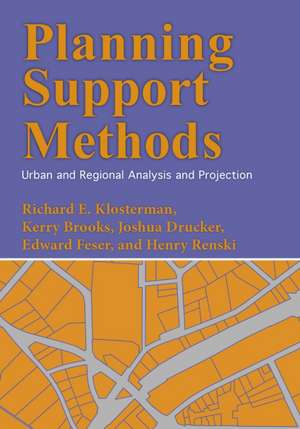
Planning Support Methods: Urban and Regional Analysis and Projection
Autor Richard E. Klosterman, Kerry Brooks, Joshua Drucker, Edward Feser, Henry Renskien Limba Engleză Paperback – 22 iun 2018
Descoperim în Planning Support Methods o abordare riguroasă a planificării teritoriale, definită printr-o interdisciplinaritate necesară care îmbină demografia, economia regională și analiza geografică. Subliniem faptul că acest volum nu se rezumă la teorie, ci servește drept ghid practic pentru înțelegerea dinamicii creșterii urbane, fiind esențial în curriculumul de studii urbane și politici publice.
Structura cărții este organizată progresiv, pornind de la fundamente și un studiu de caz aplicat (Decatur), avansând apoi către metode complexe de proiecție. Apreciem includerea detaliată a metodelor de tip „cohort-component” și a analizelor de adecvare a terenului (land suitability), elemente vitale pentru orice planificator contemporan. Dincolo de text, volumul este susținut de un aparat vizual dens, cu peste 100 de ilustrații și 38 de hărți, oferind claritate unor concepte matematice și spațiale dificile.
Cititorii familiarizați cu Selected Methods of Planning Analysis de Xinhao Wang vor aprecia modul în care acest volum aduce nou o integrare mai strânsă a instrumentelor digitale, oferind acces la registre Excel și resurse online care transformă metodele de calcul din formule abstracte în instrumente de lucru imediate. Față de alte manuale care se concentrează strict pe cercetarea academică, lucrarea de față, publicată de Rowman & Littlefield, menține un echilibru între precizia statistică și aplicabilitatea pe teren, fiind un instrument de sprijin decizional pentru administrația locală și regională.
Preț: 492.42 lei
Preț vechi: 657.64 lei
-25%
Carte disponibilă
Livrare economică 14-28 noiembrie
Specificații
ISBN-10: 1442220295
Pagini: 400
Ilustrații: 100 b/w illustrations;38 maps; 115 tables; 1 textbox
Dimensiuni: 178 x 254 x 20 mm
Greutate: 0.7 kg
Editura: Bloomsbury Publishing
Colecția Rowman & Littlefield
Locul publicării:New York, United States
V-ar putea interesa
-
 -23%Preț: 589.04 lei764.99 lei
 -
 The Cambridge Companion to HayekEdward FeserPreț: 267.11 lei
 -
 Asia Inside Out – Connected PlacesEric TagliacozzoPreț: 401.14 lei
 -
 Lived Topographies: and their Mediational ForcesGary Backhaus-25%Preț: 306.74 lei407.13 lei
 -
 -34%Preț: 633.75 lei958.73 lei
 -
 The Administrative Challenges of (Play) TherapyAllan M. Gonsher-25%Preț: 216.87 lei290.69 lei
 -
 Urban Social ListeningJustin B HollanderPreț: 383.79 lei
 -
 -9%Preț: 99.50 lei109.02 lei
 -
 -36%Preț: 677.66 lei1058.11 lei
 -
 The Making of America's Culture RegionsRichard L. Nostrand-25%Preț: 526.27 lei703.61 lei
 -
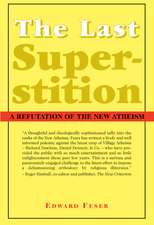 The Last SuperstitionEdward FeserPreț: 186.55 lei
 -
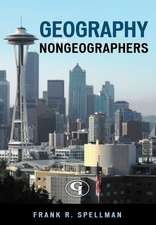 Geography for NongeographersFrank R. Spellman-19%Preț: 325.45 lei402.28 lei
 -
 By Man Shall His Blood Be ShedEdward FeserPreț: 150.98 lei
 -
 Grade 1 GeographyBabyPreț: 67.12 lei
 -
 Preț: 68.91 lei
 -
 Die Ökozone der feuchten MittelbreitenBarbara HedelerPreț: 86.67 lei
 -
 Les archives sédimentaires témoins des phases d'érosionSerafina Sechi-19%Preț: 663.51 lei819.15 lei
 -
 Approvisionnement en produits vivriers de la ville de Porto-NovoGbènoukpo René KouchokehoPreț: 296.26 lei
 -
 -15%Preț: 589.10 lei693.06 lei
 -
 Aristotle's RevengeEdward FeserPreț: 293.62 lei
 -
 Fünf GottesbeweiseEdward FeserPreț: 189.83 lei
 -
 Philosophie des GeistesEdward FeserPreț: 150.62 lei
 -
 Preț: 217.37 lei
De ce să citești această carte
Recomandăm această carte studenților și profesioniștilor care au nevoie de o metodologie clară pentru proiecții urbane. Veți câștiga nu doar cunoștințe teoretice despre analiza demografică și economică, ci și acces la instrumente practice (Excel) pentru modelarea datelor reale. Este resursa ideală pentru a trece de la analiza de date la elaborarea unor planuri de dezvoltare regională fundamentate științific.
Despre autor
Richard E. Klosterman este profesor emerit de geografie, planificare și studii urbane la University of Akron, fiind o autoritate recunoscută în domeniul metodelor de suport pentru planificare. Alături de el, coautorii Kerry Brooks, Joshua Drucker, Edward Feser și Henry Renski aduc o expertiză vastă din mediul academic american, ocupând funcții de conducere și cercetare în instituții precum Oregon State University și University of Illinois at Chicago. Această colaborare reunește perspective complementare asupra politicilor publice și arhitecturii peisajului.
Descriere
For helpful tools from the author including Excel workbooks, visit https://planningsupport.org/tools/.
For resources including PowerPoint presentations and supplemental readings, visit https://planningsupport.org/resources/.
Cuprins
Preface
1 Foundations
2 Welcome to Decatur
3 Trend Projection Methods
4 Share Projection Methods
5 Cohort-Component Methods
6 Economic Analysis Methods
7 Spatial Analysis Methods
8 Land Suitability
9 Using Planning Support Methods
Appendix A: US Census Geography
Appendix B: American Community Survey
Appendix C: US Data Sources
Glossary
References
Index
Recenzii
This book aims to describe the essential quantitative methods for local and regional analysis and projection. It is best suited for planning practitioners (especially community planners) and students targeting a professional planning career. For practical planners, one key merit for this book is that, despite its breadth in quantitative regional economic methods, it requires no prerequisite of advanced statistics, calculus, or microeconomic background and materials in the book can be well understood for someone without this background. I would recommend this book to (perspective) community planners at various levels, who have interests in understanding the basics of regional population and employment projection and forecasting. . . . Overall, this book provides an important introduction to a rapidly evolving subfield.
In sum, the book adds to the modern approach to neighborhood-centered analysis with a focus on community, geospatial data analysis, and use case scenarios. The book provides ample illustrations, informative and user-friendly. Undergraduate and graduate students, community scientists, planners in practice, and applied researchers will find Planning Support Methods: Urban and Regional Analysis and Projection to be a comprehensive book that can be used for both bottom-up and top-down urban and regional data analysis.
This delightfully hands-on approach will be a breath of fresh air for students and practitioners alike. At long last we have a book that teaches urban planners to be intelligently analytical and ultrapractical.
Good books on planning methods are rare. Klosterman and his colleagues have done us a great service by updating Klosterman's previous book and extending its scope in population forecasting, spatial analysis, and GIS. A key text.
I predict-and making accurate predictions is a big part of what this new volume covers-that Planning Support Methods will become an essential 'go-to' reference for both beginning students and experienced professionals. New chapters and sections on spatial analysis methods, land suitability analysis methods, and public participation methods help round out this extremely well-written, easy-to-use, and important new work.
Klosterman and his colleagues have done a masterful job of assembling and describing the core methods that planners use to understand the dynamics of urban growth and development. No other text combines demographic, economic and land suitability techniques in such an effective manner. This book provides a clear explanation of fundamental planning support methods.