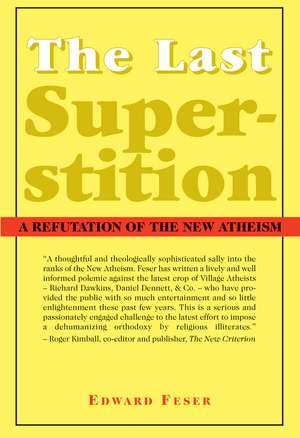
The Last Superstition
Autor Edward Feseren Limba Engleză Paperback – 10 dec 2010
Aplicabilitatea practică a analizei teoretice din această lucrare constă în demontarea argumentelor seculare folosite în dezbaterile contemporane despre știință și religie, oferind un ghid logic pentru evaluarea fundamentelor raționalității și moralității în discursul public. În această primă ediție (First Edition), publicată de St. Augustine's Press, reținem o critică structurată la adresa curentului numit „Noul Ateism”, susținut de gânditori precum Richard Dawkins sau Sam Harris. Subliniem că volumul nu se limitează la o simplă replică polemică, ci propune o reevaluare a conflictului dintre viziunea clasică, „teleologică” (reprezentată de Platon, Aristotel, Augustin și Toma de Aquino) și cea modernă, „mecanică” (Descartes, Hobbes, Locke și Hume). Cartea demonstrează relevanța pentru curriculumul de filozofie a religiei și istoria științei, arătând cum concepția mecanicistă este doar o interpretare filozofică, nu o teorie științifică validată. Observăm că autorul argumentează riguros cum negarea teleologiei anulează însăși baza rațiunii umane. Lucrarea extinde cadrul propus de The New Atheism cu date noi din perioada contemporană. Poziționăm The Last Superstition în contextul celorlalte scrieri ale lui Edward Feser, precum Aquinas, Five Proofs of the Existence of God și Philosophy of Mind. Dacă lucrările anterioare se concentrau pe prezentarea sistemelor clasice de gândire sau pe analiza componentelor minții, volumul de față utilizează aceste premise metafizice ca instrumente de combatere directă a secularismului modern. Cu un total de 312 pagini în format paperback, textul oferă o perspectivă clară, lipsită de artificii retorice, utilă studenților și cercetătorilor din domeniul științelor umaniste.
Preț: 149.34 lei
Carte disponibilă
Livrare economică 12-26 noiembrie
Livrare express 28 octombrie-03 noiembrie pentru 68.45 lei
Specificații
ISBN-10: 1587314525
Pagini: 312
Dimensiuni: 152 x 226 x 23 mm
Greutate: 0.45 kg
Ediția:First Edition,
Editura: St. Augustine's Press
V-ar putea interesa
-
 God: A Very Short IntroductionJohn Bowker-20%Preț: 57.15 lei71.12 lei
 -
 Agnosticism: A Very Short IntroductionRobin Le Poidevin-20%Preț: 56.92 lei71.00 lei
 -
 -18%Preț: 110.64 lei135.55 lei
 -
 Morality Without God?Walter Sinnott-Armstrong-17%Preț: 168.51 lei203.85 lei
 -
 The Cambridge Companion to HayekEdward FeserPreț: 267.11 lei
 -
 There Is No God and He Is Always with YouBrad Warner-19%Preț: 92.29 lei114.32 lei
 -
 Everybody Is Wrong about GodJames A. LindsayPreț: 110.52 lei
 -
 The Twilight Of AtheismAlister McgrathPreț: 115.68 lei
 -
 Christian Atheist - Belonging without BelievingBrian MountfordPreț: 75.52 lei
 -
 Philosophy of MindEdward FeserPreț: 79.98 lei
De ce să citești această carte
Adresat studenților la filozofie, teologie și cercetătorilor interesați de polemica dintre știință și laicism. Cititorul câștigă o înțelegere profundă a diferențelor dintre modelele teleologice și cele mecanice, obținând argumente clare împotriva dogmatismului secular. Este o recomandare esențială pentru cei care doresc să exploreze validitatea rațională a teismului clasic în raport cu provocările Noului Ateism.
Despre autor
Edward Feser este conferențiar de filozofie la Pasadena City College. Activitatea sa academică este strâns legată de studiul filozofiei medievale și al metafizicii, fiind recunoscut pentru capacitatea de a traduce concepte complexe în expuneri accesibile. Printre cele mai recente cărți ale sale se numără monografia dedicată lui Sfântul Toma de Aquino, Aquinas, și volumul de față, The Last Superstition. Abordarea sa integrează tradiția aristotelico-tomistă în dezbaterile contemporane din filozofia minții și a științei, oferind o perspectivă critică asupra curentelor laice moderne.
Descriere scurtă
But as Edward Feser argues inThe Last Superstition, in fact there is not, and never has been, any war between science and religion at all. There has instead been a conflict between two entirely philosophical conceptions of the natural order: on the one hand, the classical “teleological” vision of Plato, Aristotle, Augustine, and Aquinas, on which purpose or goal-directedness is as inherent a feature of the physical world as mass or electric charge; and the modern “mechanical” vision of Descartes, Hobbes, Locke, and Hume, according to which the physical world is comprised of nothing more than purposeless, meaningless particles in motion. As it happens, on the classical teleological picture, the existence of God, the immortality of the soul, and the natural-law conception of morality are rationally unavoidable. Modern atheism and secularism have thus always crucially depended for their rational credentials on the insinuation that the modern, mechanical picture of the world has somehow been established by science. Yet this modern “mechanical” picture has never been established by science, and cannot be, for it is not a scientific theory in the first place but merely a philosophical interpretation of science. Moreover, as Feser shows, the philosophical arguments in its favor given by the early modern philosophers were notable only for being surprisingly weak. The true reasons for its popularity were then, and are now, primarily political: It was a tool by which the intellectual foundations of ecclesiastical authority could be undermined and the way opened toward a new secular and liberal social order oriented toward commerce and technology. So as to further these political ends, it was simply stipulated, by fiat as it were, that no theory inconsistent with the mechanical picture of the world would be allowed to count as “scientific.” As the centuries have worn on and historical memory has dimmed, this act of dogmatic stipulation has falsely come to be remembered as a “discovery.”
However, not only is this modern philosophical picture rationally unfounded, it is demonstrably false. For the “mechanical” conception of the natural world, when worked out consistently, absurdly entails that rationality, and indeed the human mind itself, are illusory. The so-called “scientific worldview” championed by the New Atheists thus inevitably undermines its own rational foundations; and into the bargain (and contrary to the moralistic posturing of the New Atheists) it undermines the foundations of any possible morality as well. By contrast, and as The Last Superstition demonstrates, the classical teleological picture of nature can be seen to find powerful confirmation in developments from contemporary philosophy, biology, and physics; moreover, morality and reason itself cannot possibly be made sense of apart from it. The teleological vision of the ancients and medievals is thereby rationally vindicated – and with it the religious worldview they based upon it.