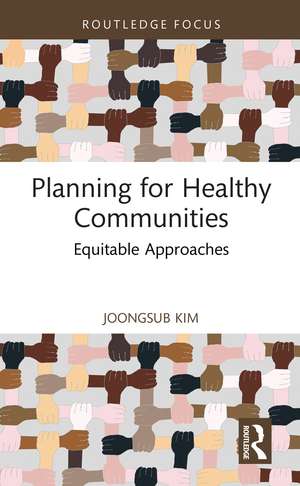
Planning for Healthy Communities: Equitable Approaches: Health and the Built Environment
Autor Joongsub Kimen Limba Engleză Hardback – 16 sep 2025
The core concepts underlying the book are three dimensions of support infrastructure (people: human-centering; place: place-cultivating; and ecosystem: sustainable capitalization), leveraging several theories (community capital, social justice) from community development. This book is based on the results of a recent grassroots, citywide engagement-driven initiative in Detroit, and on best-practice case studies in Chicago, Indianapolis, Cleveland, Boston, Philadelphia, Minneapolis, Richmond, and Portland. The initiative’s significant outcomes include a consensus—bolstered by those case studies—on seven components deemed essential to an equitable system for community development. This book proposes that the CDS can enhance community health if at least the following requirements are met: (1) adoption of a community-vitality framework as a citywide shared narrative; (2) coordination across financial institutions to allocate funds equitably to underserved communities; and (3) implementation of system governance with stronger attention to resident voices.
This book demonstrates that bottom-up CDSs can and should be leveraged to enhance the health of underserved communities and investigates how best to address the three requirements to make the equitable system-based approach work effectively in practice. The audience of community development and community health actors will learn from Detroit and the case studies—offering lessons for other cities facing similar issues—how to leverage equitable CDSs to promote healthy communities.

Preț: 432.92 lei
Preț vechi: 509.32 lei
-15%
Puncte Express: 649
Carte tipărită la comandă
Livrare economică 01-15 decembrie
Livrare express 27-31 octombrie pentru 33.99 lei
Livrare prin curier în România Termenul estimat este afișat lângă disponibilitate.
Transport gratuit pentru acest produs Plată online sau ramburs, în funcție de opțiunile comenzii.
Retur gratuit în 14 zile Comandă securizată și suport în română.
Specificații
ISBN-13: 9781032680279
ISBN-10: 103268027X
Pagini: 126
Ilustrații: 2
Dimensiuni: 138 x 216 x 13 mm
Greutate: 0.26 kg
Ediția:1
Editura: Taylor & Francis
Colecția Routledge
Seria Health and the Built Environment
Locul publicării:Oxford, United Kingdom
ISBN-10: 103268027X
Pagini: 126
Ilustrații: 2
Dimensiuni: 138 x 216 x 13 mm
Greutate: 0.26 kg
Ediția:1
Editura: Taylor & Francis
Colecția Routledge
Seria Health and the Built Environment
Locul publicării:Oxford, United Kingdom
V-ar putea interesa
-
 Social Prescribing: Paradigms, Perspectives and PracticeHeather Henry-31%Preț: 233.12 lei339.92 lei
 -
 -30%Preț: 408.70 lei584.37 lei
 -
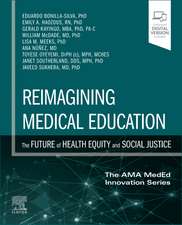 Reimagining Medical Education: The Future of Health Equity and Social JusticeEduardo Bonilla-Silva-27%Preț: 333.97 lei459.63 lei
 -
 -34%Preț: 167.77 lei252.80 lei
 -
 -33%Preț: 335.44 lei501.84 lei
 -
 Toward Sustainable Communities, Fifth EditionMargaret StoutPreț: 302.22 lei
 -
 -5%Preț: 362.23 lei381.30 lei
 -
 Preț: 391.82 lei
 -
 Preț: 385.07 lei
 -
 Community-Based Participatory Research for HealthNina Wallerstein-5%Preț: 640.86 lei674.59 lei
 -
 Architecture and Health Equity in an Imperiled WorldStephen VerderberPreț: 444.75 lei
 -
 Community Development: A Critical ApproachMargaret LedwithPreț: 238.72 lei
 -
 Preț: 280.53 lei
 -
 Urban AlchemyMindy Thompson FullilovePreț: 164.95 lei
 -
 The Homegrown CityMatias EchanovePreț: 152.61 lei
 -
 Urban Healthonomics: How to create healthy cities that accelerate economic growthMartin Prince-ParrottPreț: 339.99 lei
 -
 The Empathic CityNimish Biloria-5%Preț: 1084.69 lei1141.78 lei
 -
 Transforming Social Determinants to Promote Global HealthJill B. Hamilton-5%Preț: 663.98 lei698.92 lei
 -
 Sustainable Development Goals and Urban HealthAbraham R. Matamanda-18%Preț: 1041.79 lei1270.47 lei
 -
 Community HealthKurt Waldendorf-9%Preț: 215.42 lei236.93 lei
Public țintă
Academic, Postgraduate, and Undergraduate AdvancedCuprins
List of figures and tables
Acknowledgements
1. Introduction
2. Learning from Detroit: A bottom-up community development system and its potential for enhancing community health
3. Community vitality as a shared narrative for promoting community health
4. Coordination of capitalization for equitably enhancing community health
5. System governance for achieving healthy communities
6. Research implications, lessons learned, recommendations, and conclusions
Index
Acknowledgements
1. Introduction
2. Learning from Detroit: A bottom-up community development system and its potential for enhancing community health
3. Community vitality as a shared narrative for promoting community health
4. Coordination of capitalization for equitably enhancing community health
5. System governance for achieving healthy communities
6. Research implications, lessons learned, recommendations, and conclusions
Index
Notă biografică
Joongsub Kim, PhD, FAIA, AICP, is a full professor at Lawrence Technological University (Michigan, United States) and directs its Detroit Studio. He has engaged in various applied research projects in socially responsive design, community development, urban design, and environmental psychology. He has also served as a reviewer for grant competitions for the Social Sciences and Humanities Research Council of Canada and Kresge Foundation in the United States. He has received numerous grants and other awards from National Endowment for the Arts, National Science Foundation, American Institute of Architects, National Council of Architectural Registration Boards, Association of Collegiate Schools of Architecture, Kellogg Foundation, Graham Foundation, and more. His work has been published in various peer-reviewed journals, and his book entitled What Do Design Reviewers Really Do? was published in 2019.
Recenzii
“Prof. Kim, PhD, FAIA has spent the majority of his impressive career working with students and community organizations planning and designing equitable communities. This short but powerful Routledge book summarizes his multidisciplinary approach to planning for healthy communities and provides a thoroughly thought out lesson to all”.
Stephen Vogel, Dean Emeritus and Distinguished Professor, FAIA, University of Detroit Mercy School of Architecture and Community Development, United States.
"Joongsub Kim, distinguished architect, planner, and educator in Planning for Healthy Communities reveals that healthy communities, based on principles of equitability and sustainability, don’t happen inherently. His insightful research demonstrates how healthy communities require rigorous “grassroots” planning, appropriate capitalization through community partnerships, and active implementation strategies."
Glen LeRoy, FAIA, FAICP, President Emeritus, Boston Architectural College.
Stephen Vogel, Dean Emeritus and Distinguished Professor, FAIA, University of Detroit Mercy School of Architecture and Community Development, United States.
"Joongsub Kim, distinguished architect, planner, and educator in Planning for Healthy Communities reveals that healthy communities, based on principles of equitability and sustainability, don’t happen inherently. His insightful research demonstrates how healthy communities require rigorous “grassroots” planning, appropriate capitalization through community partnerships, and active implementation strategies."
Glen LeRoy, FAIA, FAICP, President Emeritus, Boston Architectural College.
Descriere
This book investigates multi-disciplinary approaches to addressing the health of disadvantaged communities through equitable community development systems (CDSs).