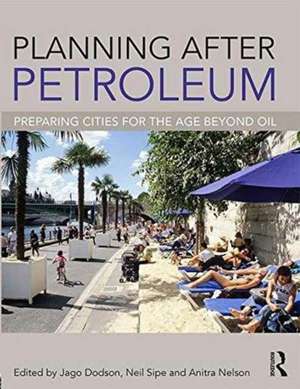
Planning After Petroleum: Preparing Cities for the Age Beyond Oil
Editat de Jago Dodson, Neil Sipe, Anitra Nelsonen Limba Engleză Paperback – 6 oct 2016
Such questions are the focus of contributors to this book with perspectives ranging across the planning challenge: overarching petroleum futures, governance, transition and climate change questions, the role of various urban transport nodes and household responses, ways of measuring oil vulnerability, and the effects on telecommunications, ports and other urban infrastructure. This comprehensive volume – with contributions from and focusing on cities in Australia, the UK, the US, France, Germany, the Netherlands and South Korea – provides key insights to enable cities to plan for the age beyond petroleum.
Preț: 395.88 lei
Puncte Express: 594
Carte tipărită la comandă
Livrare economică 27 mai-10 iunie
Specificații
ISBN-13: 9780415504584
ISBN-10: 0415504589
Pagini: 272
Ilustrații: 40 b/w images
Dimensiuni: 189 x 246 x 25 mm
Greutate: 0.5 kg
Ediția:1
Editura: Taylor & Francis
Colecția Routledge
Locul publicării:Oxford, United Kingdom
ISBN-10: 0415504589
Pagini: 272
Ilustrații: 40 b/w images
Dimensiuni: 189 x 246 x 25 mm
Greutate: 0.5 kg
Ediția:1
Editura: Taylor & Francis
Colecția Routledge
Locul publicării:Oxford, United Kingdom
V-ar putea interesa
-
 Blood and OilMichael KlarePreț: 109.88 lei
 -
 The Peace-Athabasca Delta: Portrait of a Dynamic EcosystemDr. Kevin P. Timoney-25%Preț: 838.83 lei1119.63 lei
 -
 Petro-Aggression: When Oil Causes WarJeff D. ColganPreț: 273.88 lei
 -
 OilMatthew YeomansPreț: 120.22 lei
 -
 -30%Preț: 458.76 lei651.59 lei
 -
 -30%Preț: 1572.58 lei2257.90 lei
 -
 The Oil RoadJames MarriottPreț: 128.79 lei
 -
 The Secret World of OilKen SilversteinPreț: 196.79 lei
 -
 -8%Preț: 63.24 lei68.46 lei
 -
 -28%Preț: 74.36 lei102.72 lei
Public țintă
Professional Practice & DevelopmentCuprins
Acknowledgements
List of Figures
List of Tables
List of Abbreviations
Notes on Contributors
Foreword
Brendan Gleeson
Introduction
1. Investigating Cities After Oil: Planning for Systemic Urban Oil Vulnerability
Jago Dodson, Neil Sipe and Anitra Nelson
Part I. Energy Horizons
2. A Stormy Petroleum Horizon: Cities and Planning Beyond Oil
Jago Dodson
3. The Paradox of Oil: The Cheaper it is, the More It Costs
Samuel Alexander
4. Institutional Planning Responses to a Confluence of Oil Vulnerability and Climate Change
Tony Matthews and Jago Dodson
5. Energy Security and Oil Vulnerability Responses
Jago Dodson and Neil Sipe
6. Post-Petroleum Urban Justice
Wendy Steele, Lisa de Kleyn and Katelyn Samson
Part II. Transport and Land Use
7. Walking the City
John Whitelegg
8. Cycling Potential in Dispersed Cities
Jennifer Bonham and Matthew Burke
9. Children’s Active Transport: An Upside of Oil Vulnerability?
Scott Sharpe and Paul Tranter
10. Public Transport Networks in the Post-Petroleum Era
John Stone and Paul Mees
11. Oil and Mortgage Vulnerability in Australian Cities
Jago Dodson and Neil Sipe
12. Outer Suburbs, Car Dependence and Residential Choice in France
Benjamin Motte-Baumvol and Leslie Belton-Chevallier
13. Greenspace After Petroleum: From Freeways to Greenways
Jason Byrne
III. Urban Systems
14. Local Energy Plans for Transitions to a Low Carbon Future
Brendan F.D. Barrett and Ralph Horne
15. Motor Vehicle Fleets in Oil Vulnerable Suburbs: A Prospect of Technology Innovations
Tiebei Li, Neil Sipe and Jago Dodson
16. Energy for Cities
Cheryl Desha and Angela Reeve
17. The Role of Telecommunication in Post-Petroleum Planning
Tooran Alizadeh
18. Peak Oil: Challenges and Changes for the Air Transport Industry
Douglas Baker, Nicholas Stevens and Md. Kamruzzaman
Conclusion
19. Planning and Petroleum Futures: Research Directions
Neil Sipe, Jago Dodson and Anitra Nelson
Index
List of Figures
List of Tables
List of Abbreviations
Notes on Contributors
Foreword
Brendan Gleeson
Introduction
1. Investigating Cities After Oil: Planning for Systemic Urban Oil Vulnerability
Jago Dodson, Neil Sipe and Anitra Nelson
Part I. Energy Horizons
2. A Stormy Petroleum Horizon: Cities and Planning Beyond Oil
Jago Dodson
3. The Paradox of Oil: The Cheaper it is, the More It Costs
Samuel Alexander
4. Institutional Planning Responses to a Confluence of Oil Vulnerability and Climate Change
Tony Matthews and Jago Dodson
5. Energy Security and Oil Vulnerability Responses
Jago Dodson and Neil Sipe
6. Post-Petroleum Urban Justice
Wendy Steele, Lisa de Kleyn and Katelyn Samson
Part II. Transport and Land Use
7. Walking the City
John Whitelegg
8. Cycling Potential in Dispersed Cities
Jennifer Bonham and Matthew Burke
9. Children’s Active Transport: An Upside of Oil Vulnerability?
Scott Sharpe and Paul Tranter
10. Public Transport Networks in the Post-Petroleum Era
John Stone and Paul Mees
11. Oil and Mortgage Vulnerability in Australian Cities
Jago Dodson and Neil Sipe
12. Outer Suburbs, Car Dependence and Residential Choice in France
Benjamin Motte-Baumvol and Leslie Belton-Chevallier
13. Greenspace After Petroleum: From Freeways to Greenways
Jason Byrne
III. Urban Systems
14. Local Energy Plans for Transitions to a Low Carbon Future
Brendan F.D. Barrett and Ralph Horne
15. Motor Vehicle Fleets in Oil Vulnerable Suburbs: A Prospect of Technology Innovations
Tiebei Li, Neil Sipe and Jago Dodson
16. Energy for Cities
Cheryl Desha and Angela Reeve
17. The Role of Telecommunication in Post-Petroleum Planning
Tooran Alizadeh
18. Peak Oil: Challenges and Changes for the Air Transport Industry
Douglas Baker, Nicholas Stevens and Md. Kamruzzaman
Conclusion
19. Planning and Petroleum Futures: Research Directions
Neil Sipe, Jago Dodson and Anitra Nelson
Index
Recenzii
"When future generations look back on today’s struggle to move off oil as the lifeblood of global society, they will wonder why it took so long for people to see the writing on the wall and find a better way to power the engines of human endeavor. This volume makes an important contribution to that writing on the wall and presents promising tools needed to deal with our energy problems. If contemporary economic and political leaders can learn from the thoughtful approaches in this book, the inevitable post-carbon future that awaits will bring a brighter day for human civilization."
Anthony Perl, Professor of Urban Studies & Political Science, Simon Fraser University, Canada
Anthony Perl, Professor of Urban Studies & Political Science, Simon Fraser University, Canada
Descriere
Tackles the social and economic vulnerability of cities to petroleum depletion and rising oil prices.