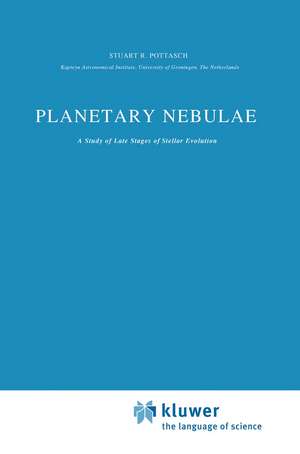
Planetary Nebulae: A Study of Late Stages of Stellar Evolution: Astrophysics and Space Science Library, cartea 107
Autor Stuart R. Pottaschen Limba Engleză Hardback – 30 noi 1983
Din seria Astrophysics and Space Science Library
- 18%
 Preț: 945.61 lei
 - 18%
 Preț: 759.68 lei
 - 18%
 Preț: 1062.06 lei
 - 18%
 Preț: 923.08 lei
 -
 Preț: 387.27 lei
 - 15%
 Preț: 639.26 lei
 -
 Preț: 383.03 lei
 - 18%
 Preț: 917.70 lei
 -
 Preț: 395.40 lei
 - 18%
 Preț: 1177.62 lei
 - 18%
 Preț: 1771.33 lei
 -
 Preț: 385.06 lei
 - 18%
 Preț: 926.82 lei
 - 18%
 Preț: 916.64 lei
 -
 Preț: 383.23 lei
 -
 Preț: 379.14 lei
 -
 Preț: 398.02 lei
 -
 Preț: 400.80 lei
 - 18%
 Preț: 910.89 lei
 -
 Preț: 389.13 lei
 - 18%
 Preț: 923.09 lei
 - 18%
 Preț: 913.32 lei
 -
 Preț: 388.40 lei
 - 18%
 Preț: 1187.11 lei
 - 18%
 Preț: 1177.32 lei
 -
 Preț: 388.93 lei
 - 15%
 Preț: 629.48 lei
 - 18%
 Preț: 1199.62 lei
 - 18%
 Preț: 924.33 lei
 - 18%
 Preț: 1774.21 lei
 - 18%
 Preț: 1185.07 lei
 - 18%
 Preț: 1199.62 lei
 - 18%
 Preț: 1186.57 lei
 -
 Preț: 395.98 lei
 - 18%
 Preț: 1190.02 lei
 - 15%
 Preț: 640.68 lei
 - 18%
 Preț: 1189.05 lei
 -
 Preț: 386.37 lei
 - 15%
 Preț: 639.26 lei
 -
 Preț: 376.90 lei
 - 18%
 Preț: 1180.81 lei
 - 18%
 Preț: 904.96 lei
 - 18%
 Preț: 1187.08 lei
Preț: 916.80 lei
Preț vechi: 1118.05 lei
-18%
Puncte Express: 1375
Carte tipărită la comandă
Livrare economică 27 mai-10 iunie
Specificații
ISBN-13: 9789027716729
ISBN-10: 9027716722
Pagini: 340
Ilustrații: IX, 326 p.
Dimensiuni: 170 x 244 x 24 mm
Greutate: 0.69 kg
Ediția:1983
Editura: SPRINGER NETHERLANDS
Colecția Springer
Seria Astrophysics and Space Science Library
Locul publicării:Dordrecht, Netherlands
ISBN-10: 9027716722
Pagini: 340
Ilustrații: IX, 326 p.
Dimensiuni: 170 x 244 x 24 mm
Greutate: 0.69 kg
Ediția:1983
Editura: SPRINGER NETHERLANDS
Colecția Springer
Seria Astrophysics and Space Science Library
Locul publicării:Dordrecht, Netherlands
V-ar putea interesa
-
 -20%Preț: 71.28 lei89.19 lei
 -
 The Hidden RealityBrian GreenePreț: 111.01 lei
 -
 Spectroscopy: The Key to the StarsKeith RobinsonPreț: 259.80 lei
 -
 Extreme Stars: At the Edge of CreationJames B. KalerPreț: 270.12 lei
 -
 The Cambridge Star AtlasWil TirionPreț: 217.40 lei
 -
 Galactic AstronomyJames Binney-16%Preț: 682.84 lei812.91 lei
 -
 Stellar Evolution PhysicsIcko Iben-11%Preț: 703.88 lei790.88 lei
 -
 An Introduction to Star FormationDerek Ward-ThompsonPreț: 424.45 lei
 -
 Lightning in a Bottle: Electrical Energy StorageFedor Novikov-30%Preț: 1626.48 lei2333.28 lei
 -
 Galaxies: Evolution, Morphology & DynamicsAbran Guerrera Sanchez-30%Preț: 1146.63 lei1644.56 lei
 -
 Particle Physics, Dark Matter and Dark EnergyDavid ChapplePreț: 179.20 lei
 -
 Cataclysmic Variable Stars - How and Why they VaryCoel Hellier-8%Preț: 426.13 lei463.18 lei
Public țintă
ResearchCuprins
I: History, Morphology and Evolution.- A Historical Review.- II: Distribution of Planetary Nebulae in the Galaxy.- A. Methods of discovering planetary nebulae.- B. Distribution in galactic coordinates.- C. Radial velocities of the nebulae.- D. Extragalactic planetary nebulae.- III: Interpretation of Emission Lines and Nebular Abundances.- A. Recombination lines.- B. Collisionally excited lines.- C. Line formation in heavier elements by other processes.- D. Nebular models.- E. Abundances in planetary nebulae.- IV: Nebular Continuum Emission.- A.Sources of continuum emission.- B. Comparison of theory with observations.- C. Separation of continuum radiation from the nebula and the exciting star.- D. Radio continuum radiation.- E. Comparison of radio continuum with hydrogen line emission.- V: Distance to the Nebulae.- A. Extinction.- B. Distances to individual nebulae.- C. Mass of the nebula.- D. Statistical methods for determining distances.- E. Absolute nebular flux.- F. The space density of nearby nebulae and their distribution with height above the galactic plane.- VI: Morphology, Expansion and Mass Loss.- A. Morphology: measurements.- B. Nebular expansion.- C. Morphology: models and classification.- D. Morphology: ‘halo’ structures.- E. Morphology: four individual cases.- F. Mass loss from the central star: ultraviolet lines.- G. Other evidence for mass loss: visual lines.- VII: The Temperature of the Central Stars.- A. The line spectra.- B. The continuous spectrum of the central star.- C. Model atmospheres.- D. ‘Zanstra’ temperatures.- E. ‘Stoy’ temperatures.- F. Temperatures derived from nebular ionization equilibrium.- VIII: Infrared and Millimeter Radiation.- A. Infrared continuous emission.- B. Interpretation as dust emission.- C. Energy input to thedust.- D. Consequences for the central star temperature determination.- E. Broad and narrow infrared emission features.- F. Molecular hydrogen.- G. Carbon monoxide emission.- IX: Evolution of the Central Star.- A. Observational evidence.- B. Theoretical models.- C. Comparison of theory and observation.- X: Evolution from Red Giant to Planetary Nebula.- A. The cool giants.- B. The Mira variables.- C. The OH/IR masers.- D. Protoplanetary nebulae and symbiotic stars.- E. FG Sge and its nebula.- F. Discussion of the evolution.- XI: Influence of Planetary Nebulae on the Interstellar Medium.- A. The mass input.- B. The dust input.- C. Kinetic energy input.- D. Element abundance changes.- E. The far-ultraviolet radiation field.- Appendix I: Positions and other Information of the Brightest Planetary Nebulae and Their Central Stars.- Appendix II: Infrared Continuum Flux from Planetary Nebulae.- Author Index.- Index of Individual Objects.